



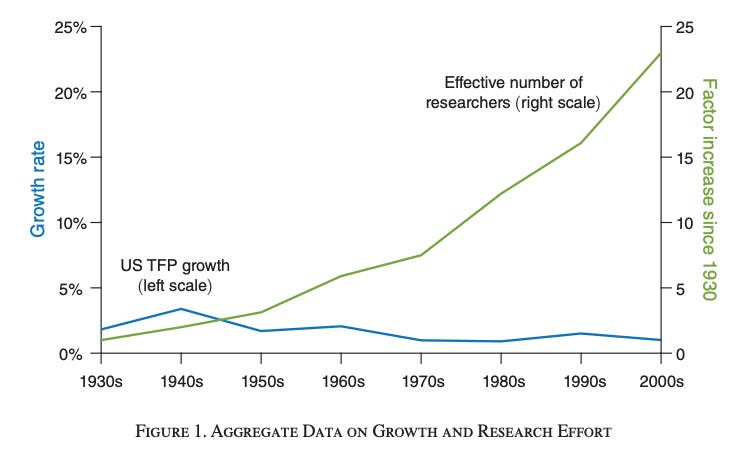
In 2018 Paul Romer won the Nobel Prize in economics for a model linking research, ideas, and economic growth. It’s a beautiful model that shows how ideas produced by the scientific workforce can add to our stock of shared knowledge and result in exponential growth. One of the most elegant intuitions from the model is that growth will be proportional to the number of researchers. Sadly, this prediction is completely rejected by the data from postwar America.
Long-run exponential growth in the economy relies on productivity growth. Productivity growth, or the efficiency with which we transform inputs like capital, labor, and land into products and services, is primarily driven by research and development that produces non-rival ideas to use these inputs in new and output-raising ways. But productivity growth is lower than it was in the 1950s and 1960s even as research has expanded, prompting economists (and others interested in sustained growth and progress) to search for a cause. One or more parts of the pipeline from resources spent on R&D to productivity growth are broken.
The White House Office of Science and Technology Policy (OSTP) appears to believe that the cause is institutional problems at federal science funding agencies and universities.1 Many economists favor another explanation: as science has advanced and knowledge has accumulated across many fields, new discoveries have become harder to make. Since new discoveries lead to valuable intellectual property and eventually to new products, this could be a major drag on productivity growth. Others object to calling what is happening a slowdown, or locate the problem in the markets that commercialize products rather than earlier in the process when ideas are discovered.2 In this piece, though, I’ll focus on what the proponents of the scientific slowdown are claiming (a subject of much confusion) and evaluate the leading explanations: ideas getting harder to find and institutional decline.
Defining and measuring the slowdown
When we say that science is slowing down, we mean that for a standard amount of resource expenditure on science, such as researcher labor or money, we get less output. Trying to collapse output across all science into one measure can be perilous, but some metrics we can use, in order from general to specific, are per capita GDP growth, total factor productivity (TFP) growth, papers or patents, and industry-specific measures (e.g., changes in crop yields, transistor density, or new molecular entities for drugs). Across many different metrics we see a decline in efficiency: we’re getting less output (in growth rate terms) per unit input (scientists, money spent on science).
Since the early 1970s, US per capita GDP growth has declined. Over the same period, the number of researchers has more than doubled.3 Science is still progressing and contributing to economic growth, but the process of achieving that growth is getting less efficient. Despite massive increases in research funding and the number of researchers, real GDP per capita grew about 2.5% a year from 1948 to 1973, about 2% from 1974 to 1999, and about 1.4% since 2000.
Productivity data is also discouraging. TFP growth and labor productivity growth have drifted up and down, but their trailing averages have not shifted much from the low average of the post-1973 period, apart from the IT boom in the late 1990s and early 2000s. As noted, this is against the prediction of early endogenous growth models (such as Romer’s), which usually projected that productivity growth is proportional to the number of researchers.4 If those models were right, then more researchers would mechanically result in more growth. The evidence for that has been getting weaker and weaker since the era of lower TFP growth began.
Thus science slowing down, at least formally, refers to the empirical observation that having more scientists and spending more on research has not raised the productivity growth rate.5 The related but more precise economic version of this claim is that the proportional relationship between research inputs and productivity growth has not held. Confusingly, the classic paper “Are Ideas Getting Harder to Find?” by Bloom et al. actually primarily addresses whether science is slowing down, not whether ideas are getting harder to find.
This doesn’t imply that science or R&D is a bad investment for the federal government — in fact, it’s a great investment even if the returns aren’t as astronomical as before. The Congressional Budget Office (CBO) estimates that each dollar of federal nondefense R&D adds roughly $2 to $5 of GDP (in present value terms) over the subsequent three decades, and academic estimates are even higher. Fieldhouse and Mertens estimate annual returns of 140% to 210% (for more, see the NBER returns to R&D project). The return to federal R&D remains extremely high relative to other uses of government funds. A 2025 CBO letter estimated that nondefense R&D spending increases GDP eight times as much as infrastructure spending on a per dollar basis.6
Why has science slowed?
So why has science slowed down, or become less efficient? One explanation is that ideas are getting harder to find. Since “ideas” is an inherently fuzzy and hard-to-measure concept, it’s difficult to precisely define what this means. Roughly: something about the structure of knowledge makes discovery harder as science advances.7 There are two main reasons people think ideas might be getting harder to find: (1) we’ve picked the “low-hanging fruit” from the science and technology tree, and (2) the “burden of knowledge”: as knowledge accumulates, it takes longer to reach the frontier, leaving each researcher less time to make discoveries.8 Increasing specialization, longer training, and necessarily larger teams slow down science.9
However, even applying a discount to the number of active researchers due to longer training times, there has still been large growth in the number of active employees spending time on R&D.10 Bloom’s measurement of effective researchers increased 23-fold from the 1930s to the 2000s and more than doubled between 1970 and 2000. The burden of knowledge is a headwind but can’t fully explain why ideas are getting harder to find.
Low-hanging fruit, or what economists call “fishing out,” is the primary explanation of why ideas are getting harder to find, and so for the decline in scientific efficiency. It holds that the easiest and most valuable discoveries have already been made, and subsequent discoveries will be harder as science and technology become more advanced. Less complex ideas (lower-hanging fruit, or easier-to-catch fish) have already been discovered (picked, caught). One intuition for this comes from a general observation that making new discoveries in science requires searching over many ideas, very few of which pan out, and that as our knowledge stock grows, the search effort required for an advance might increase. Robert Gordon’s magisterial book The Rise and Fall of American Growth gives another version of this argument with respect to technology: we will never discover electricity again, and the discoveries of the late 19th and early 20th centuries were so transformative to everyday life that it will be very difficult, or at least take much greater resources, to make technological leaps of that magnitude again. One distinguishing feature of low-hanging fruit is that it’s generally not controllable and can be thought of more as a property of nature than something we can change.
Another explanation for decreasing efficiency in science is that institutions, and particularly research institutions, are functioning less well over time. In contrast to previous explanations, how we organize our institutions is controllable. Institutional decline also appears to be the White House’s preferred theory for why American science has slowed. The July OSTP report, Science: A New Golden Age, explicitly dismisses low-hanging fruit as a central cause.11
Though OSTP is probably too confident in their diagnosis (which places the blame for many issues on universities and the federal bureaucracy), there is a lot of evidence of institutional ossification in American science. There is good research showing that administrative burden is growing as regulations proliferate, and that peer review is risk-averse to the detriment of scientific progress. The average age of scientists who receive government funding has risen rapidly, especially at NIH, and funding stability for individual scientists has declined.
But these issues, while certainly a drag on scientific productivity, don’t seem to me to be so large that they fully account for a more than 20-fold increase in research effort resulting in flat or declining productivity growth. Our institutions are far from ideal, but they were also far from ideal in the decades of outlier productivity growth.
Institutional decline and low-hanging fruit are probably both significant contributors to the slowdown in science. Even if, as I believe, low-hanging fruit is the main driver of the stagnation in productivity growth of the last 50 years, it is still worth striving to reform institutions to be more effective while keeping the parts that are robust and working.
US research agencies like NSF and NIH are extraordinary institutions with illustrious histories, and the rest of the world often emulates them for their science funding systems. But they could do a much better job funding younger investigators, decreasing the time it takes from application to grant money disbursement, allowing for pivots in research agendas, and funding high-ambition science. Of course, keeping funding stable for research and keeping the US’s scientific talent pipeline strong are also essential for American science. The level of spending on science is mostly beyond the direct control of the agencies, so it is incumbent on Congress to appropriate adequate funds and incumbent on the Trump administration to allow the agencies to obligate and disburse those funds.
There’s been an enormous amount written on this topic, and I hope this cleared up some common confusions.12 The good news is that both major explanations for the slowdown give reason for hope. Institutions are changeable, and the technology tree is unpredictable. There’s no iron law preventing new general purpose technologies (like AI!) from raising growth and productivity, breaking the pattern of falling research productivity in recent decades.13 In fact, I expect a significant boost in growth. I will eat my shoe if inventing intelligent machines doesn’t have at least some noticeable impact on productivity.
From Science: A New Golden Age: “One might argue that it is natural for the pace of progress to decline, once the proverbial low-hanging fruit has been picked. A slowdown could even be read as evidence of success. However, this intuition has repeatedly been proven wrong throughout modern history.” And from OSTP Director Michael Kratsios’s remarks at the National Academy of Science “We are seeing diminishing returns. For example, despite biomedical research budgets soaring since the 1990s, scientific progress has stalled—new drug approvals have flatlined or even declined, more researchers are needed to achieve the same outputs, and workforce training has stagnated. More money has not meant more scientific discovery, and total dollars spent has not been a proxy for scientific impact. As in scientific inquiry, when we uncover evidence that conflicts with our existing theories, we revise our theories and conduct further experiments to better understand the truth. This evidence of a scientific slowdown should spur us to experiment with new systems, new models, new ways of funding, conducting, and using science.”
For a wonderful extended treatment of the models and their intuitions, see Karthik Tadepalli’s piece titled “Ideas Aren’t Getting Harder to Find, Growth Is.” I wish I could engage more here but want to keep this piece focused on the two top candidates.
This is a measure of effective researchers from Bloom et al.; both the paper and adjustment are discussed later.
Note that reduced misallocation, capital accumulation, and other factors also drive growth rates in practice. TFP has some significant measurement challenges, but we mostly care about averages on the decade scale or longer here so I won’t discuss them at length. TFP is literally a residual but is still a useful indicator for broad trends.
An example from Bloom et al.: the number of researchers working to increase transistor density (Moore’s Law) increased by 18x between 1971 and 2014, all in order to keep a constant growth rate in transistor density.
See pg. 10 of https://www.cbo.gov/publication/61375.
Holding institutional context and other background factors like researcher potential equal.
A term used in this context first by Tyler Cowen in The Great Stagnation (2011); Charles Jones referred to the concept in his original 1995 semi-endogenous growth paper but called it “fishing out.”
The burden of knowledge is under the umbrella of ideas getting harder to find because in this model training time expands directly because of the cumulative nature of science, which is taken as a property of nature.
The adjustment is: when estimating the relationship between researchers and growth, reduce the number of researchers to account for their longer training times.
They say the “intuition has repeatedly been proven wrong,” citing an article called “Ideas Aren’t Getting Harder to Find and Anyone Who Tells You Otherwise is a Coward and I Will Fight Them” by Adam Mastroianni.
I would’ve liked to use some of this piece to argue against Karthik’s excellent argument for barriers to commercializing new ideas (via Fort et al.), or to explain how ideas getting harder to find can be formalized by spatial models of innovation that integrate ideas getting harder to find and commercialization difficulty (see Spreading Out Across Expanding Idea Space). Gaetani and Burkes give an explanation that integrates the burden of knowledge and low-hanging fruit explanation for ideas getting harder to find (see here for an excellent treatment by Matt Clancy). Please email me to discuss these things!

