


Editor’s note: There’s a lot we don’t know about how to make science more effective, and much of what we publish at Macroscience aims to explore new evidence on what might work. But one thing we have great certainty about is the impact of skilled immigrants on research and innovation. The famous Bloom, Van Reenen, and Williams paper “A Toolkit of Policies to Promote Innovation” suggests that encouraging skilled immigration is one of the most efficient policies for supporting innovation. Conversely, restrictions to skilled immigration can damage innovation. More specifically, student visa restrictions could reduce the supply of skilled immigrants to the US, costing us both crucial innovations and economic growth.
It can be difficult to keep up with the multitude of changes being proposed and made to US international student visas. So I asked the IFP High-Skilled Immigration team if they could provide an update for folks who care about American science. Thankfully, IFP’s Connor O’Brien obliged.
Science policy is inextricably linked with high-skilled immigration policy. The United States remains the premier destination both for top scientists and high-achieving students from around the world hoping to join their ranks, to our great advantage.
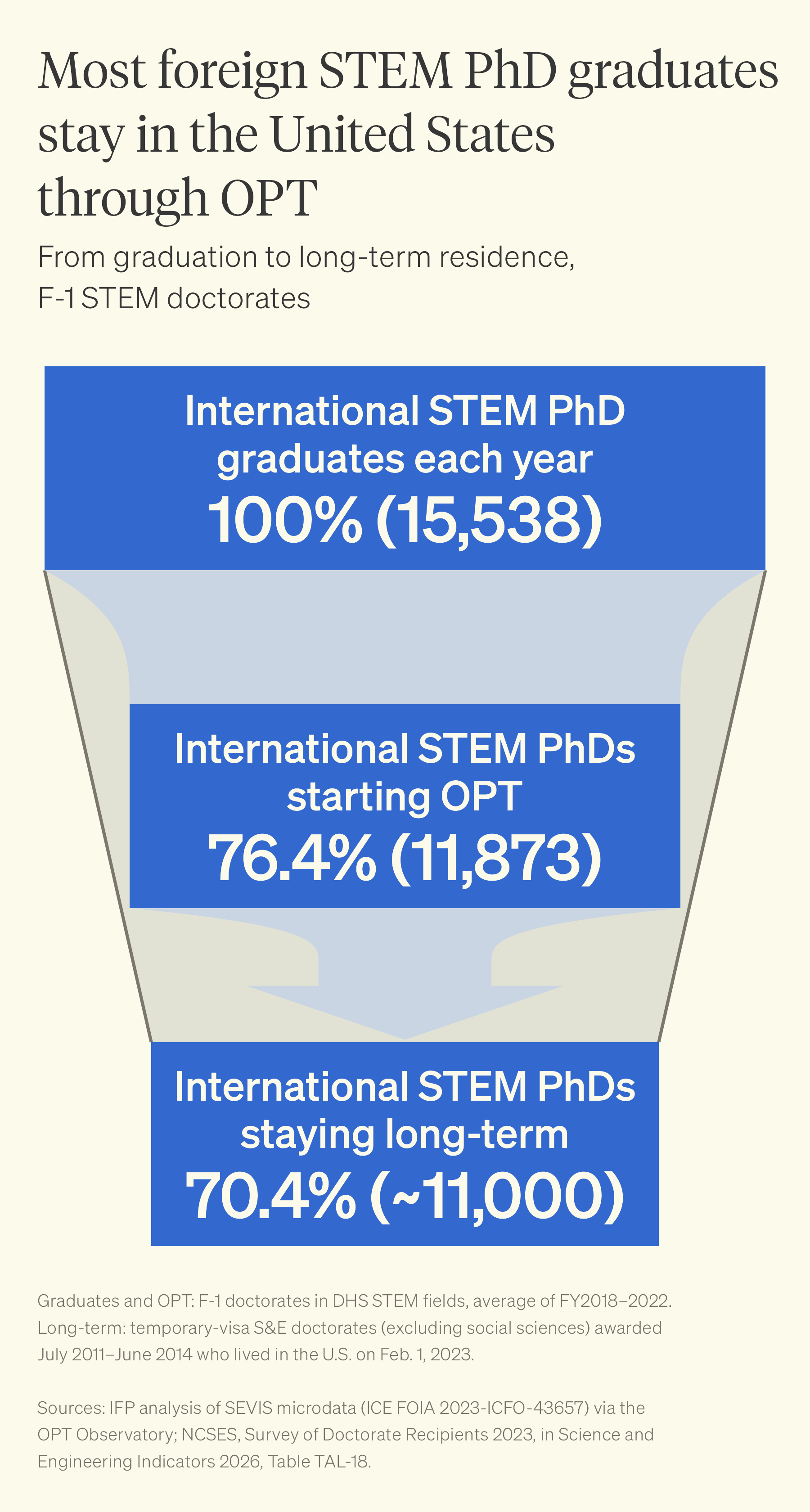
The US is able to attract, train, and retain foreign-born scientists at a scale no other country can match. According to the National Survey of College Graduates, more than 40% of STEM PhDs in the US are foreign-born.1 Most of them stay, too — three-quarters of international students who earned a science or engineering PhD between 2017 and 2019 were still living in the US as of 2023.
This is a very good outcome for American science and innovation.
Foreign scientists greatly contribute to American progress in critical and emerging fields. Immigrant scientists are far more productive in the US than those migrating to other countries. High-skilled immigrants contribute disproportionately to innovation; one leading estimate suggests that they are responsible for one-third of aggregate innovation between 1990 and 2016, a majority of which stems from the productivity-boosting effects they have on native colleagues. Immigrant scientists also represent a large share of American winners of major scientific awards.
The career ladder for native-born American scientists, while demanding, is typically straightforward: undergraduate study, internships or industry experience, a PhD, postdoctoral research, and ultimate employment in academia, a non-profit research organization, or the private sector. But for foreign-born scientists, each rung requires specific approval from the US government.
The journey of most foreign-born scientists working in the US starts in our student visa system, typically through an F-1 student visa (though some PhDs also come on J-1 visas). International students can use Curricular Practical Training (CPT) through their F-1 visa to do internships or co-ops while in school. After graduation, those who wish to continue working in the US use Optional Practical Training (OPT) to work for one to three years.
The student visa system is the “front door” to the rest of our high-skilled immigration system. Recent graduates on OPT account for the bulk of applications to the H-1B visa program (a work visa for those in “specialty occupations,” including in science and technology). Some graduates go directly from OPT to being sponsored for an employment-based green card (i.e., permanent residency), but most get sponsored while on a longer-duration work visa like the H-1B.
Recent immigration policy changes put forward by the Trump administration would break the different steps along this journey. Alongside a torrent of science policy changes, President Trump’s second term has seen unprecedented restrictions on high-skilled immigration. From student visas to H-1B visas to green cards, nearly every immigration pathway used by scientific talent is under pressure.
To help keep track of this dizzying array of new restrictions, below I describe the major relevant rules and new policies, along with their current status.
Optional Practical Training (OPT) fees of up to $100,000
Status: Proposed rule; public comments due November 9.
The most damaging immigration policy move for American science so far proposed is a plan by the Department of Homeland Security (DHS) for massive fees on the OPT program. OPT allows international students to work for one to three years after graduation in jobs related to their field of study. DHS has proposed charging universities fees of $70,000 for each student they recommend for OPT for the first time and $30,000 for subsequent recommendations (including the 24-month STEM OPT Extension). The typical STEM graduate using all three years of OPT would incur $100,000 in total fees to their alma mater.
OPT is a critical step in the typical high-skilled immigrant’s journey to permanent status. More college-educated professionals enter the US workforce each year through OPT than through any other work visa program, including the H-1B. Among top, award-winning scientists, most came to the US through the student visa program (and OPT). According to a Center for Security and Emerging Technology review of recent American winners of STEM Nobel Prizes, the Turing Award, the Lasker Award, and the MIT Technology Review’s Innovators Under 35, 47% were foreign-born, two-thirds of whom first came to the US as students.
We think fees of the magnitude proposed by DHS would essentially destroy the OPT program, cutting off most international students from transitioning into the labor force after their degree program. As a result, many would-be top scientists and researchers would leave after graduating from American universities, if they aren’t deterred from coming here to study at all. Since tuition revenue from international students typically cross-subsidizes native students, opportunities for American students will suffer as well.
DHS has issued this proposed rule through the traditional notice-and-comment rulemaking process, allowing the public to weigh in before the rule is finalized and implemented. DHS is accepting comments on its OPT fee proposal through November 9 here. A sign-on letter for scientists opposing the rule is available here.
Ending “duration of status” for student visas
Status: Finalized but struck down by a federal court.
Historically, student visas have not come with a fixed period of admission. Students with an F-1 or J-1 status could come to the US for the duration of their program of study (a period known as “duration of status”). DHS has published a rule ending duration of status, fixing F-1 and J-1 visas at up to four years. Under the rule, students seeking to remain for longer — for example, to finish their degree or transition to OPT — would be required to apply for an extension of status.
A requirement to request an extension of status substantially increases uncertainty for prospective students, who may have their extension declined before their degree program or OPT period ends. This will substantially deter international enrollment; a survey of international students by IFP and NAFSA found that a large share of international students would not have studied in the US if duration of status did not exist. The end of duration of status would be particularly bad for PhD students, who generally need more than four years to finish their program, let alone complete a postdoctoral fellowship.
In September, shortly before the rule was set to go into effect, a federal judge enjoined the rule, ruling it “arbitrary and capricious” under the Administrative Procedure Act. The policy is on hold while the federal government appeals the ruling.
The 2025 H-1B entry fee of $100,000
Status: Struck down by a federal court.
The administration’s first big move to restrict the H-1B visa program came in September 2025, when a presidential proclamation imposed a $100,000 fee on petitions for H-1B visas on behalf of foreign professionals outside the US.
This fee was structured as an entry ban, with an exemption from the ban for beneficiaries for whom a $100,000 fee had been paid. This meant that international students and graduates already in the US (such as those on OPT) were not subject to the fee. However, any employer — including universities and non-profit research organizations that are normally not subject to the annual H-1B cap or lottery (so-called “cap-exempt” as opposed to “cap-subject”) — had to pay the $100,000 fee to sponsor a scientist abroad for an H-1B visa, in addition to standard sponsorship fees.2
In June, a federal court ruled this fee was a tax and that the administration did not have the authority to impose it. The judge vacated the policy, which the administration is still appealing. The President attempted to renew it in September, but the new proclamation was swiftly stopped in federal court. It is currently not in place.
Proposed $103,265 fee on cap-subject H-1B visas
Status: Proposed rule; comments closed September 24.
After losing in court on the initial H-1B fee proclamation, DHS proposed a new six-figure fee on H-1B visas, this time through the traditional rulemaking process. Specifically, in August DHS proposed a fee of $103,265 for all initial, cap-subject H-1B petitions, far broader than the earlier presidential proclamation. The agency’s public comment window closed September 24, and the agency is expected to finalize the rule early next year, implementing it in time for the next H-1B lottery.3
This new fee is different from the one imposed via presidential proclamation in at least two ways. First, the 2025 fee applied to all initial H-1B petitions on behalf of workers not in the US, whether filed by cap-subject employers or cap-exempt employers like universities or research non-profits. The new proposed fee applies to cap-subject employers only (exempting universities and non-profit research organizations), but does apply to sponsored workers already here. Most consequentially, recent international graduates already here would be subject to the fee. So if you are a foreign researcher at a US company currently working on OPT, your firm would need to pay $103,265 to retain you even if you had been working for it for years. Given that the private sector performs a large share of research and development in the US, even a fee that applies only to cap-subject employers will impose high costs on American science.
Second, the new proposed fee rests on an entirely different legal basis. US Citizenship and Immigration Services (USCIS) operates on a fee-funded model where the agency sets fees for immigration benefits in accordance with the agency’s overall costs. DHS’s proposed rule breaks with that longstanding practice, proposing to use fees collected from employers of H-1B workers to fund immigration functions across the federal government, not just at USCIS. DHS proposes to use fee revenue to pay for Immigration and Customs Enforcement (ICE) investigations, immigration judges, a voter verification system, and offices at the Department of Labor (DOL). For this reason, this proposal conflicts with core principles of fiscal law.
Together, the proposed OPT and H-1B fees would mean that the typical journey of an international scientist moving from PhD student to OPT participant to H-1B holder to permanent resident would incur between $173,265 and $203,265 in additional fees. That is, of course, if they come to the US at all.
The public comment period for this new H-1B fee is now closed, and the rule will likely be finalized in early 2027.
Curricular Practical Training (CPT) restrictions
Status: In force.
ICE, the agency that administers the Student and Exchange Visitor Program, has severely restricted international students’ ability to engage in internships or co-ops during their studies in the US through CPT. More than 100,000 international students every year take advantage of CPT to participate in internships at companies, co-ops for course credit, or doctoral research. Such experiences should align with the Office of Science and Technology Policy’s goal of getting PhD students, in particular, more direct experience in industry.
Yet in August, ICE issued two “broadcast messages” abruptly changing decades-old agency policy on CPT eligibility. ICE asserted that CPT can only be authorized for international students if they are participating in an internship or co-op program required of all students (domestic or international) in their academic program for graduation. Many international students have since found their internships and co-ops suddenly cancelled.
A number of educational organizations have sued, arguing that such a policy change must go through standard notice-and-comment rulemaking. At least for now, however, the policy remains in effect.
Revising prevailing wage requirements in the H-1B and PERM programs
Status: Proposed rule; comments closed May 26.
In March, DOL proposed a rule to increase prevailing wage requirements that govern the pay of workers on various temporary work visas like the H-1B, along with employees sponsored for employment-based green cards. Employers wanting to sponsor a foreign worker for an H-1B visa or green card must pay at least the relevant prevailing wage, which will vary depending on the job and location.
Prevailing wage levels differ across occupations and local labor markets. Jobs are sorted into one of four prevailing wage levels based on employer-provided job requirements. Jobs can be tagged as “entry-level,” “qualified,” “experienced,” or “fully competent,” requiring employers to pay at or above the 17th, 34th, 50th, or 67th percentile of earnings for the worker’s occupation. DOL has proposed raising those thresholds to the 34th, 52nd, 70th, and 88th percentiles, respectively.
While the prevailing wage system is meant to ensure foreign workers are not paid less than what is commensurate with their education and experience (which would undercut American workers), the prevailing wage system has long been unable to accurately do that. Basing prevailing wage requirements on job duties rather than qualifications of foreign workers themselves means that prevailing wage requirements are often well below the actual market-rate wage for workers with a given set of qualifications. This allows employers to underpay a large segment of workers on H-1B visas.
The proposed rule would reduce rates of underpayment but maintain the longstanding flaw that makes prevailing wages less accurate than they could be. As a result, in addition to allowing underpayment to persist, the proposal would, for many workers and employers, set prevailing wage requirements far above market-rate pay, perhaps leading to staff cuts or reduced hiring at universities, research labs, or other employers sponsoring workers for visas. One of the alternatives offered by the agency, called “Experience Benchmarking,” would make the prevailing wage system more accurate by using additional data collected by the Census Bureau to make apples-to-apples comparisons to American workers’ wages.
We expect this rule to be finalized in the next few months.
Reforms to the PERM green card sponsorship process
Status: Proposed rule to be published imminently.
Most workers who are sponsored for permanent residency (i.e., green cards) by their employer are required to have an approved “permanent labor certification” through the so-called “PERM” process. PERM is a labor market test that requires employers sponsoring foreign workers for a green card to test the labor market for other qualified, native workers. DOL is nearing publication of a rule to reform this process. While details of the rule are not yet publicly available, we expect the rule to include stricter limits on green card sponsorship for employers who have recently laid off workers and additional requirements for recruiting American workers.
Announced J-1 visa investigations
Status: Unclear.
On October 8, Vice President Vance and other high-ranking members of the administration held a press conference announcing a number of enforcement actions against companies and universities. Among them was the announcement of investigations into the hiring of researchers on J-1 visas at nine universities: Harvard, Yale, MIT, Stanford, Brown, Pitt, UC Davis, Arizona State, and Caltech. The Vice President accused these schools of paying their employees on J-1 visas less than American peers. The press conference provided no details on the data used to make these claims or the scope of the investigations.
Conclusion
Together, the changes above, if they go into effect, will do immense damage to America’s ability to attract and retain top scientific talent from across the world. The proposed OPT fee, in particular, will effectively destroy the “front door” of our high-skilled immigration system.
Public comments from experts in response to notices of proposed rulemaking are important. Currently, the OPT fee rule is open for public comments; you can make a comment here.
Professional scientists who are concerned about the rule’s effects on America’s scientific engine can sign a joint letter expressing opposition to the rule here. The deadline to sign is noon on November 9.
Among postdoctoral researchers in the sciences, engineering, and health, a majority work in the US on temporary visas.
Very few employers ultimately paid the fee when it was in place. Evidence provided by DHS suggests the policy, while it was in place, reduced demand for fee-subject H-1B visas by 91–99%.
Cap-subject employers (i.e., not universities or research non-profits) hiring someone on an H-1B visa for the first time must enter an application into the H-1B lottery that takes place each March. In total, 85,000 H-1B visas are allocated each year through the lottery, which typically gets hundreds of thousands of applications. After an employer’s registration on behalf of a specific worker is selected in the lottery, it then files a petition to sponsor that person for an H-1B, with a start date of October 1 or later. Universities, non-profit research organizations, and employers sponsoring someone for a visa renewal are not subject to the 85,000-visa cap and do not need to enter the lottery. Find more information here.

While you are right that all this damages US competitiveness and STEM talent pipelines, this is perhaps the worst and the most vicious anti-immigrant admin you are going to have in USA. All they could do was dance the paper horses around, impose fees that mean nothing and no one actually ends up paying.
Some moves like ending duration of stay visa validity is also same. All it means is that Phd grads might have to apply for an extension. It is not a big deal. If MAGA feels good about harassing a Chiense or Indian Phd grad this way, be my guest.
H1B visa holders are abused so badly that it has long stopped attracting the finest. Most of them have moved to O1 or just Canada or India. So it wont have much impact either in the long run.
Next President is unlikely to play these Stephen Miller games either as the goalpost would probably move to other areas.