


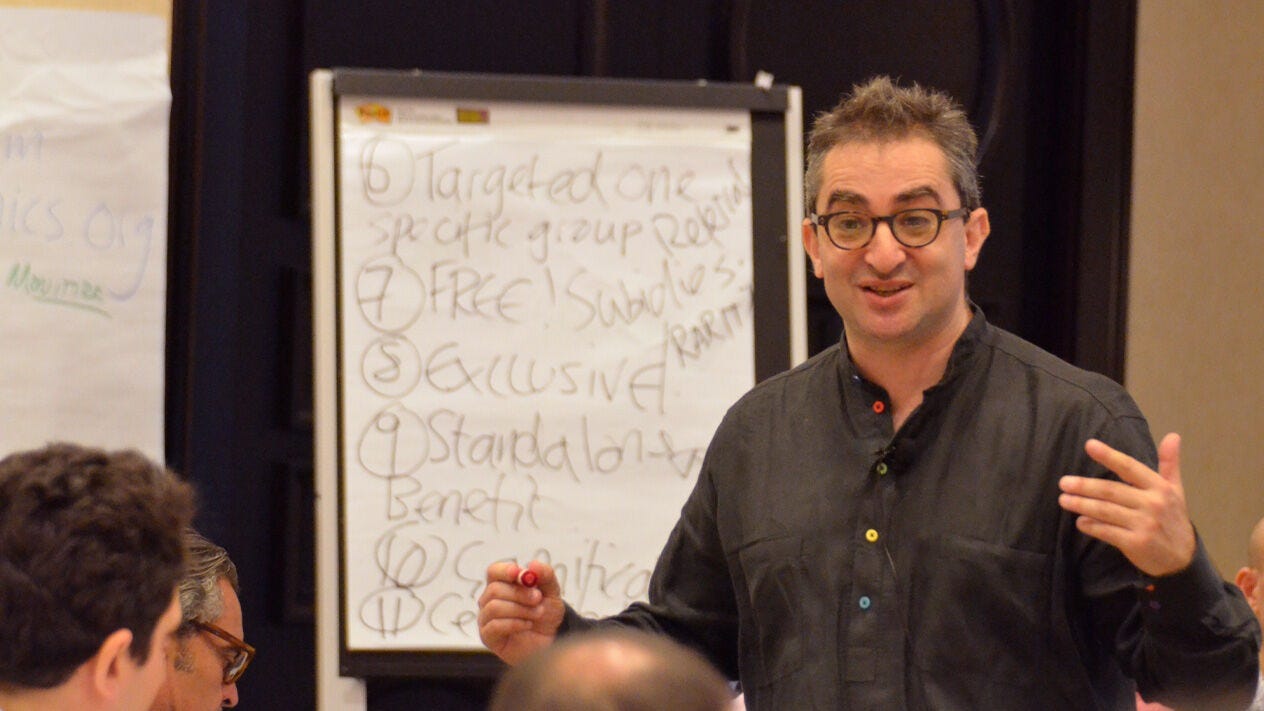
We just wrapped the third year of the Economics of Ideas, Science, and Innovation online short course. Targeted at economics PhD students, the course features many of the luminaries of innovation economics. This time around, we recorded the lectures and will be releasing one every other week to Macroscience subscribers (for free!), starting today. Regular Macroscience essays will continue on alternate weeks.
The reason we’ve held three iterations of this course and are publishing the recordings is that we believe more people should study the economics of innovation. Let me suggest five reasons.
1. Impact
The best way to increase human flourishing in the long run is via technological progress, the speed of which is in part determined by social systems. The economics of innovation is the study of the social systems that drive technological progress — markets, governments, non-profits, universities, etc. There is no reason to think these systems already operate as well as they could, so better understanding could help us design better ones. Because ideas and discoveries are public goods and technological progress is cumulative, even small increases in the rate of discovery have enormous long-run effects on human welfare.
2. Government Demand
We need more people who understand this material. Scientific expertise is in short supply in some parts of government (a small share of legislators have STEM backgrounds), and this is especially true for social science research about science and innovation. While the US government has infrastructure for bringing in scientific expertise (nearly every major agency has a chief scientist and the American Association for the Advancement of Science places 250+ science policy fellows per year in government) and employs many economists, the intersection of these two sets is surprisingly small. In short, there are scientists and economists in the government, but few economists focused on science policy. Yet people with this kind of expertise are needed in science agencies, the White House Office of Science and Technology Policy, congressional offices, and in the Metascience Units that are emerging in the US and abroad.
3. Research Opportunity
For those interested in a research career, this is an exciting time. Scientific progress often accelerates when new tools for research come online, and AI seems poised to be just such a research tool. Modern AI is especially good at working with text, which means it’s very well suited to the economics of innovation, as scientific and technological progress generates a lot of text (scientific papers, patents, and software code).
4. Creative Destruction
New AI tools make this an exciting time to study the economics of innovation for another reason. AI will likely change the way we do science, and it’s not that unlikely that we’ll need entirely new theories and empirics to design optimal policy. The results derived prior to AI may become like economic history, with questionable relevance to optimal policy design.
5. Inherent Mystery
Finally, the economics of innovation is, in itself, fascinating. Cumulative improvements in toolmaking — technological progress — is one of the things that sets humans apart from the rest of the animal kingdom, and this special feature of ours mostly stems from our social systems, rather than our biological capabilities. Species close to biologically modern humans existed for many thousands of years without strong technological progress. And we still don’t fully understand so much of how this system works. What a great thing to study!
If that intrigued you, I hope you’ll check out the Economics of Ideas, Science, and Innovation PhD short course. The course consists of 11 roughly hour-long lectures. Each is taught by a different expert — truly a who’s who of innovation economics:
Introduction to the Economics of Ideas, by Benjamin Jones
Idea-Based Models of Economic Growth, by Chad Jones
The Supply of Innovators, by Ina Ganguli
Open Science as an Economic Institution, by Pierre Azoulay
The Direction of Science, by Kyle Myers
Science and the Returns to R&D, by Matt Clancy (me)
AI and Innovation, by Kevin Bryan
Innovation Policy, by John Van Reenen
Immigration and Innovation, by Michael Clemens
Competition and Innovation, by Mitsuru Igami
Patent Policy, by Janet Freilich
Subscribe to Macroscience for an introduction to each course, along with recommended reading. If you find this topic interesting but aren’t yet looking for a PhD-level course, check out the Metascience 101 podcast, also produced by IFP.
We’re launching the course with Benjamin Jones’ introduction to the Economics of Ideas. In this lecture, Jones discusses ideas as unique goods, with a particular focus on how market failures and spillovers can justify government support for the production of ideas.
Here are the readings Jones assigned to the PhD students (truly some of the foundational pieces on the economics of innovation):
Arrow, Kenneth. “Economic Welfare and the Allocation of Resources for Invention.” In The Rate and Direction of Inventive Activity: Economic and Social Factors (1962). Princeton, NJ: Princeton University Press, 609-625.
Jones, Benjamin F. and Summers, Lawrence H. “A Calculation of the Social Returns to Innovation.” In Innovation and Public Policy, University of Chicago Press (2021).
Bloom, Nicholas, Mark Schankerman, and John Van Reenen. “Identifying Technology Spillovers and Product Market Rivalry.” Econometrica 81(4) (2013): 1347-1393.
Jones, Benjamin F. “The Burden of Knowledge and the ‛Death of the Renaissance Man’: Is Innovation Getting Harder?” Review of Economic Studies 76(1) (2009): 283-317.
To paraphrase Jones in his presentation, if the social returns to R&D are high, the social returns to studying R&D are very high.
Go forth and produce some social returns!
A full transcript is available here.

Looking forward to listening to these as they come out! You should run a concerted version focused on practitioners in/around gov who engage with these topics frequently and do not have PhDs.
I’ve completed a master degree in Firm and enterprise economics and my thesis was on the Economics of innovation, where I’ve studied the Value of Portuguese Patents. I really enjoyed the field of innovation in the economics.