


In her lecture (#3 of this series), Ina Ganguli talked about the supply of innovators. One important supply of innovators is immigrants. This lecture from Michael Clemens focuses on immigration economics.
Michael is an economist, a professor at the Johns Hopkins School of Government and Policy, and one of the most thoughtful researchers bridging immigration economics, innovation economics, and policy. He asks: what happens when you study immigration in the way that innovation economists study growth?
Some immigration economists start by asking what happens when more workers arrive, while holding tools, technology, and ideas fixed. But as we’ve learned through this course, innovation economists start from new ideas.
Taking an innovation viewpoint makes us rethink whether what we thought of as the first-order effects of immigration are actually the most relevant ones. What assumptions researchers build into their economic models and what they take as given fundamentally shape how to interpret the facts and their implications for policy. As Michael puts it, it’s “a shift of assumptions rather than a shift of facts.”
This lecture is an outstanding introduction to the ways immigration research can be reconsidered and augmented from an innovation perspective. Michael walks through how to understand the ways immigration can change the pace and direction of innovation and what we know about each.
Much is still unknown, and parts of this literature are waiting to be written. Just maybe, you can help write it.
Here are the readings that go with this lecture:
Azoulay, Pierre, Benjamin F. Jones, J. Daniel Kim, and Javier Miranda. 2022. “Immigration and Entrepreneurship in the United States.” American Economic Review: Insights 4(1): 71–88.
Bernstein, Shai, Rebecca Diamond, Abhisit Jiranaphawiboon, Timothy McQuade, and Beatriz Pousada. 2022 (revised 2025). “The Contribution of High-Skilled Immigrants to Innovation in the United States.” NBER Working Paper No. 30797.
Hunt, Jennifer, and Marjolaine Gauthier-Loiselle. 2010. “How Much Does Immigration Boost Innovation?” American Economic Journal: Macroeconomics 2(2): 31–56.
Lewis, Ethan. 2011. “Immigration, Skill Mix, and Capital Skill Complementarity.” Quarterly Journal of Economics 126(2): 1029–1069.
Peri, Giovanni, Kevin Shih, and Chad Sparber. 2015. “STEM Workers, H-1B Visas, and Productivity in US Cities.” Journal of Labor Economics 33(S1): S225–S255.
Thanks to William Higbie and Harry Fletcher-Wood for their support in producing this video and the transcript.
Lecture Transcript:
Immigration through an innovation lens
I’m here to talk about immigration, but I am not here to talk about what immigration economics can contribute to the economics of innovation. It’s more the opposite: what I want to talk about is what an innovation lens could do to make immigration economics more interesting and useful — as a social science and also as a guide to policy. You’ll be able to tell I’m an immigration economist who is very dissatisfied with immigration economics.
Immigration economics has a shibboleth, and it’s this: the downward-sloping labor demand curve.
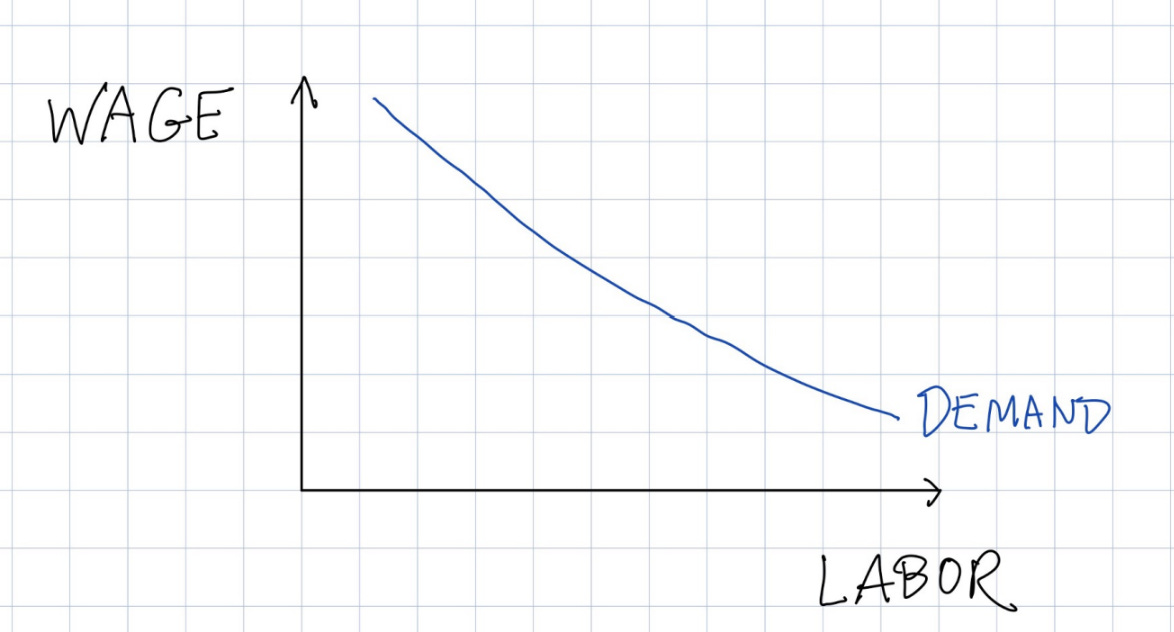
The idea that increasing supplies of labor necessarily have to be associated with a declining marginal product of labor. If you believe in the tradition of Alfred Marshall, you have to believe in this. This is the first-order effect onto which other second- and third-order effects might be pinned. But if you’re talking about immigration economics, people tend to start from here, and the most influential textbooks do start from here. I want to tear that apart through the lens of innovation economics.
The crowded potato plot
The downward-sloping labor demand curve has an inventor. We didn’t learn about this in my graduate program — maybe you did — but there was a moment of invention. There’s a page of a book on which it was created, in 1850. It was written by this guy, Johann von Thünen, who’s not widely studied outside of urban economics and a few other subfields, but he was one of the founders of the economics discipline back in the 19th century. He coined the term “marginal,” for example, in German, and Alfred Marshall brought it into English.
He wasn’t an economist in the modern sense. He was an aristocrat and a landowner, and he kept careful records and astutely observed what people were doing on his lands, including harvesting potatoes. In this 1850 book he recorded what happens when, on the same plot of land with the same tools, more and more people — a greater supply of labor — produce more potatoes, but at a decreasing rate. It’s from this that he wrote down, on this page in 1850, the first downward-sloping labor demand curve: the idea that a profit-maximizing farmer, or business in this case, would have to pay a lower wage as the labor supply goes up, because people are crowding each other on the same land with the same tools, trying to get potatoes out of the ground. He was so proud of this discovery that he wrote the decreasing marginal returns to labor on a potato plot equation in gold on his tombstone. He thought of this as the discovery of his life.

You and I might say there have got to be giant differences between a country and a potato plot. Of course we know that. But when we start from a paradigm, from a bedrock assumption that this equation has to be the first-order effect — and other things might come along to shift the demand curve or change the production function, but those are second-order effects — it shapes how we think, and how we see the same facts.
I don’t know of a better example of that than to step back from economics for a minute into the history of science and notice that 2,000 years ago, brilliant astronomers in China had noticed that vertical objects spaced far apart on the earth, at the same time of day, cast shadows of different angles. They incorporated this into a model saying, “If you assume that the earth is flat, then you can use this observed fact to measure, using trigonometry, the distance to the sun.” They did that, and they came up with a number. Today we would think that the distance to the sun is 6,000 times the number they came up with. It results in a low sun, but it’s quite a brilliant use of observed facts.
Not too much distant in time, astronomers on the other side of the earth had noticed exactly the same fact — that vertical objects spaced far apart on the earth at the same time of day cast shadows at different angles — but under different assumptions, they interpreted those facts very differently. They said, “If I assume that the sun’s really far away, so that the rays of the sun are parallel, and I relax the assumption of a flat earth, then I can use these shadows to measure the arc and thus the circumference of the earth.” Which they did, to a remarkable accuracy of 99% relative to the value that we believe today.
I take you on this distraction of a journey just to point out that the facts being observed were exactly the same. It’s how they were being interpreted, through a model, that shapes how people thought about it — and that can change the answer you get from a given exercise by orders of magnitude.
If I were to show you this fact — that the long-term aggregate observed labor demand curve of the United States slopes up — it’s not disputable.
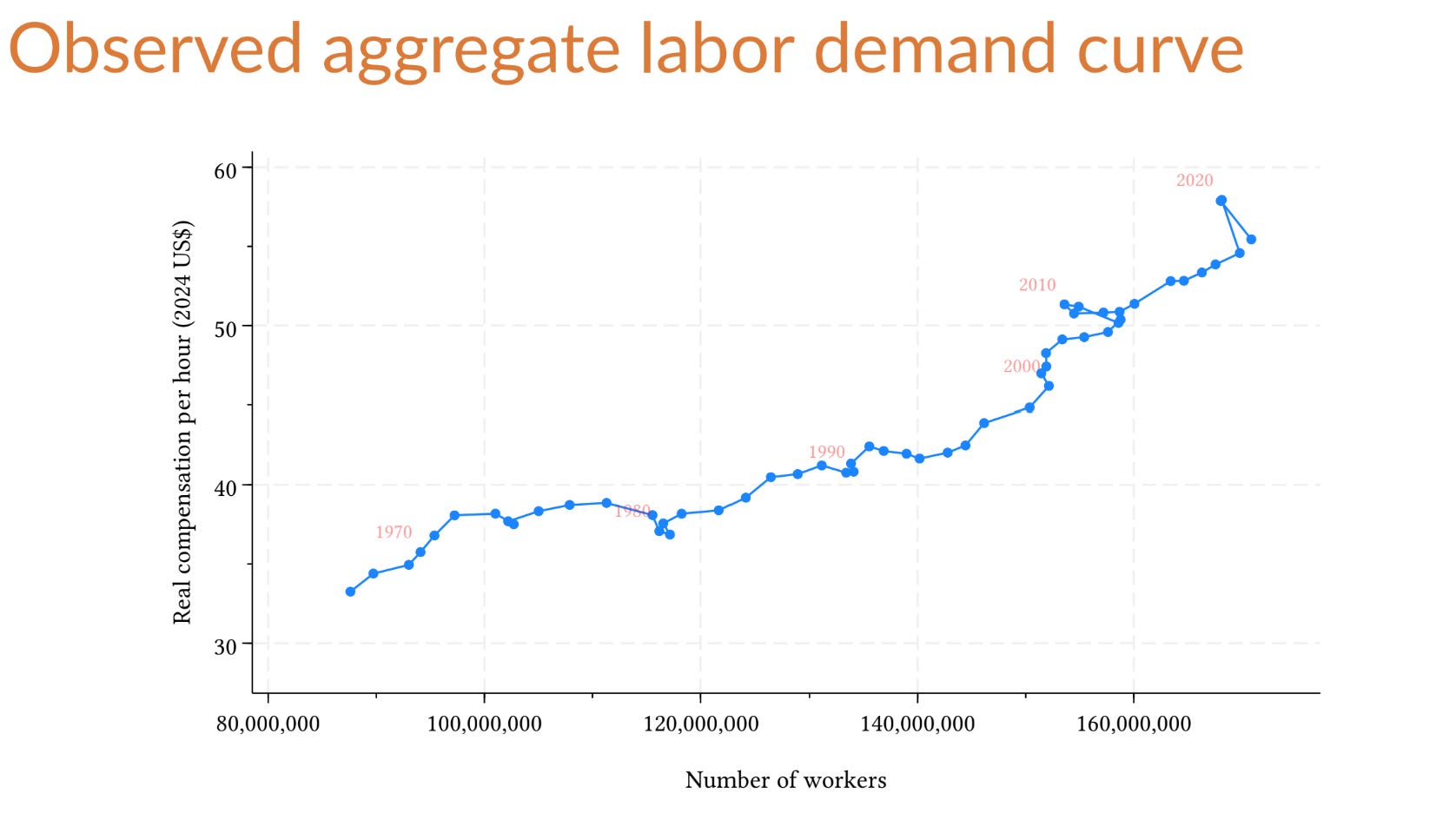
The United States, with a growing number of workers over the years, has had generally higher real compensation per worker over time. If the set of bedrock foundational first-order assumptions in your mind are the flat-earth assumptions, and you say that the downward-sloping labor demand curve, or the crowded potato plot, is the most useful economic model of this phenomenon, then the first thing your mind is going to jump to is: “Thank goodness that something else came along exogenously and fortuitously to offset the necessary crowding of the potato plot that would have resulted in lower wages and lower marginal productivity of labor. Thank goodness that coincidentally ideas came along to expand productivity and counteract that necessary first-order force.”
But think about it for a second. If we make the curved-earth assumption instead, and we relax the idea that the labor demand curve has to slope down, then it’s at least possible that there’s something about this relationship that has a causal component — that there’s something about having more workers, including through immigration, that changed the production function to such a degree that the aggregate labor demand curve need not slope down at all. It might even slope up, due to the population increase, maybe even due specifically to immigration. But whether or not we even consider those things is shaped by our assumptions.
Taking growth theory seriously
This conundrum played out in the pages of the Journal of Economic Literature, in an unforgettable article by David Card, the Nobel laureate, and Giovanni Peri, who by any measure are two of the leading immigration economists on earth — stating exactly the dissatisfaction with immigration economics that I’m putting forward to you today, and arguing that it can be remedied with an innovation lens.
They are reviewing critically a book by a leading immigration economist, and quoting him to say that it is “mathematically impossible to manipulate the canonical model of the competitive labor market so as to yield a large net gain from immigration to the United States.” This is the flat-earth, partial-equilibrium, downward-sloping labor demand curve model.
In an unforgettable passage that still, 10 years later, makes me smile, David and Giovanni follow that quotation with this passage: “This is certainly true. The real question is whether one wants to take seriously any of the ideas of modern growth theory, which allow for effects from human capital externality, skill variety, task specialization, market integration, potential gains from rising numbers of scientists and engineers. These models allow for potential increasing returns, etc., etc. Factors that arguably dominate the second-order surplus calculations.”
Look what they’re doing here. They’re flipping it and saying, “Wait a minute. We reject the idea that the downward-sloping labor demand curve is the first-order effect and everything else is second- or third-order epiphenomena. In fact, ideas are the long-term driver of growth. And if immigration plays a key role in ideas, then that’s the first-order effect.” It’s no longer ridiculous that the aggregate labor demand curve you just looked at sloped up. In fact, maybe our prior should be that it slopes up. A shift of assumptions rather than a shift of facts.
I would go further than David and Giovanni and say it’s not just that we need to take seriously the ideas of modern growth theory. It’s that the original downward-sloping labor demand curve didn’t even take Marshall seriously. If you read Marshall 1890, there is of course the canonical supply and demand curves that we’re all so familiar with. But a large part of the book is about economic growth. Marshall even specifically mocked the great vitality of the common belief that wages could be raised generally by making labor scarce, and the idea that long-term effects had to be the same sign, much less the same magnitude, as short-term effects.
The seeds of the idea that changing labor supply — and certainly changing immigration — could shift these curves, and could result in aggregate and long-term curves that look nothing like the crowded potato plot, are in Marshall and even well before it. It’s just that immigration economics has come to be a subfield of labor: not a subfield of innovation economics, or growth, or international. It’s come to be dominated by paradigms that I think have greatly impoverished it.
What I want to talk about will be partly a review of what we mean by innovation, because I want to highlight three specific levers relevant to the effect of immigration on innovation, and therefore on economic performance and efficiency. These are levers by which immigration can, on a whiteboard, affect innovation. After that I’ll go through six different mechanisms by which we have good theory and evidence, of various degrees of advancement, through which immigration can pull on those three levers. Then I’d like to conclude with some recommendations about where those of you who are particularly interested in this could go to push the frontier of knowledge.
What do we mean by innovation?
I want to start with the flat-earth production function, where output Y is produced by combining capital and labor with a Solow-style exogenous total factor productivity parameter. They could be combined with constant elasticity of substitution — for example σ, a standard setup, with σ less than one representing gross complements and σ greater than one representing gross substitutes.
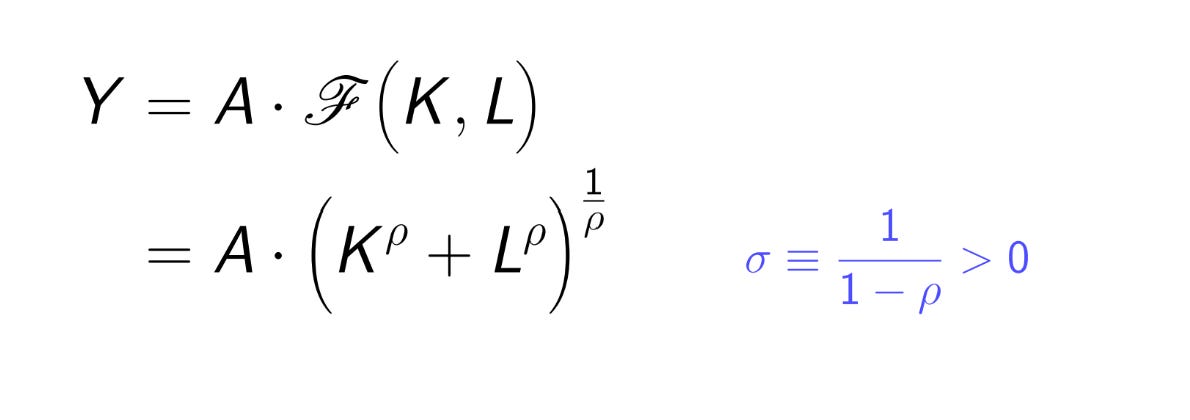
Then ask: what is innovation? What I mean by innovation is changes in the parameters or the structure of the production function. Specifically, it could come from new ideas that are developed for the purpose of altering the structure or parameters of the production function, or ideas just adopted from others that are already out there. This is how Daron Acemoglu defines technical advance: as the creation of ideas, or the adoption of production techniques that have already been ideated by somebody else but not adopted by a firm, a region, or a country, until the moment of adoption — and that is also a new idea, as I define it.
Innovation is not the Marshall-Hicks laws of derived demand. It’s not how quantities respond to prices with technology fixed. It’s not complementarity that arises from capital accumulating to catch up to inflows of labor. I’m talking about fundamental changes in the production function. For me, that’s an idea.
Aghion and Howitt have a very useful distinction between horizontal and vertical innovation. In horizontal innovation, innovation is about expanding varieties. Here, in the way that Romer — and before him, Ethier — conceptualized it, the variety of products was a disaggregation of the capital input: there are N different products indexed by i, and capital is distributed among them, and this is a production input.
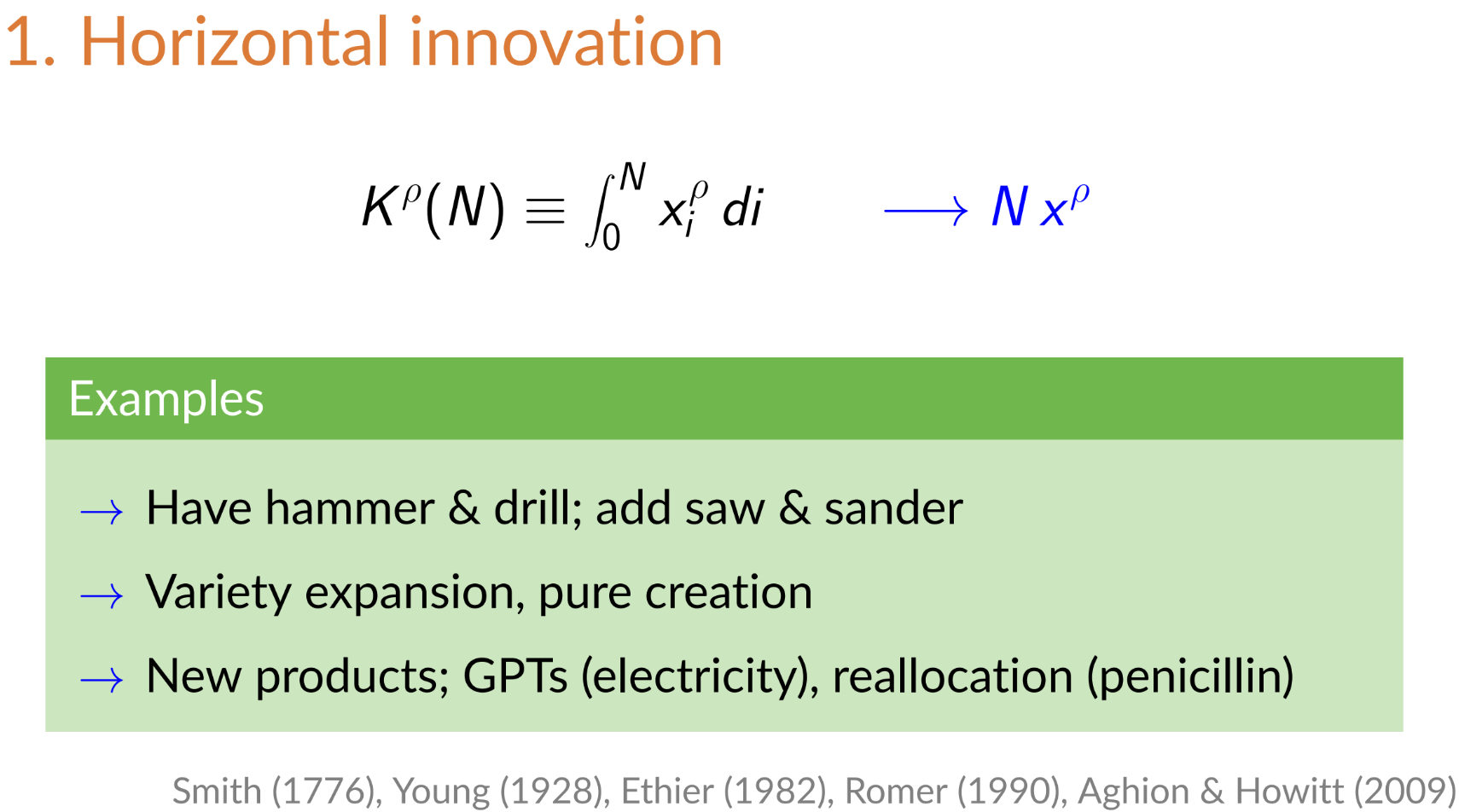
It’s a little subtle, because the way that Romer set it up, capital is divided into these things that are both final products and inputs to production. It captures the complexity that there are very few final products that are strictly and exclusively final products. The development of an antibiotic is a new variety of product to be consumed, but it is also an input to the provision of health services, which contribute to producing GDP. Breakfast cereal is something that you spoon into your mouth, but it’s also an input, at the breakfast at a hotel, into the provision of accommodation services, which end up in GDP. This conceptualization captures the joint role of product varieties as both outputs and inputs to production.
You can see that an increase in variety, through having new ideas for new products and new kinds of inputs, is going to have a positive effect on output by augmenting the contribution of the capital term. You can see that intuitively just by saying: what if capital were evenly spread across all the i varieties? Then that integral would reduce to Nx^ρ, and obviously the derivative of that with respect to the number of varieties is going to be positive. It’s also true if you don’t make that assumption.
Intuitively, this is the idea that you already have a hammer and a drill in a production process. If you’re adding more varieties — you also add a saw and a sander — the hammer and the drill are still useful, but you can do more things. You can produce more stuff and greater varieties of stuff with that greater variety of tools. This is pure creation. It can come about even through general-purpose technologies: the advent of mass electrification didn’t just make stuff more efficient, it allowed for the creation of entirely new products that without mass electrification never could have been viable.
An entirely different dimension of innovation that Aghion and Howitt have highlighted, along with others, is what they call vertical innovation.
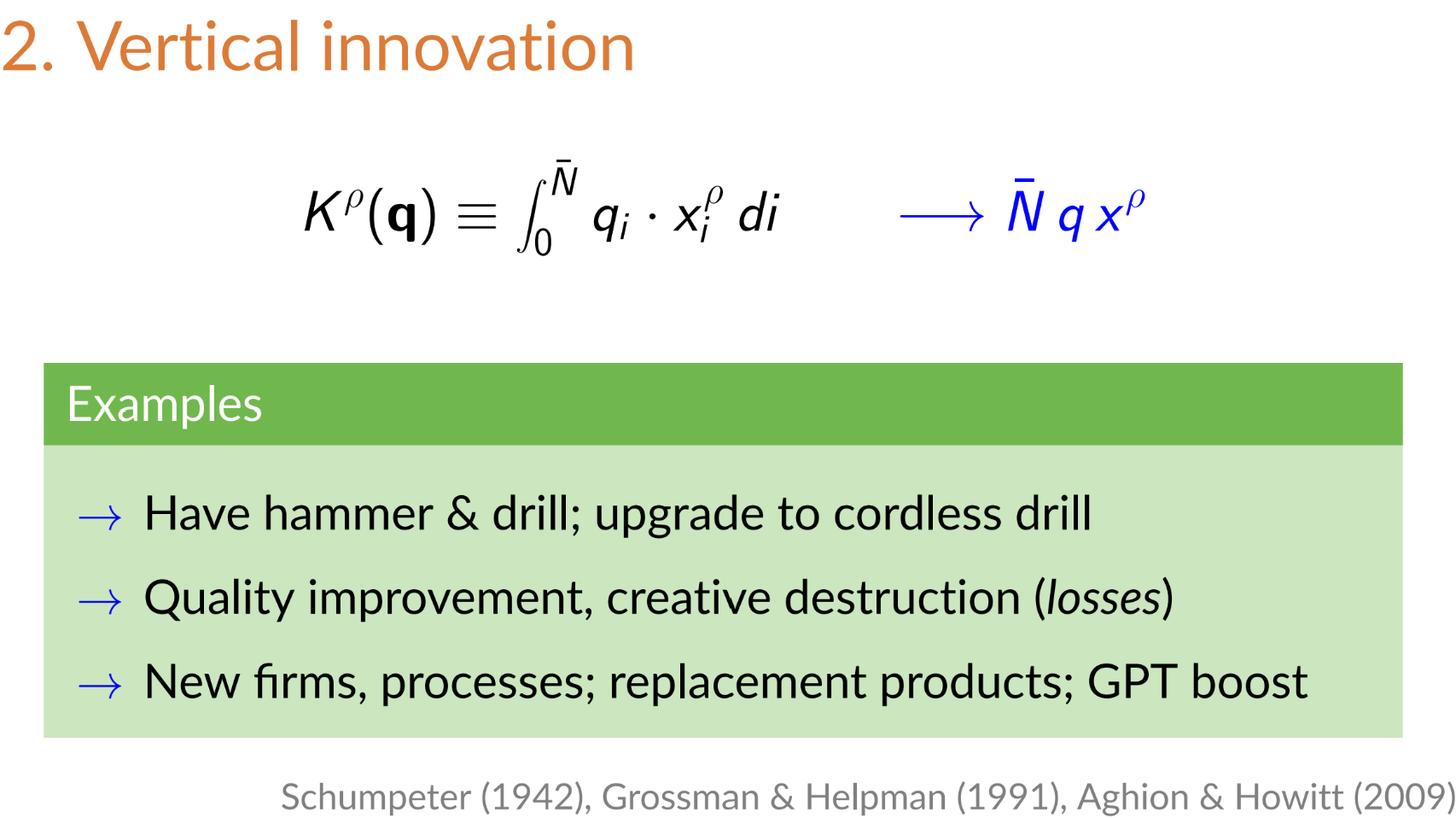
This is the idea that among an existing set of N̄ product varieties, each of them has a quality parameter — a kind of ladder of quality. Increasing quality is going to augment the productivity of the entire capital term in terms of its ability to create GDP. Again, you can see this intuitively just by assuming that capital is evenly spread across the N̄ varieties; then the integral reduces to something very simple whose derivative with respect to the average q is obviously positive.
More quality, intuitively, for one or all of the varieties is going to augment the capital term, increase productivity — also coming from new ideas, but a fundamentally different kind of new idea. If you start out with a hammer and a drill, now you upgrade to a cordless drill. That is displacing the previous corded drill that you had. This is a quality improvement, and it’s a kind of creative destruction, because it’s not strictly an expansion of what’s possible. It’s also rendering obsolete another product, or pushing a business that made strictly corded drills perhaps out of business, or reducing the value of assets of people who were invested in producing or doing something with corded drills. This is not just about new products. It’s about new firms and processes to make products, as well as replacement products that produce creative destruction.
A third lever on which immigration could push or pull, through the power of ideas, is what Acemoglu calls directed innovation: the idea that output is a constant-elasticity-of-substitution combination of inputs, each of which has an augmenting parameter.
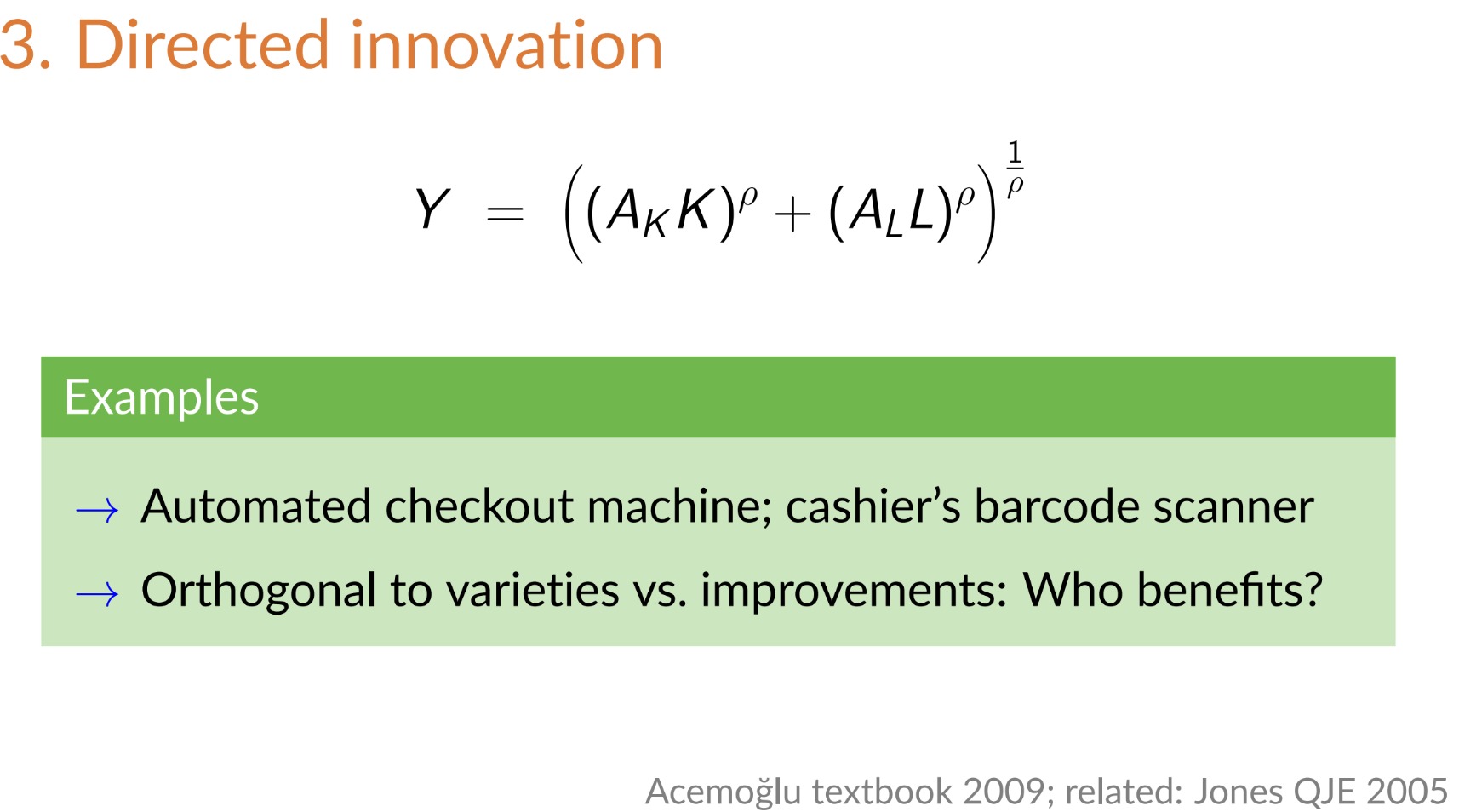
We could imagine ideas for an automated checkout machine. If we’re thinking of the task of checking people out of Home Depot, the idea for an automated checkout machine augments Aₖ, the productivity of capital, and an idea for a better handheld barcode scanner augments the productivity of a human cashier. This is orthogonal to horizontal versus vertical innovation. It’s not about varieties versus improvements. It’s about which factor benefits from ideas.
If we put all these together, starting from the flat-earth assumption of the traditional Solow-style production function, additional labor in an economy through immigration has to hurt workers, and the only question is how long it will take capital to catch up so that the hurt is diminished or erased — but there’s never going to be a benefit. Or: might ideas come along, as total factor productivity, to coincidentally, fortuitously, and exogenously increase the marginal product of labor, to counteract this necessary downward-sloping partial-equilibrium phenomenon?
In a curved-earth production function, we’re making three changes all at once.
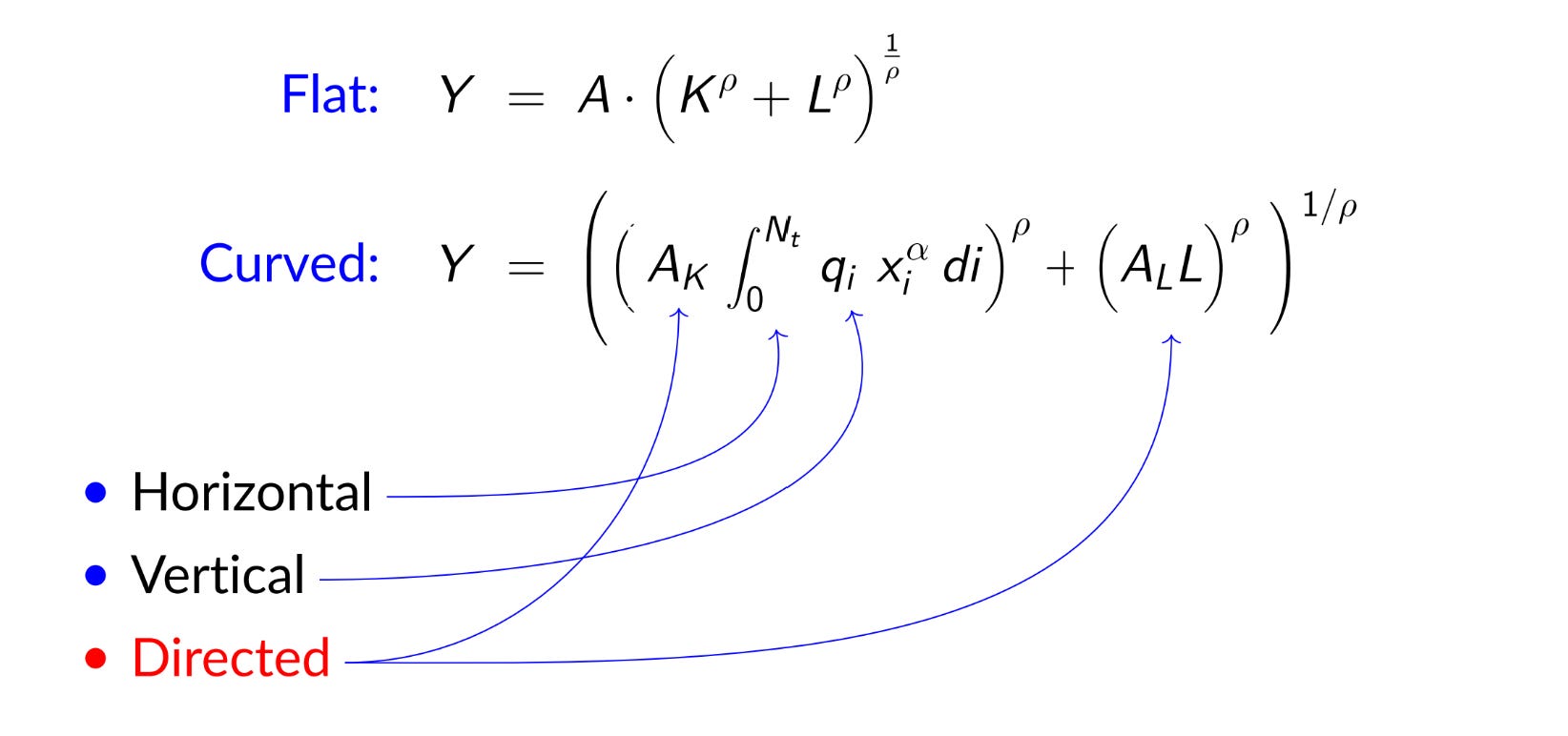
We’re going to allow a range of varieties to constitute the capital term, so that horizontal innovation could raise productivity by that mechanism. We’re going to allow each of them to have a quality parameter q, so that ideas could increase productivity by that dimension. We’re going to allow capital and labor to be augmented by ideas that are specific to factors, through directed innovation.
What I want to talk about is six different ways that the literature has explored, in theory and in empirics, how immigration can push on each of those three levers under the curved-earth assumption. I’m calling this “what we know so far,” because I’m trying to give you my best impression of where the literature stands right now.
Mechanism 1: Market scale
Market scale is the first of the six mechanisms I want to talk about. This is the idea, going back to Adam Smith, that the extent of the market determines the ability for specialization — the capacity for an economy to specialize and to generate new varieties of inputs that generate new products and new opportunities for further specialization.
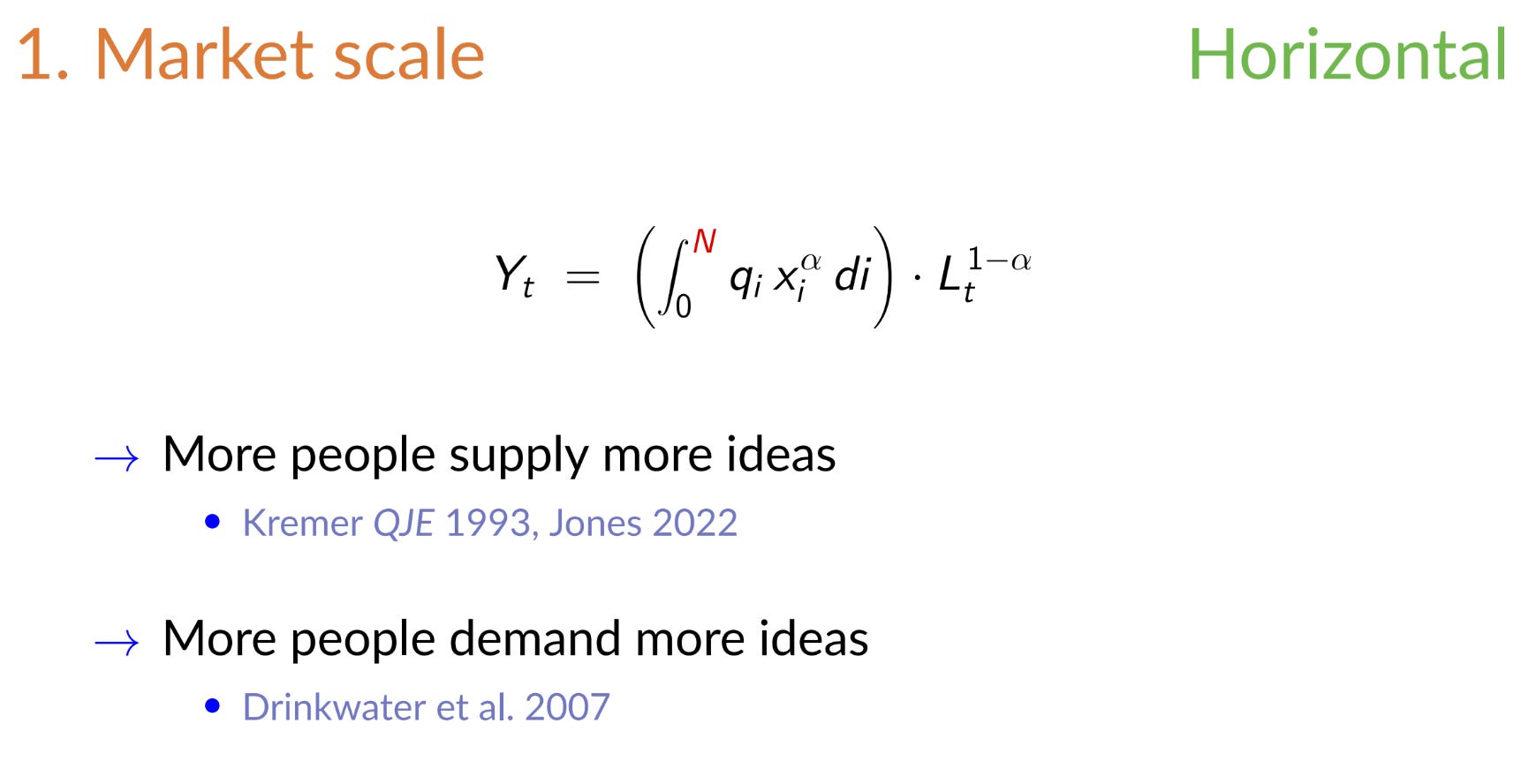
This could happen in two ways through immigration. In a classic paper, Michael Kremer, the Nobel laureate, pointed out that this could happen because more people supply more ideas. People just have ideas all of the time. He pointed out memorably that the rate of change in total factor productivity had been proportional to the size of the human population, going back literally a million years. In more recent work, the great Chad Jones has pointed out implications of related models for what might happen to total factor productivity in countries where the labor force is currently and sharply declining, like Germany and Korea.
This is the idea that immigration could change the number of human beings who are supplying ideas. But another strand of the literature that’s quite interesting points out that there’s another side to that. There’s a demand side. Stephen Drinkwater et al. have a nice model where they allow a larger market — which could be caused by demographic forces of various kinds, including immigration — to raise the return to any given innovation, which you can see intuitively in the equation. Both of those could be happening at the same time.
There are a couple of nice papers that have provided broad tests of these scale-based models, using different methods to get quasi-exogenous immigration flows over time and space.
One, by Sandra Sequeira, Nathan Nunn, and Nancy Qian, studies the effects of the age of mass migration into the United States during the long 19th century. They use big swings in the national-level immigration arrivals in the United States at that time, interacted with expansion of the railroad network, to get quasi-exogenous placement of new immigrants in various places in the territory. Then they show that in the short term, just the arrival of more people is causing more patenting, more industrialization, and more founding of new firms — to such an extent that today, well over a century later, the places receiving more immigrants quasi-exogenously have substantially higher income, higher employment, and other measures of economic development.
There’s a groundbreaking paper by Stephen Terry et al., coming out this year in the American Economic Review, that studies the effects of more modern immigration flows. They are also using historical data, but for a different purpose. It’s a shift-share exercise, but they’re not just using baseline shares of immigrants in 1975. They’re using long-term, over-a-century variation in national- and local-level determinants of immigration leading up to 1975 to construct the baseline shares in a way that’s much more plausibly exogenous than just asserting that baseline shares by themselves are exogenous. They’re finding, in modern times also, more immigration per se going into counties causing more innovation, higher wages, and various measures of economic dynamism.
Mechanism 2: Entrepreneurship and creative destruction
A second of these six channels is entrepreneurship: creative destruction of various kinds, through creation and destruction of businesses and product lines. Here again there’s a supply and a demand effect that has been explored in the literature.
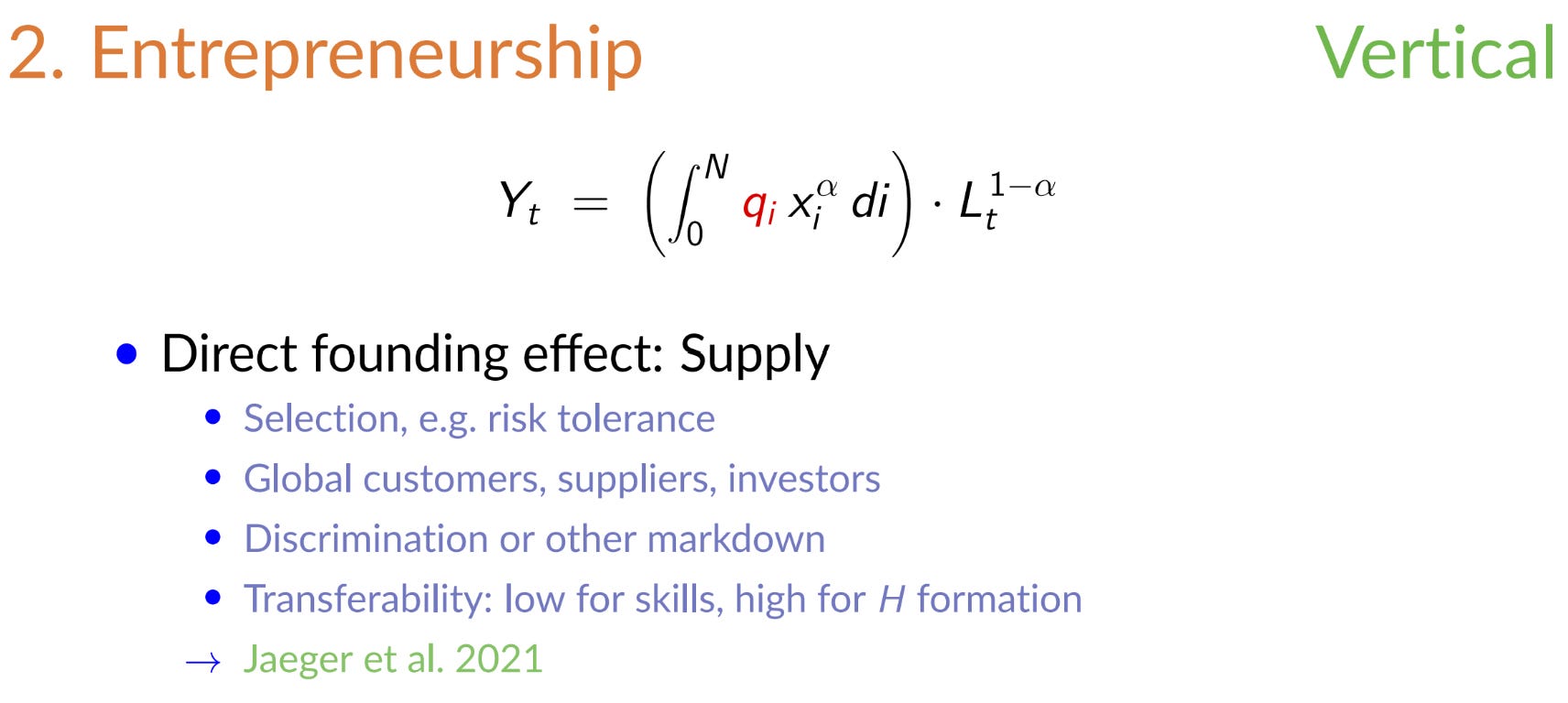
The one that’s most intuitive to people is the idea that immigrants are entrepreneurs. A corner of the theoretical literature has explored the reasons this might be true. Could it be that migrants are inherently selected for traits that complement entrepreneurship, like risk tolerance? Is it that they bring connections to global networks as customers, suppliers, or investors in new business? Is it that they face discrimination in the labor market that raises their comparative advantage in being employers rather than employees?
David Jaeger et al. have a nice and subtle theory paper arguing that immigrants face challenges in transferring their productive skills to new markets, but that they have a transferable skill in human capital formation itself — one that, unlike their productive skills, does transfer. Meaning that immigrants have a tendency to be people who have less to lose in investing in completely new skills, and for that reason might be more likely to start new businesses, or participate in the advent of new industries like AI at the moment.
There’s a lesser-known literature which is not directly linked to immigration — but it is, as soon as you read it and think about it for a second.
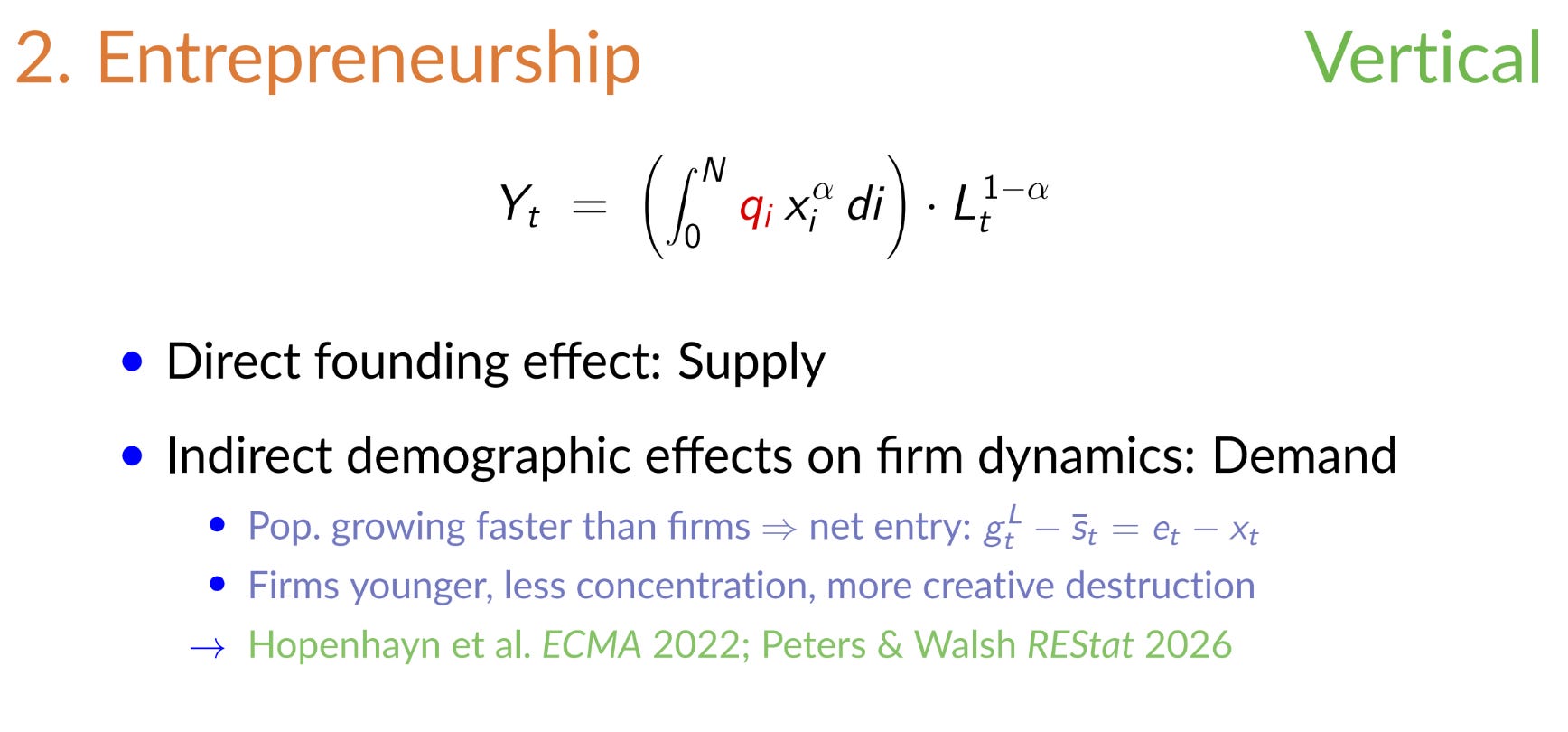
Here the key paper is by Hopenhayn et al., where they point out an inherent demographic effect on the structure and dynamics of firms in the United States. They derive this simple accounting identity, pointing out that if the population is growing faster than the employment at the average firm, mechanically — just as an accounting identity — that requires net entry of firms: the entry rate minus the exit rate on the right-hand side. An increase in the growth rate of population, such as through immigration, all else equal, must mean, mechanically, that firms are younger, that there’s less concentration in industries, therefore more competition, therefore a higher labor share, more creative destruction, and more entry of new ideas in the form of new firms. Peters and Walsh have a paper just coming out that takes that to the data, and in fact does attribute a lot of the declines in these measures of dynamism and youth in US firms to demographic change — which can obviously indirectly be affected by important changes in immigration.
On the supply side, the key paper is by Pierre Azoulay, linking together tax records with census data to identify entrepreneurs, and specifically foreign entrepreneurs, and documenting that across the entire range of firm size — not just mom-and-pop laundromats, not just Fortune 500 companies, but at every size of firm — immigrants are over-represented among founders. Across the full range, immigrants are 80% more likely to found than natives.
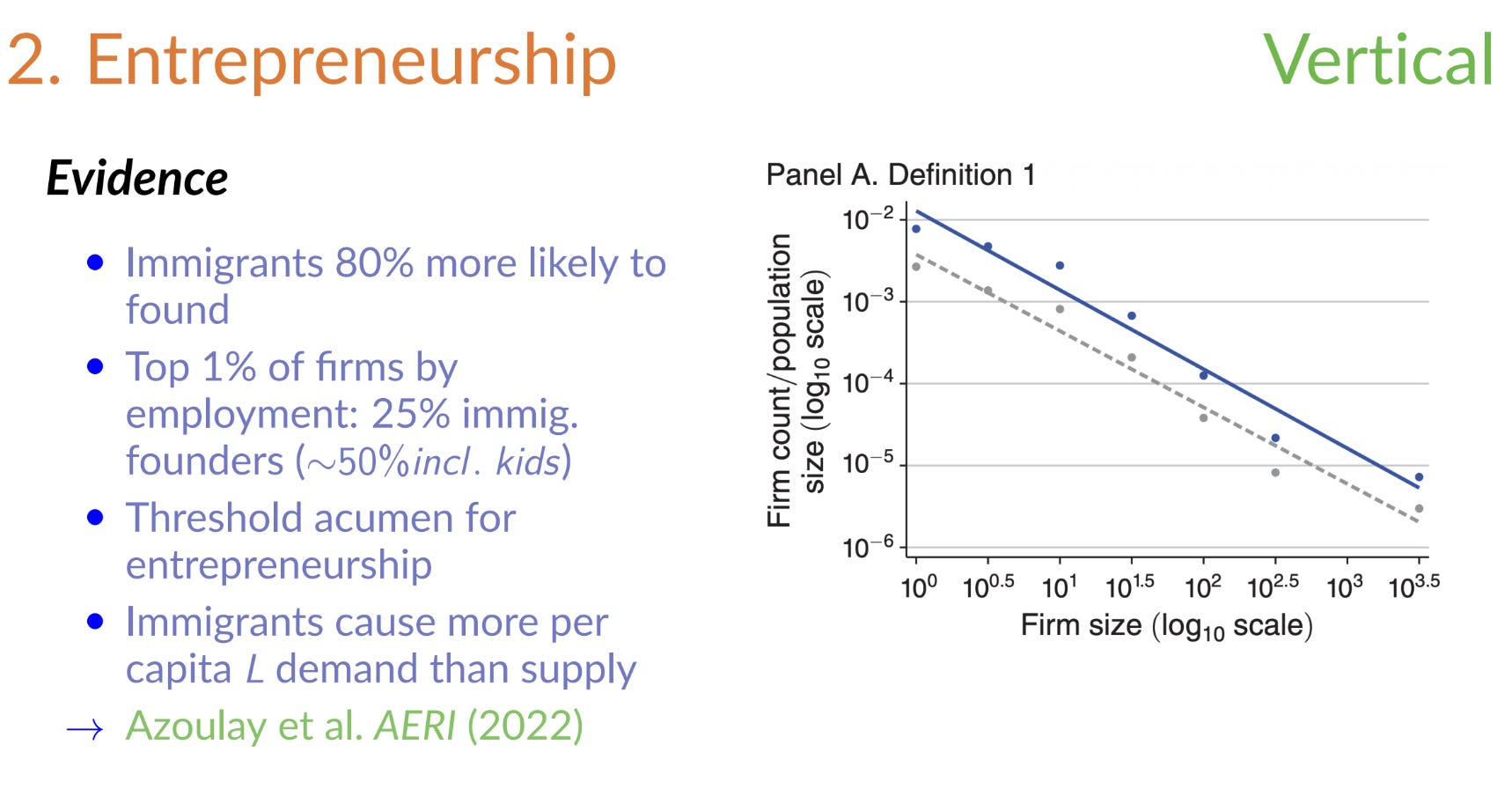
For that reason, because there seems to be this immigrant acumen for entrepreneurship, that means that mechanically immigrants, when they arrive in the country, are causing more demand for labor than they are causing supply for labor. The entire paper is framed as an answer to the question: “How could it be that immigrants seem to generate more jobs than they take?” Azoulay et al. propose a mechanism for that through this vertical innovation.
Finally, there are two notable papers by Parag Mahajan et al., using visa lotteries for high-skill workers; and a paper by me and Ethan Lewis, using also a visa lottery but for low-skill workers — pointing out substantial effects in both cases at the firm level. For some reason, Parag and co-authors don’t include treatment-on-treated effects in their paper, so I calculated those effects here. They’re not what you’ll see in the paper, but that’s because those are intent-to-treat effects.
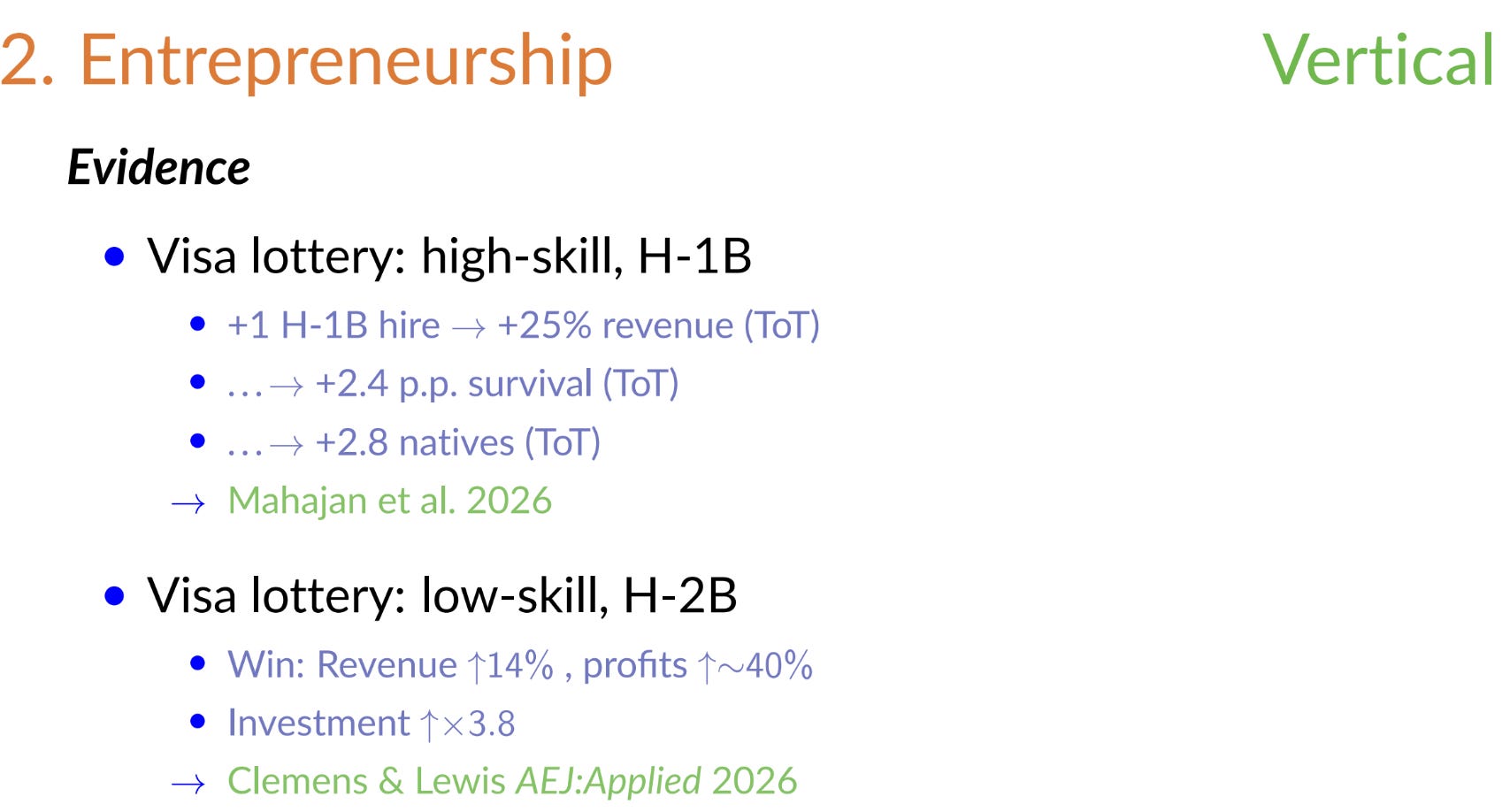
They’re finding that an exogenous, randomized, lottery-determined hire of an additional H-1B worker causes a 25% increase in revenue at the average firm. Part of the mechanism for that is that each additional high-skill foreign STEM worker caused by lottery to be hired by a US firm causes the employment of almost three additional native workers. There’s a whole lot more labor supply at the firm caused by exogenously hiring an additional H-1B worker. This has important effects on not just the scale of the firm — and therefore clearly also the profitability of the firm — but also on the survival of the firm.
Ethan and I, in a very different setting with completely different kinds of workers doing low-skill landscaping, hospitality work, seafood packing, and that sort of thing, also find large increases in investment expenditures and in profits, and therefore implicitly — although we can’t measure it — on survival of the firms and incentives for entry of new firms, caused by marginal increases in the number of foreign workers. All of this literature is pointing toward a lot of creative destruction in terms of firms.
Gaurav Khanna at UC San Diego — fascinating, and a rising-star immigration economist — has documented, in a paper that as far as I know is unique, creative destruction caused by immigrants within firms at the product level.
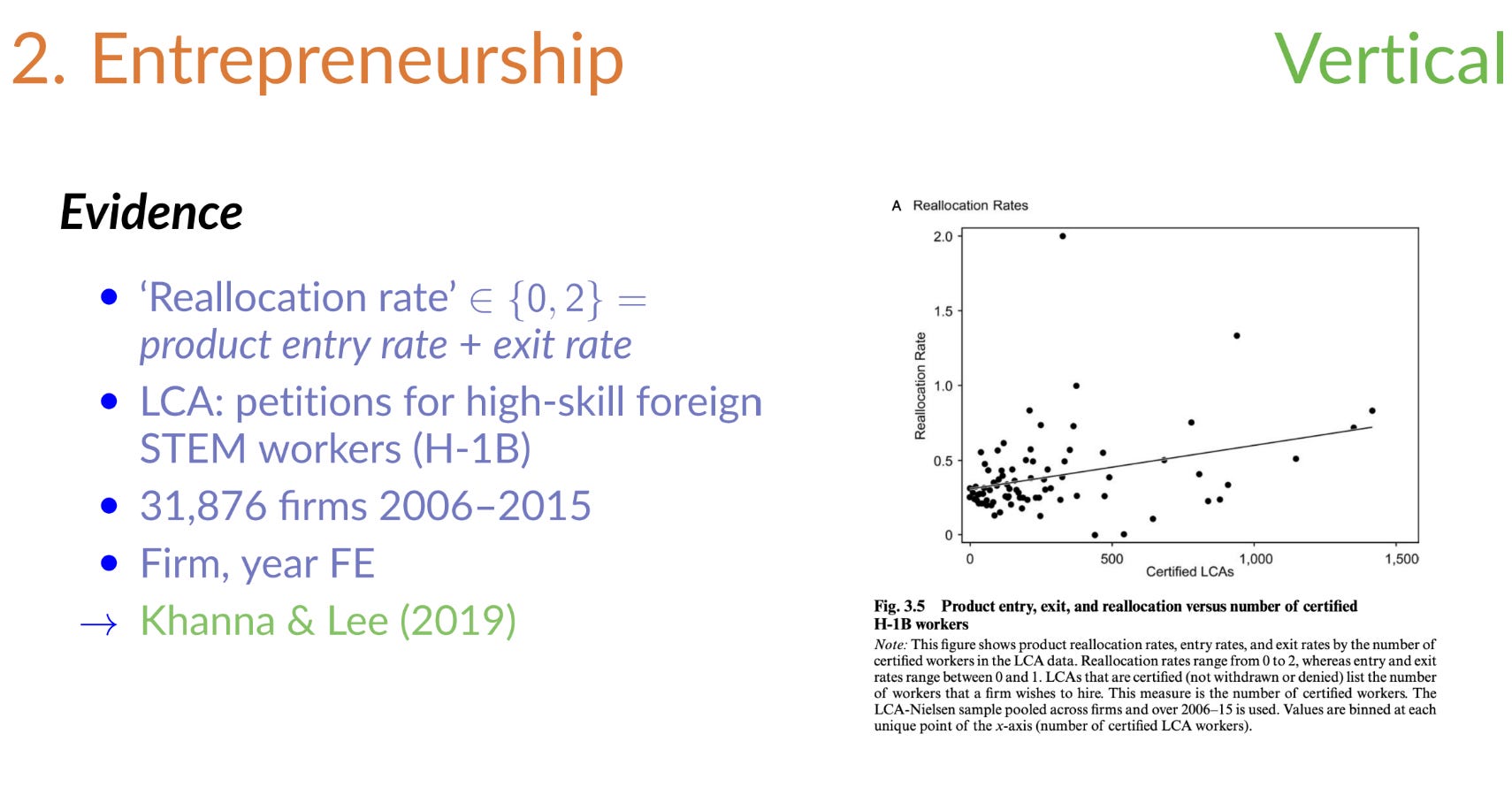
Here he’s looking at about 32,000 firms, and getting data using barcode-level product data on the advent of new products and the elimination of existing products within firms, and its relationship, with firm fixed effects and year effects, with the number of H-1B workers that firms petition for.
He points out that what he calls “product reallocation” — churn in the creation of new products and the elimination of existing products; replacement of older products with new products — is higher when there are more high-skill foreign workers around. This is creative destruction on a different margin: new ideas for new products being realized via immigration.
Mechanism 3: Research workers
Maybe the most intuitive of all — and you might be surprised why it took me so long to get to research workers — is the idea that immigrants come and generate new ideas. They work in research and development. They patent new inventions. In that sense, total factor productivity is a function of the number of research workers around, and this could happen through horizontal or vertical innovation. They could have ideas for new products that displace old ones, or they could have ideas for an entirely new product that just adds to the varieties that are out there.
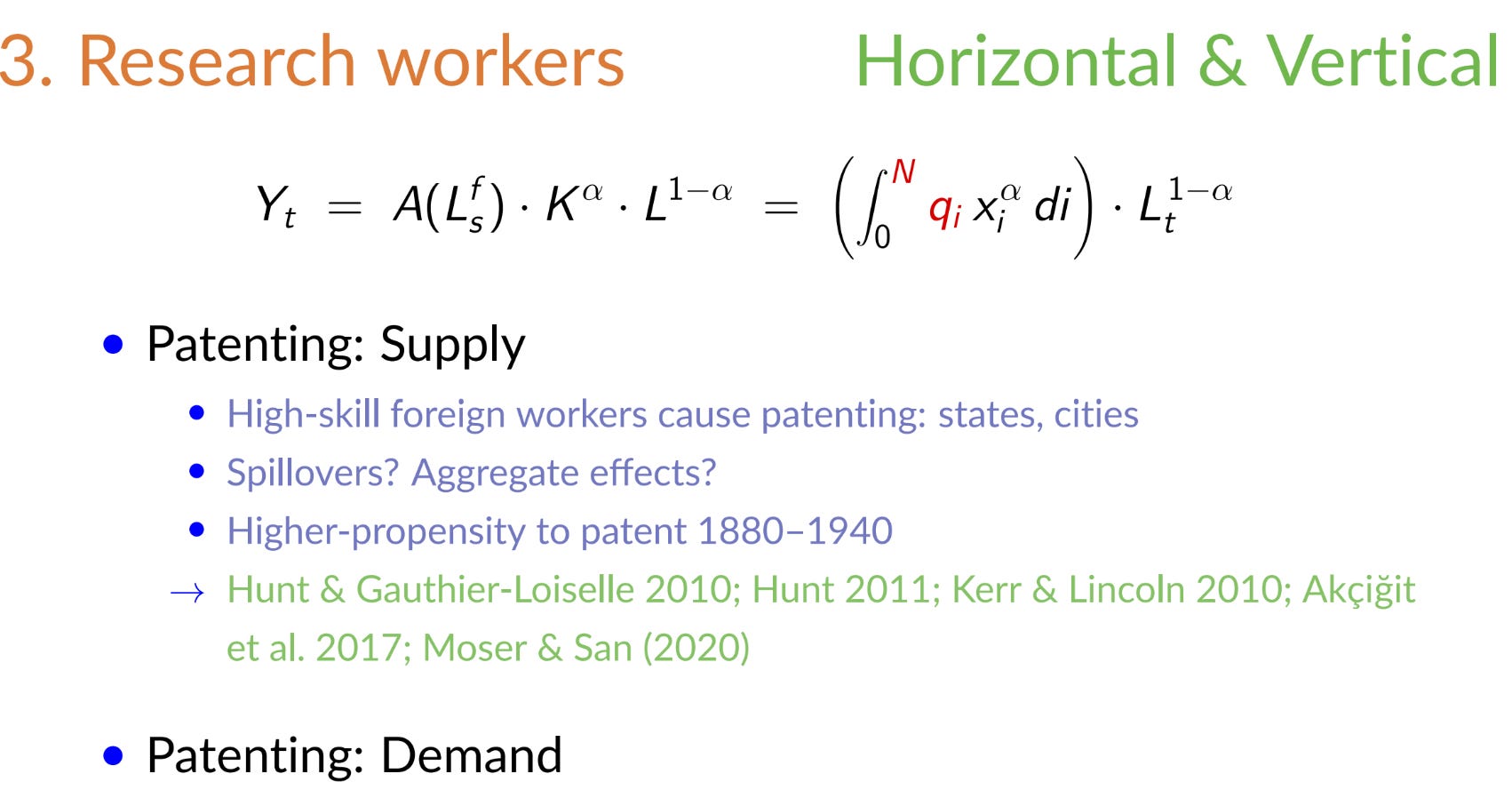
There’s a very extensive literature here, led initially by Jenny Hunt and Bill Kerr; and Giovanni Peri, of course, has foundational papers in this area. This is the first literature that people think of, which I’ve intentionally tried to push you off, because I’m trying to expand the range of the ways that we could think of immigration affecting innovation. But this is the first place that people tend to go when they think about the relationship in the literature between immigration and innovation.
Here we have foundational papers:
Jennifer Hunt and Marjolaine Gauthier-Loiselle first documented that patenting rates are higher among immigrants, and especially high among US-educated immigrants — that’s Jennifer’s 2011 paper.
Bill Kerr and William Lincoln showed that quasi-exogenous flows of H-1B workers into US cities cause more patenting in those cities.
Ufuk Akcigit et al. have even documented that this immigrant propensity to patent goes way back in time, by linking full-universe patent records to census data from 1890 to 1940. They show a selective propensity to innovate, in the sense of filing patents — horizontal and vertical innovation among immigrants going way back in time.
I want to point out a channel that is sometimes missed for research workers to cause innovation, and it is that the arrival of immigrant high-skill foreign workers can cause the creation of native high-skill workers who can also participate in idea generation. This can be a channel of their impact on idea generation. A key paper here is Kevin Shih’s, where he uses booms and busts in graduate student flows to the US.
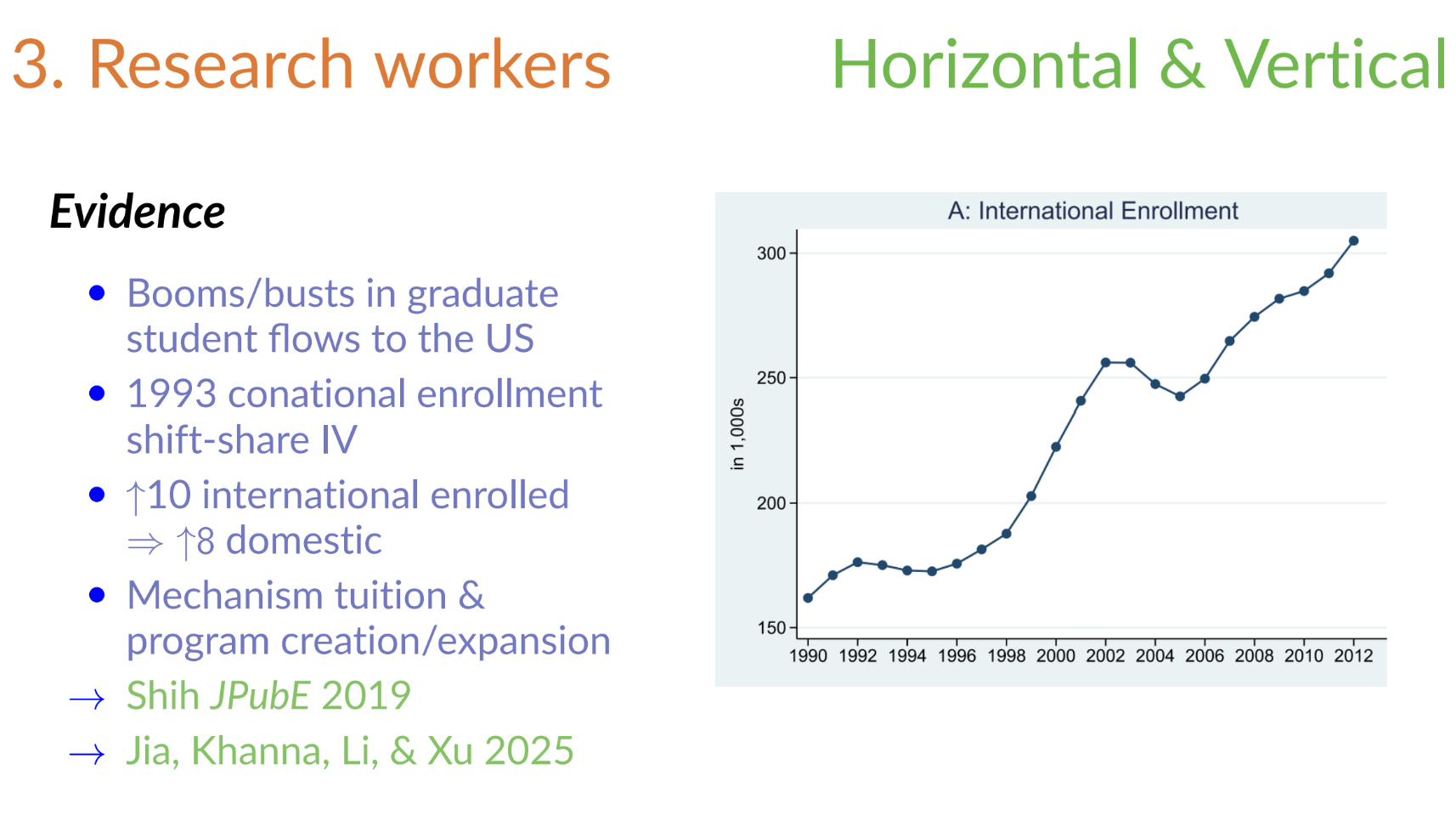
No surprise that after 9/11 there was a big drop in the number of graduate students coming to the US. He uses both positive shocks to inflows and negative shocks to inflows to establish, using a shift-share instrumental variable at the school level, that ten additional foreign graduate students at a US university cause the enrollment of eight additional domestic graduate students.
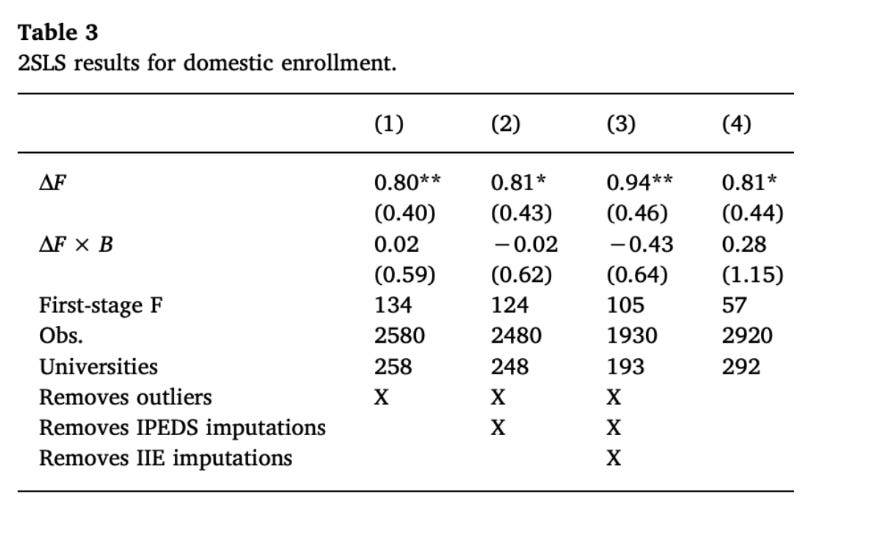
That’s the creation of quite a lot of human capital that could also engage in innovation and have a multiplier effect on ideas, and on all kinds of vertical and horizontal innovation by natives, but being caused by immigration.
Mechanism 4: Diversity spillovers
Diversity spillovers have been important in the literature as well.
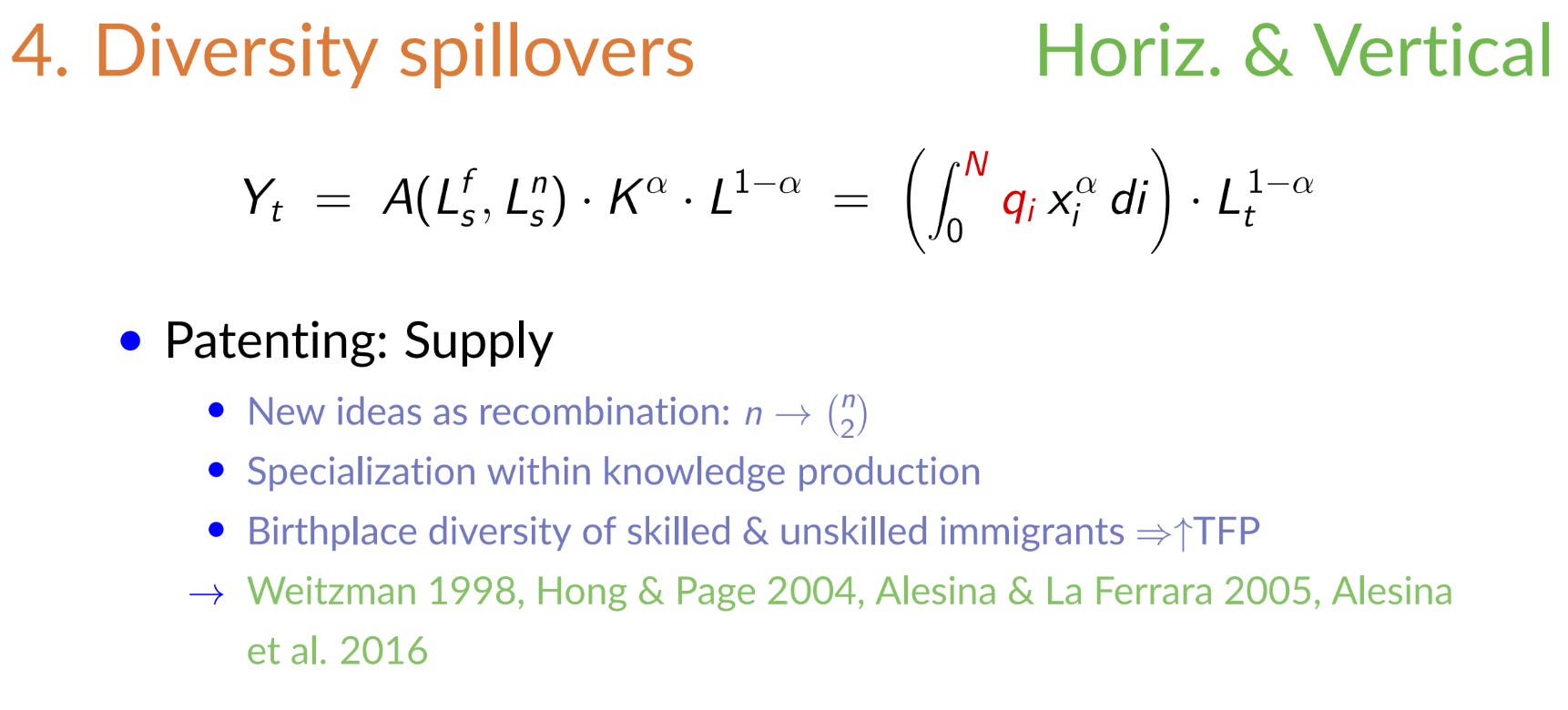
This is the idea that this total factor productivity parameter could be a product of combining research and development workers who are foreigners and natives — that there’s something about the mix of those people, rather than their independent, additively separable contributions, that creates more ideas jointly. Again, this could be through horizontal or vertical processes.
The idea that a broader range of baseline ideas is capable of generating more output ideas goes back to Marty Weitzman, with a foundational paper where he pointed out that if you model ideation as the recombination of existing ideas, then there are more opportunities for ideation the broader the range of initial ideas brought into a creative process.
The literature here spans the range from Hong and Page, proving, in theory, that more diverse teams — independently of the creative quality of each constituent member of the team — can generate more and higher-quality ideas on paper, to the late and great Alberto Alesina and co-authors, documenting that countries with greater birthplace diversity, controlling for many other determinants of growth and productivity, have higher total factor productivity and outputs simply because of this diversity.
The best direct evidence we have comes from a fascinating recent paper that is one of the coolest papers I’ve heard of in many years — everybody in my field who hears about it wishes that they had thought of it. Shai Bernstein at Harvard Business School, Rebecca Diamond, and their co-authors do this remarkable thing of linking together the universe of patents from a 17-year period with social security data. They want to know: what is the effect of immigrant inventors on non-immigrant inventors? Is there something about the mix of natives and immigrants in a team that raises everybody’s productivity collectively, through these diversity effects?
The social security records give them five digits of the person’s social security number, which coincidentally happen to convey information about the year that the social security number was issued. The social security record also has the birth date, and thus the birth year. By comparing those two things, you can identify immigrants, because almost everybody who is born in the US gets a social security number in the year they were born, and people who get a social security number much later in life are almost always immigrants. They also have deaths in the social security data. They define an unexpected death as a death before age 60, and ask: “When there’s a team of people who have co-invented together, which is very frequent, patented together in the past, and one of them experiences an unexpected death, what happens in later years to patenting by the other members of that team?” Those are the event studies that you’re seeing.
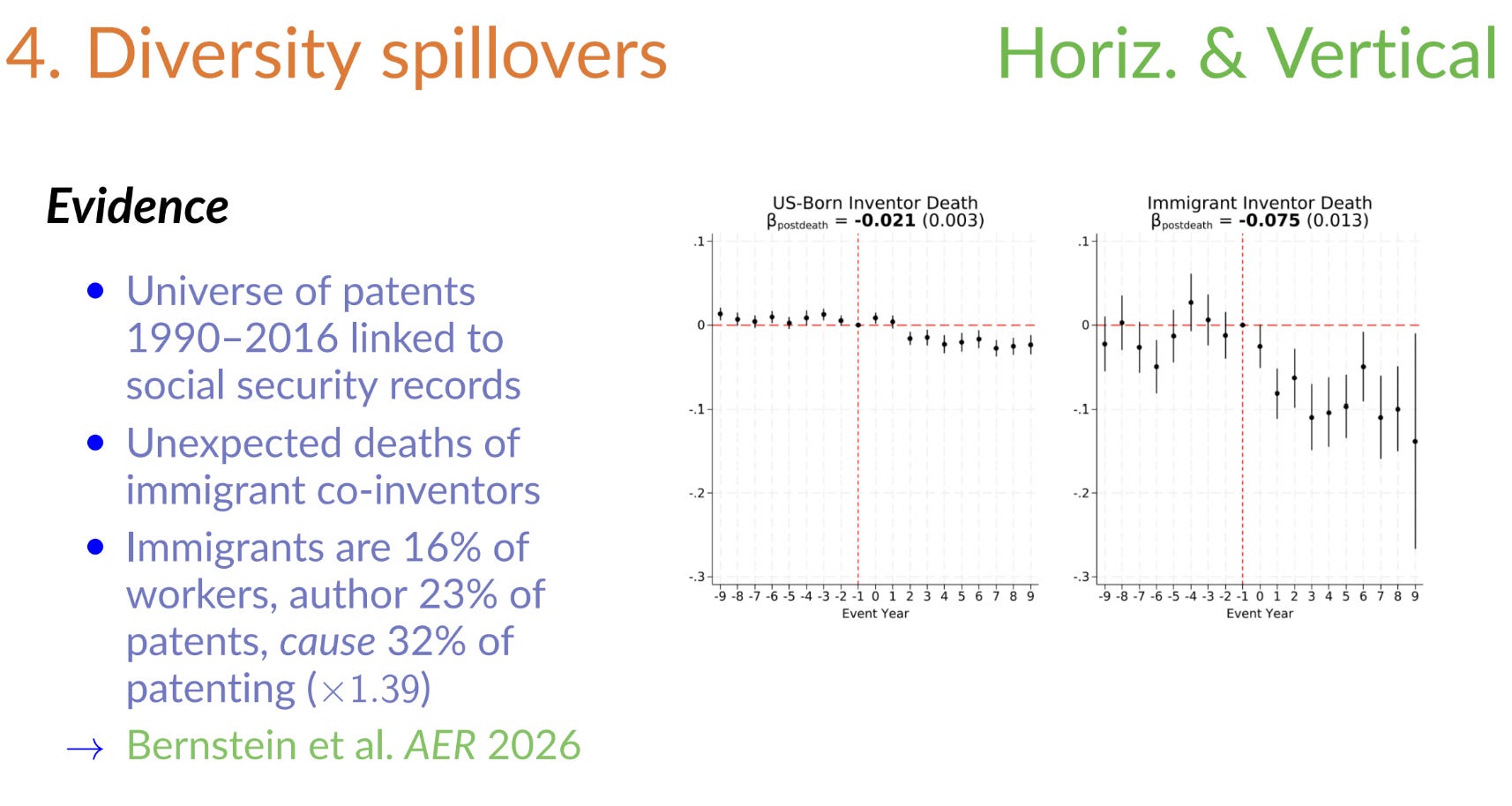
This is for top 10% forward citations of patents, so influential patents. When a native dies, that’s the panel on the left. When an immigrant dies, that’s the panel on the right. Big negative effect on team members.
Some people have looked at this paper and said, “Clearly that’s smart, talented immigrants being lost.” It’s possible, but the way that Bernstein et al. primarily interpreted it, and the way that I would interpret it, is that ideation within a team is an emergent process of combination, recombination, and specialization. What it means is that the immigrants were not necessarily smarter in an absolute sense than the other members of the team, but that they were playing a key role, where natives on the team were more substitutable with each other in the group process of ideation.
They come to the very striking conclusion that even though immigrants are 16% of workers, they are authors on 23% of patents. In terms of the patents that they file themselves with their name on them, they are over-represented. Their effect on patenting, including this spillover effect to natives, by a factor of 1.39, means they are causing 32% of all innovation by patenting in the United States, even though their names are only on 23% of it. This is the most direct and, to me, very compelling evidence we have of these diversity effects.
Mechanism 5: Idea flows and migration networks
For economic development in the long term there are two fundamental strategies, given the dominance of ideas, and they are to either produce or use ideas. Here the focus is on the latter of those two channels. What role do immigrants play in helping a country, or the industries of that country, use ideas that already exist?
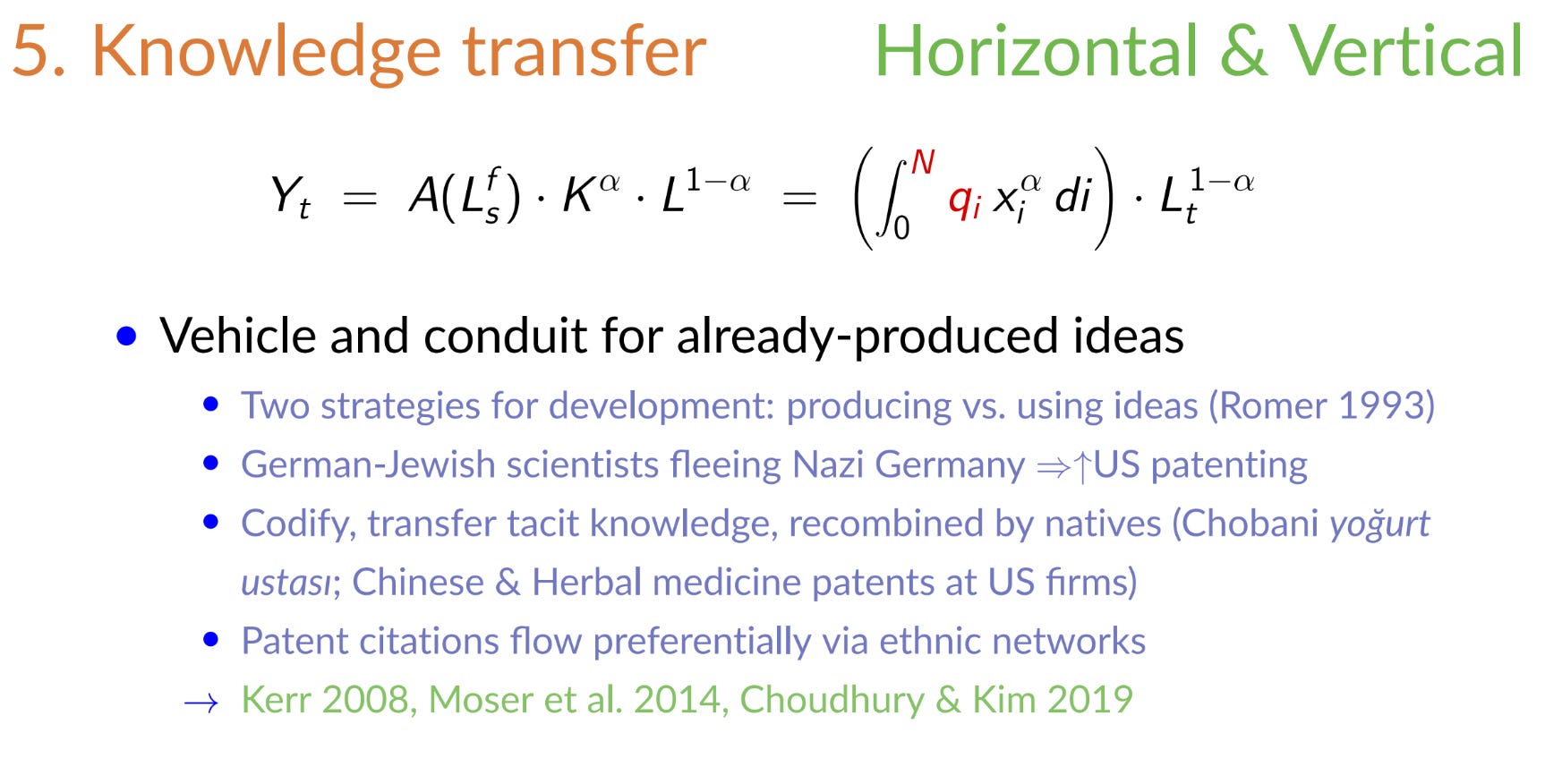
Here several of the key papers are by Petra Moser, who has documented that German Jewish scientists fleeing Nazi Germany caused increases in US patenting, by bringing especially tacit knowledge with them, specifically in the fields where they were entering.
There’s a really interesting paper by Raj Choudhury and Do Yoon Kim documenting a particular facet of this, which is the tacit aspect of the knowledge: looking at companies producing Indian and Chinese herbal medicines in the United States, requiring not just ideas and recipes downloaded from the internet but people embodying tacit knowledge that is difficult to write down, or maybe never has been written down, coming to the United States, working with natives to recombine those ideas and develop new products. The diversity of ideas is arriving embodied in a person.
An example of that that was memorable to me is that when Hamdi Ulukaya, the billionaire entrepreneur who founded Chobani yogurt in the United States, was first wanting to make Turkish-style yogurt in the United States, he brought an expert — what’s called an usta in Turkey — to upstate New York, to his plant, to personally show people the tacit knowledge that he had for how to make great yogurt in a Turkish tradition. There was something about the knowledge that couldn’t just be sent in an email.
Maybe the classic paper of this entire sub-literature is by Bill Kerr, a brilliant research design, where he got an algorithm for identifying the likely ethnicity of patent filers and grantees according to their names — who is likely ethnically Chinese, or Indian, or Russian — and then pointed out that if you are an inventor outside the United States who is citing in your patent a patent that was filed in the United States, you are much more likely than random chance to be citing a patent that was filed by co-ethnics. That is, if you are in India citing a patent filed in the United States, you are much more likely than random chance to be citing a patent whose inventors have an Indian name. Here again, ideas are traveling through migration networks. Note here, not necessarily through people moving back and forth, but through networks that are created by people moving back and forth — who are selectively in touch with each other and selectively working with each other in the creation of ideas.
Maybe the key recent paper in this area is Marta Prato’s job market paper, where she’s studying inventors who are from the EU moving to the United States.
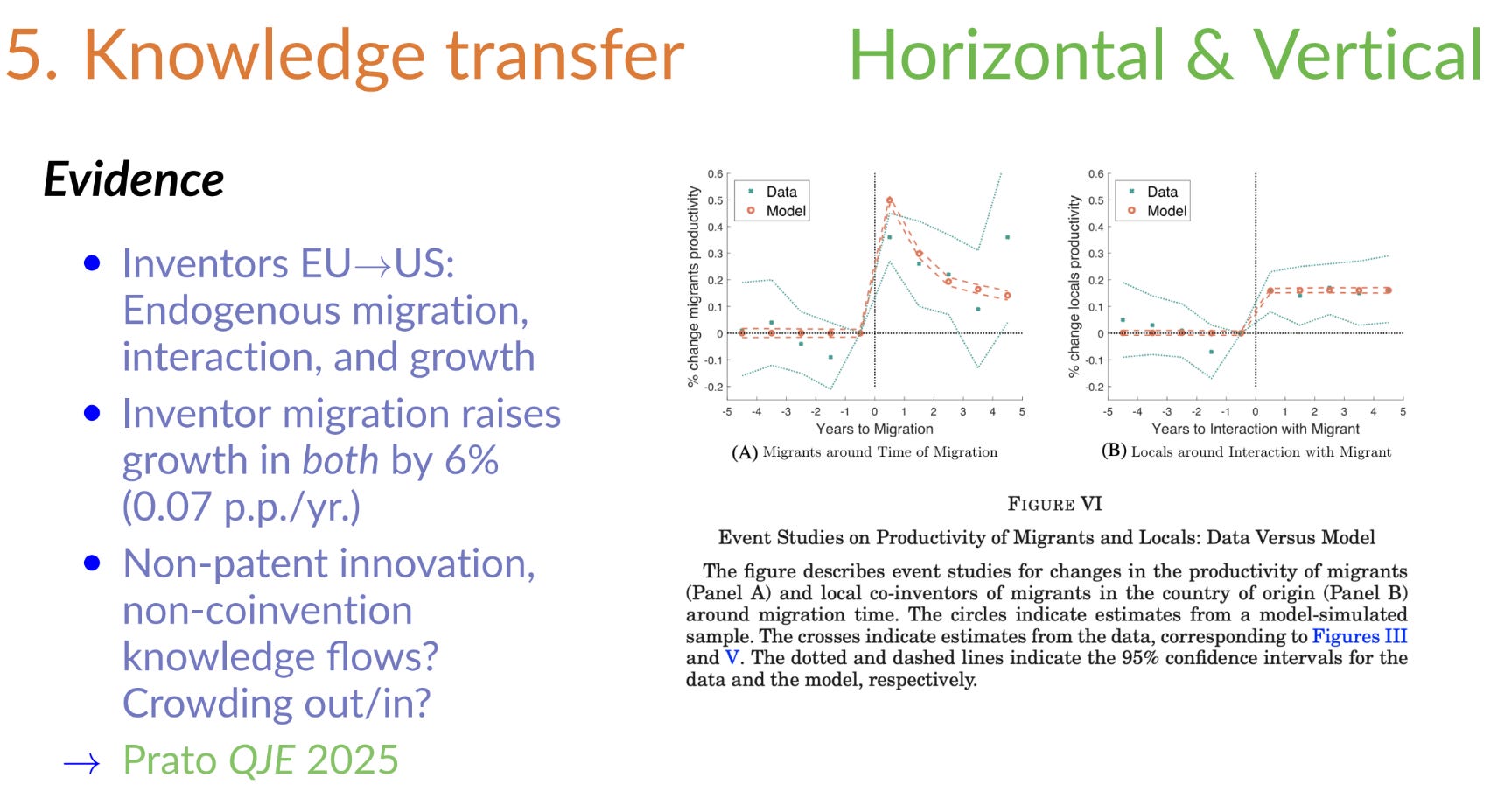
She notes that not only does their patent productivity change at the moment that they migrate — which is the figure on the left-hand side here, both data and the modeled estimates that she makes — but the patenting productivity of that person’s previous collaborators in Europe, who didn’t move, also goes up.
The striking implication is that she models what would happen under autarky: if there were no longer any movement of migrant inventors from the United States to Europe. She points out that economic growth through this innovation mechanism actually falls in both places. Even though under autarky there is less loss of inventors from Europe to the United States — so there are more people who are inventors who stay in Europe — the ones in Europe also have less innovation productivity, because they are no longer connected to people who are in the US innovation ecosystem. For that reason both countries can lose if immigration falls, by this endogenous migration and endogenous inventor interaction mechanism. Just a spectacularly creative and highly influential paper.
Mechanism 6: Induced innovation
The sixth mechanism through which immigration can pull on these levers is induced innovation. This is all about the third genre of levers — the one that Daron Acemoglu baptized as directed technical change, which is sometimes called induced technical change.

Here the idea is, as before, that capital and labor are entering the production function at constant elasticity of substitution σ, and that there is a directed innovation that can happen to augment capital or labor selectively, through these Aₖ and Aₗ parameters.
The foundational text here is Sir John Hicks’s The Theory of Wages, where he wrote, “A change in the relative prices of factors of production is itself a spur to invention, and to invention of a particular kind — directed at economizing the use of a factor which has become relatively expensive.” Here’s the idea that additional labor coming into an economy through immigration, via the downward-sloping labor demand curve, by changing the relative price of labor with respect to capital, could induce directed technical change that augments labor or capital.
It took Daron Acemoglu coming along in 2002 to refine the predictions of that prototypical model, the Hicks conjecture, to point out exactly what kind of directed technical change would happen in which circumstances. He pointed out that although Hicks was focused on the price effect, there’s a different and competing effect, which is a market size effect. If there’s more labor around due to immigration, then that means there is by definition a larger market for any given innovation that you might create in order to augment labor. By definition, if there are more laborers around, you can make more money by doing that.
There is also a competing effect, which is the price effect that Hicks was focused on, which tends to favor the other factor: if there’s a lot more labor around, so capital becomes relatively scarce, that raises the marginal product of capital, meaning that any percentage change that a capital-directed innovation might make has a higher value. These are inherently competing with each other. They could go in opposite directions. What Acemoglu influentially solved is the question of exactly what characteristic of the production function would cause it to go one way or the other.
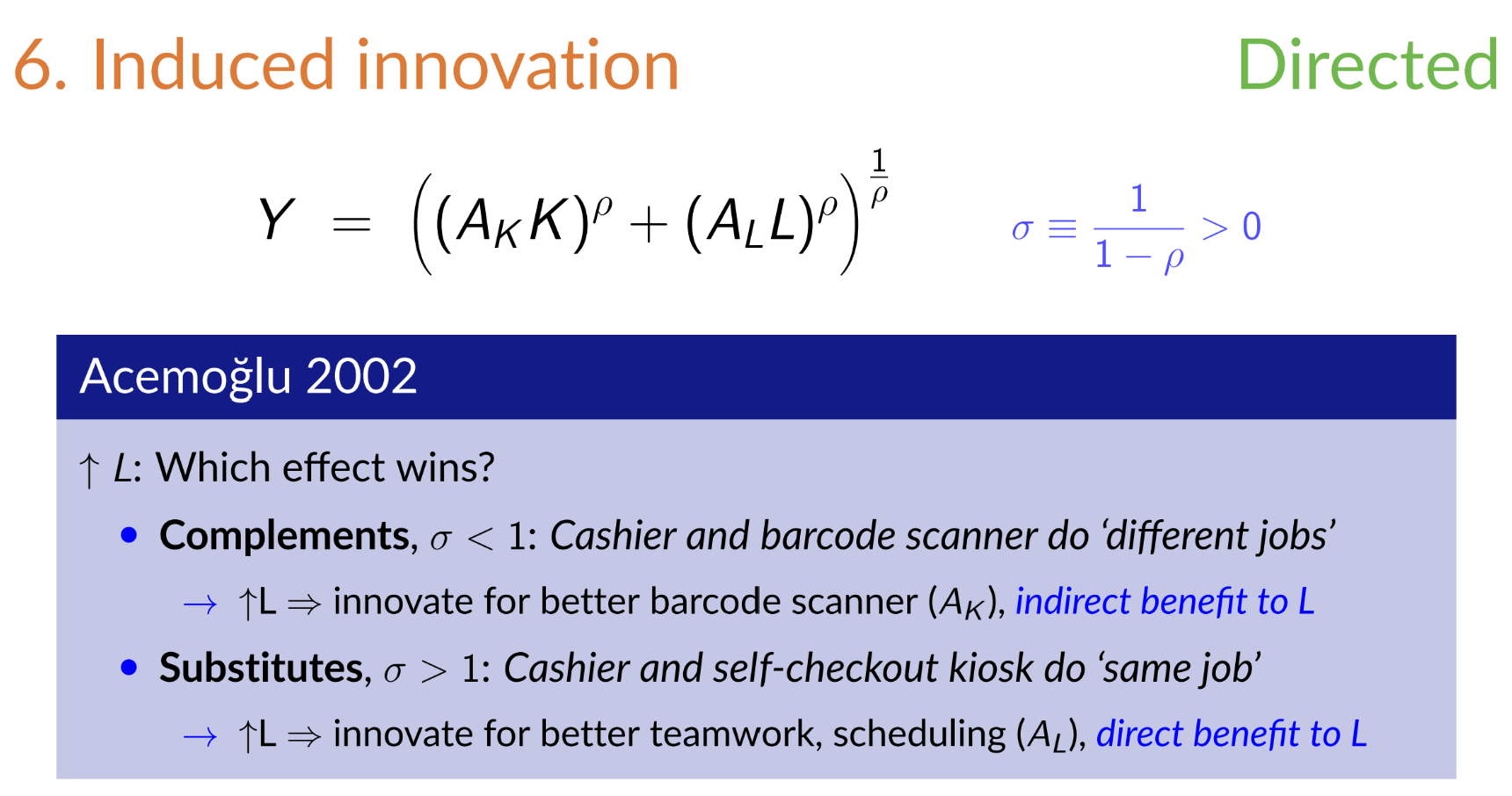
I’ve used this example of a labor-augmenting innovation like the advent of an easy-to-use handheld bar scanner in the production of cashier services at a big-box store, versus a capital-directed innovation like an automated self-checkout kiosk. In that example, it’s easy to see. Suppose there’s an increase in the labor supply from, for example, immigration, and in the technology that we’re talking about capital and labor are complements — which in English just means a cashier and a barcode scanner are doing two different things. They’re not substitutes; they complement each other in the production of cashier services. In that case, an increase in the supply of labor induces innovation for better barcode scanners, because in this case the capital is the barcode scanner, which is a complement to labor. That indirectly benefits labor, because it means that each unit of labor becomes more productive by having access to a technology that makes it more productive: the cashier with the barcode scanner can do things more quickly.
If, on the other hand, the capital is the self-checkout kiosk, which does the same job as the human cashier and is therefore a substitute for the human cashier, then an increase in the labor supply is going to increase the incentive for innovation that augments labor — like better scheduling of cashiers, better coordination of teamwork between cashiers, or lots of other innovations we could think of in processes, or even technologies, that could augment labor. Which is also a benefit to labor, but a direct benefit in this case, because instead of indirectly benefiting labor by augmenting capital that is complementary to labor, now the directed technical change serves to directly increase the marginal product of labor.
The really striking finding is that whether we’re talking about capital that is complementary to labor or capital that is a substitute for labor, an increase in the labor supply in both of these cases benefits labor by raising the marginal product of labor. Daron even derived simple conditions under which the long-term endogenous-technology labor demand curve slopes up. These are the ideas of modern growth theory that Dave Card and Giovanni Peri were taking the entire field of immigration to task for ignoring.
I want to point out that the same reasoning applies if we’re thinking of induced innovation between two types of labor, instead of capital and homogeneous labor. Suppose the production function looked like this.
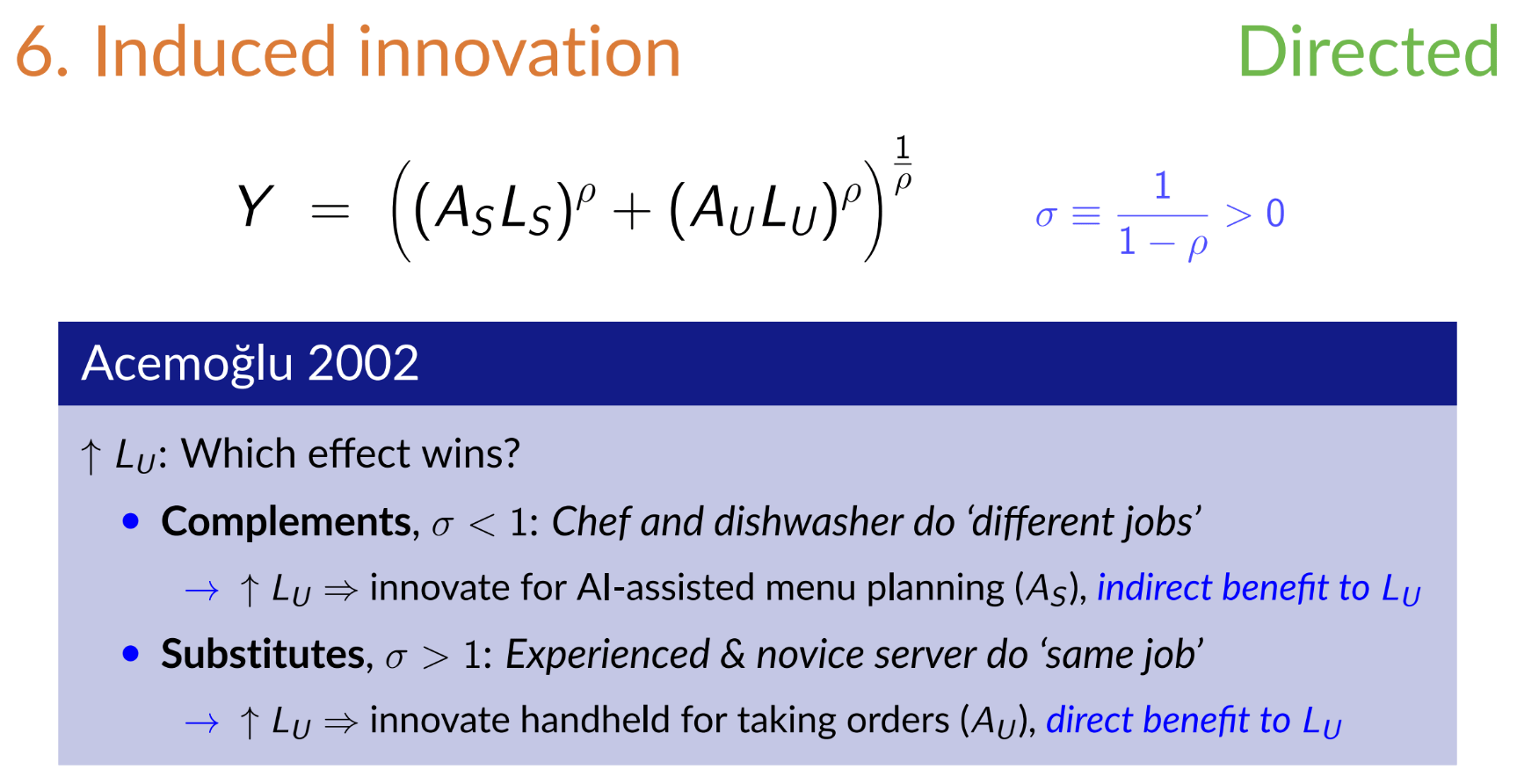
There’s skilled and unskilled labor, and there can be directed technical change that is focused at increasing the marginal product of skilled labor, and directed technical change in Aᵤ, which tends to increase the marginal product of unskilled labor.
Here’s a different example. Think of a chef and a dishwasher in the production of restaurant services, doing fundamentally different jobs. In that sense they’re complements. If there’s an inflow of unskilled labor to the area — more potential dishwashers — that creates higher returns to more chefs, but also, for the same reason, creates higher returns to ideas that increase the productivity of chefs. I made up AI-assisted menu planning, but you can think of all sorts of other things that could directly increase the productivity of chefs, with an indirect benefit to dishwashers precisely because they’re complements. Anything that increases the productivity of chefs is also going to increase the productivity of dishwashers.
If, on the other hand, you’re thinking of substitutes, like people doing the same job in a restaurant — think of experienced versus novice table servers, where the skilled workers are experienced and the unskilled workers are novices. Then an increase in the supply of unskilled labor is going to raise the incentives for innovations that are directed at raising the marginal product of unskilled labor, to take advantage of the greater supply of unskilled labor. Of course that is a direct benefit to unskilled labor.
Again, whether low-skill and high-skill labor are complements or substitutes, we have directed innovation, ideas whose creation and implementation are incentivized by this change in factor supply, offsetting the downward-sloping labor demand curve. And again, Daron derives conditions under which the low-skill labor demand curve would actually slope up with endogenous technology.
Here there’s quite a lot of evidence, which I’ve contributed to a little bit.
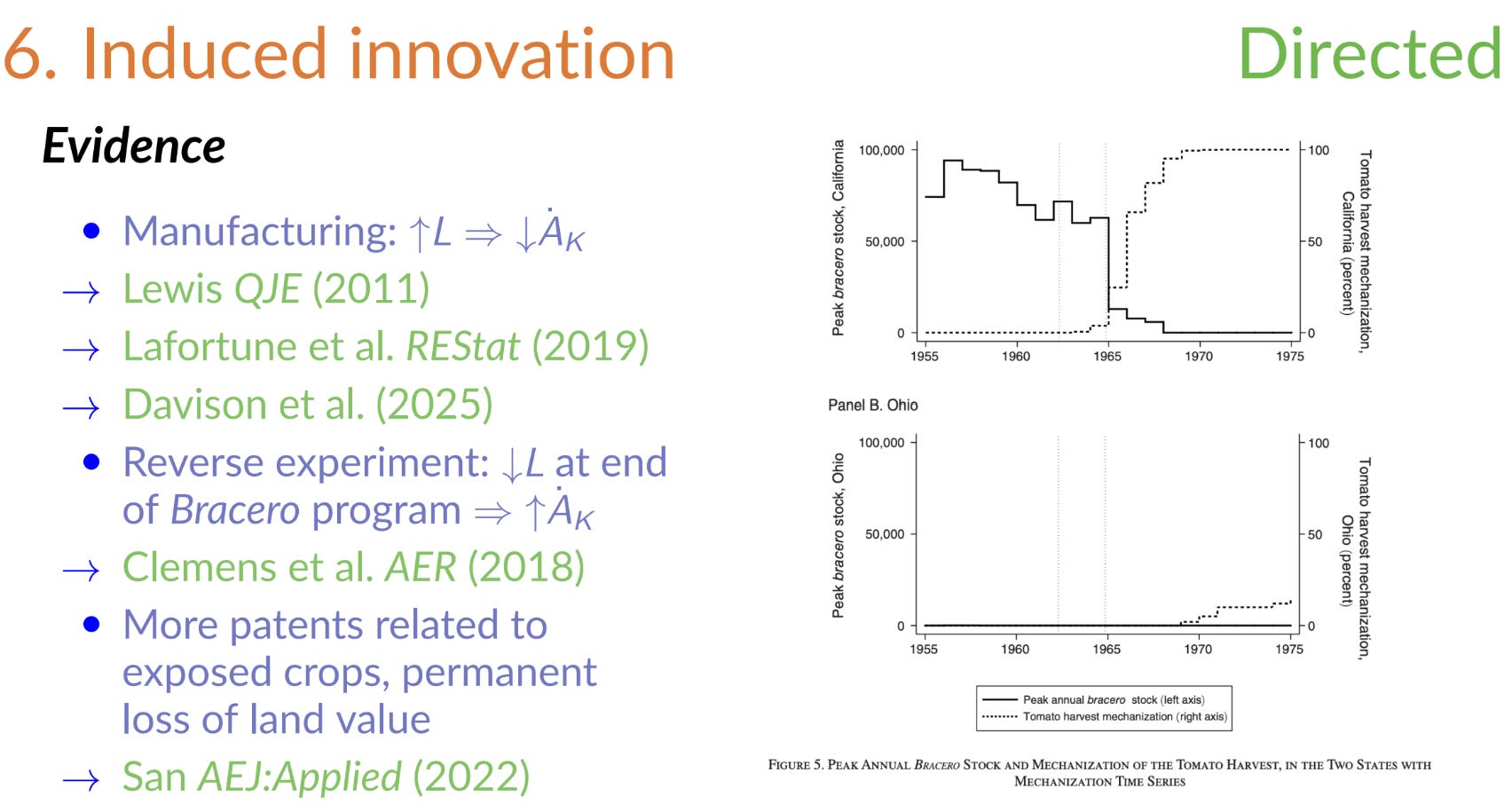
We have Ethan Lewis, with a foundational paper where he showed that manufacturing plants located in cities that got greater inflows of immigration — just numbers of people coming in — invested in less automation. This is a direct prediction of Daron’s model when capital and labor are substitutes under an automation technology.
Jeanne Lafortune et al. have found similar things in the early 20th century, in a nice paper.
Davison et al. have a working paper testing some of these same ideas. This at the moment is well-trodden territory, but very nice work in this area.
With Ethan and Hannah Postel, I have a paper where we use a natural experiment, which was the end of the Bracero farmworker program on December 31, 1964, which meant the elimination of hundreds of thousands of Mexican farm workers doing work that doesn’t require a college or even a high school degree in the United States. We documented, for automation technologies in agriculture, that the elimination of labor — in this kind of reverse experiment to Lewis — caused more automation. On the right, in solid black lines, are two different states: California versus Ohio. California had a lot of Bracero workers. They were eliminated in 1965. The dashed line is showing immediate and rapid adoption of tomato-picking machines in California. Whereas in Ohio, where tomato picking existed but was mostly done by natives, and the labor supply was not affected by Bracero exclusion at the end of 1964, there wasn’t this wave of automation.
Shmuel San, four years after us, came out with this brilliant, very complementary paper where he used the same natural experiment — the exclusion of the Bracero workers — to point out, first of all, that patenting of new inventions related to crops that were intensive in Bracero workers went way up right at the moment of Bracero exclusion, and that it went up much more in crops that were relevant to Braceros than in crops where Braceros had not been important in the harvesting or packing or field preparation for those products.
What was most striking to me in San’s findings was this figure.
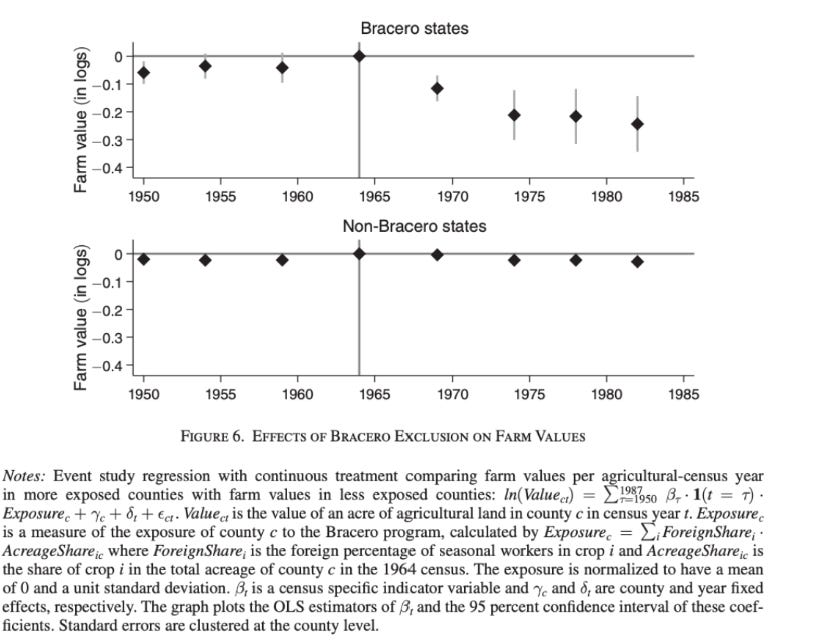
He poses the question: this innovation that took place in response to the decreased supply of labor — what was the net effect on productivity of farms? To the extent that farm land value is an indicator of the productivity of that land, and that’s quite a reasonable assumption, the innovation was not able to compensate for the exclusion of the workers. What you’re looking at is the decline of land values as an event study after Bracero exclusion, in states from which large numbers of Braceros were eliminated versus other states like Vermont, where there were barely any or no Bracero workers.
Some people have read our American Economic Review paper to say, “Great, eliminating these farm workers caused more automation. That’s modernization. Don’t we want mechanization and the higher productivity that comes with that?” What San is doing is directly testing that hypothesis and pointing out that no — in fact, the improved seed varieties, mechanization, and all of the other innovation that happened in response to this negative labor shock helped mitigate but did not fully offset the effects. Farmers ended up poorer for this reason. That’s a very interesting net effect of all of that idea creation and implementation.
Amplifiers rather than mechanisms
I want to point out several models and findings in the literature that I’m not calling, for the purposes of this presentation, different mechanisms. I’ve talked about six different mechanisms by which immigration, in theory and evidence, has been discussed in the recent literature as pulling or pushing on those innovation levers of three kinds: vertical, horizontal, and directed. These I would classify as amplifiers of those mechanisms, rather than separate mechanisms in and of themselves.
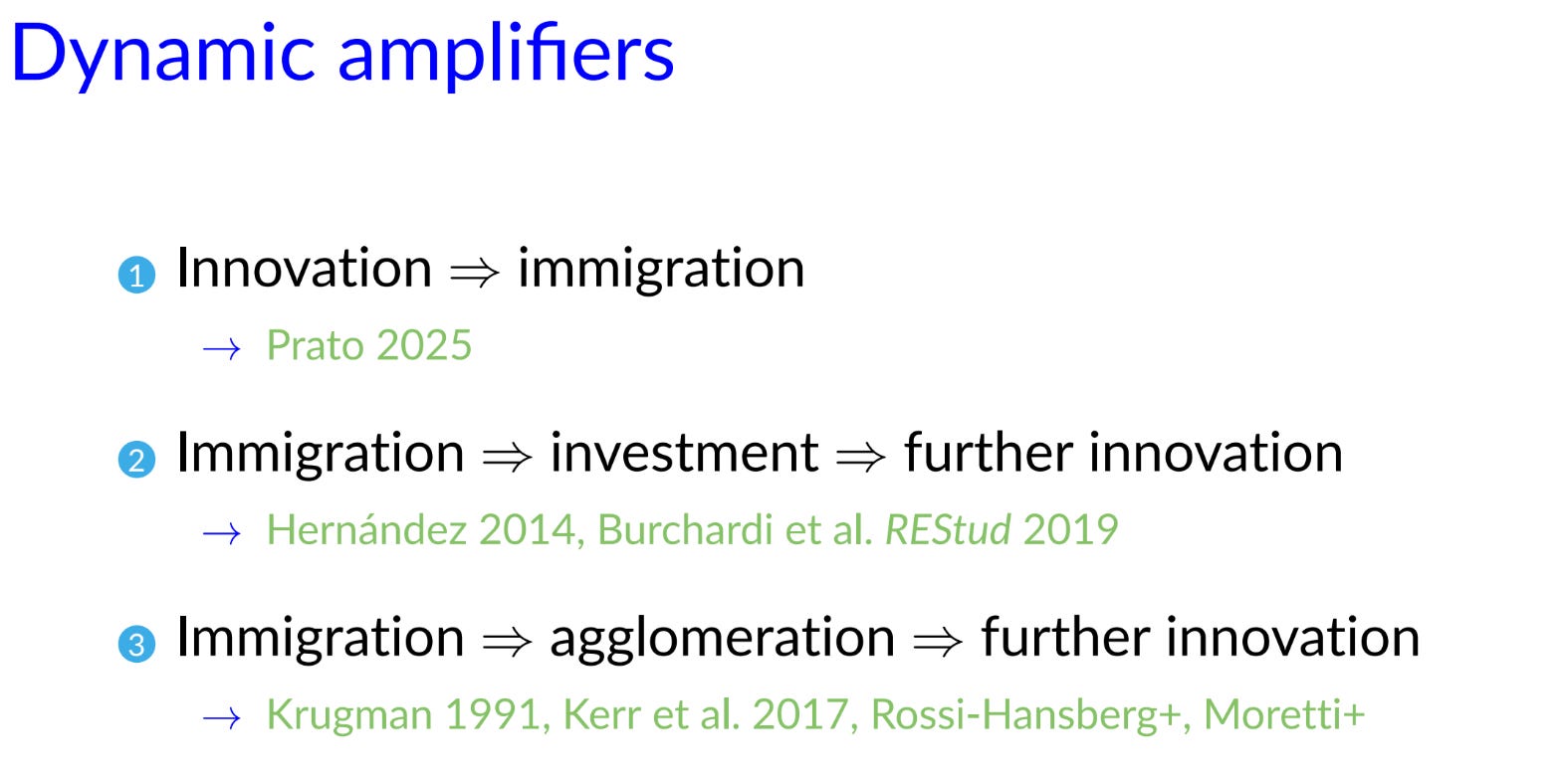
Amplifier 1: Innovation causes immigration
One is that yes, immigrants by all these mechanisms can cause innovation, but innovation itself can cause immigration. What is the reason why inventors and entrepreneurs want to come to the United States? In part because so much innovation is going on here. This is a key feature of Marta Prato’s paper: there is an endogenous migration of inventors, and endogenous interaction of inventors with other inventors, and that is driving immigration itself. The effect of inventor migration on innovation is magnified by these feedback effects. Again, not a separate channel, but something that would come to define treatment effects in a dynamic setting that you might not see in a short-run or static setting.
Amplifier 2: Immigration causes investment and spurs innovation
Immigration can cause investment — foreign, outward, and inward investment — and therefore spur further innovation. Zeke Hernandez has a paper documenting that migrant networks help determine where multinationals locate. The pre-existing population of Koreans in various cities of the United States influences the decisions of Korean multinationals to set up operations in one part of the US or another. Its direct implication is that migrant networks by themselves actually facilitate, at an international level, the location of investment, especially in branches of multinational operations through which ideas could flow.
Amplifier 3: Immigration causes agglomeration and spurs innovation
A third channel is agglomeration, starting from Krugman and in various forms before that. The best predictor of immigration all over the world, ever since the 19th century and before, has been prior immigration: both in time, as immigration tends to happen in waves, and certainly across space. The reason that a lot of immigrants go to a particular place, to a particular industry in a particular place, is the prior arrival of immigrants in those places. The more agglomeration of immigrants, the more agglomeration of innovative activity and entrepreneurship. Those can drive not just further immigration but further innovation, through agglomeration effects that again, in a dynamic sense, tend to multiply the effects above and beyond what you might expect from a partial-equilibrium production function.
I highlight these corners of the literature as being important, and explain why I’m not talking about them as mechanisms. I see them as things that dynamically extend the mechanisms that we’ve already talked about.
Policy-relevant treatment effects
I want to talk about my wish list for what a few of you who might be particularly interested in immigration could do: doors you could push on, areas that you should look in to make a major contribution to this area in the future.
Once we drop the flat-earth assumption and start thinking of ideation, and the determinants of ideation that are pushed and pulled on by immigration, as a first-order effect, entirely new vistas of research possibilities open up that are not considered relevant, or considered publishable, when immigration stays in its straitjacket of being a subfield of labor economics.
There are a bunch of different possibilities for research that have been opened up by people approaching it from a completely different angle. John Van Reenen, Heidi Williams, and Nick Bloom have a really stunning paper where they give their subjective bottom line about all of the policy tools we have that could conceivably move the needle on innovation, and the productivity effects of innovation, at the national level.
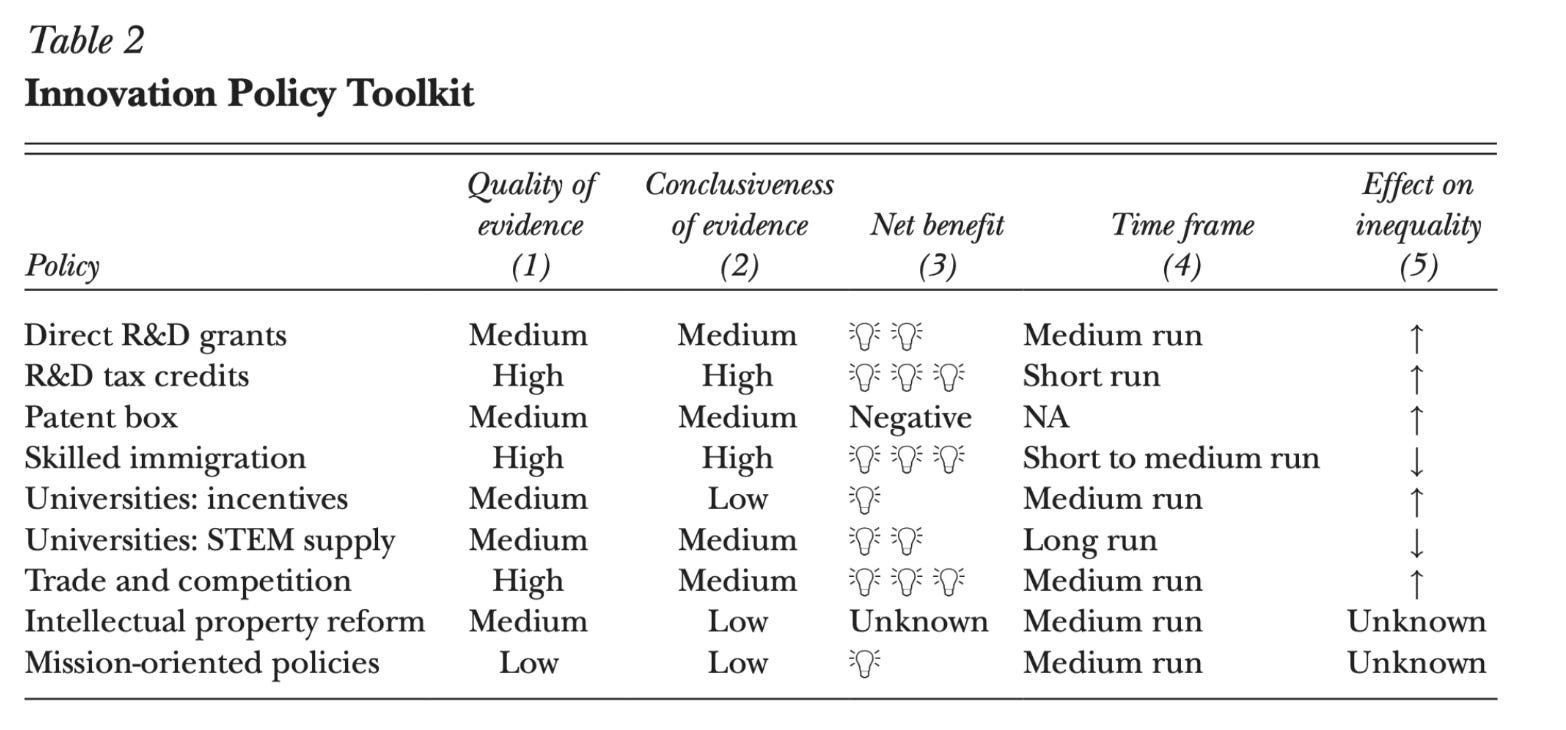
The one that they consider to have the highest potential, and to have the clearest evidence in the literature — and also the highest potential in the short run — is a form of immigration: especially high-skill immigration.
This is an area where tangible impacts are large and policy relevance is high, compared to the amount of knowledge that we have about it. Again, I would attribute that to the historical straitjacketing of economic research on immigration in corners of labor economics that are not too much concerned with the kind of effects that we’ve been talking about.
One strong wish I want to put on the table, because as a referee it’s something that I still see has not percolated across even some of the newer work that’s being done in this area, is that if what we’re interested in is policy relevance, we need to be looking at policy experiments. Or, in a short intuitive sentence: what we learn about whether a particular visa category should be expanded or restricted is limited if the causal identification in your paper is coming from rainfall, or civil wars. The local average treatment effect that you get from a particular source of exogenous variation that is not policy can be radically different from the local average treatment effect that you get from policy changes.
I highlight this paper by Heckman and Vytlacil from 2001, where they defined this term “policy-relevant treatment effect,” that I never heard in grad school and I hope has permeated the grad schools that you all go to.
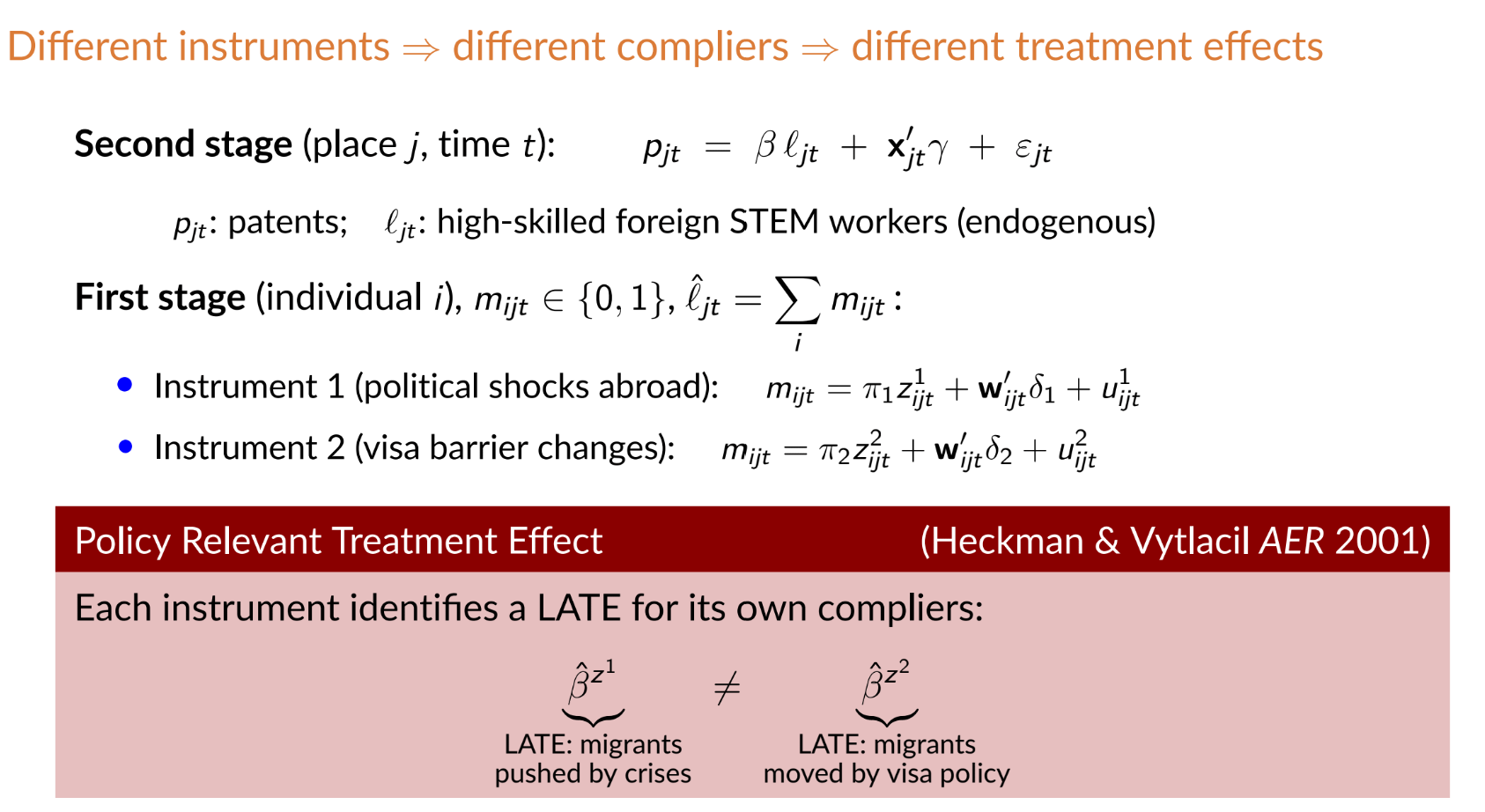
This is the simple idea that if we’re talking about, say, the effects of skilled workers on patents in some sort of second-stage regression, and we’ve got two potential instruments at the individual level — that some people are more likely to migrate because of political shocks abroad, and others are more likely to migrate because of changes in visa barriers — it is certainly possible that the composition of the migrants at the individual level i that are being caused to migrate by political shocks is completely different from the composition of the migrants that are being caused to migrate by changes in visa barriers.
Therefore the β estimate — the local average treatment effect that we’re going to get out of these two different instruments — is a different estimand. There’s no particular theoretical reason to think that those things would necessarily have the same magnitude, or even the same sign. If we’re interested in policy relevance, we need, to the extent possible, to be looking for policy experiments.
I want to highlight an example of that from my own ongoing work. This is a very striking graph on the right of the cumulative number of F-1 international student visas to come attend a university in the United States, by calendar year of recent years.
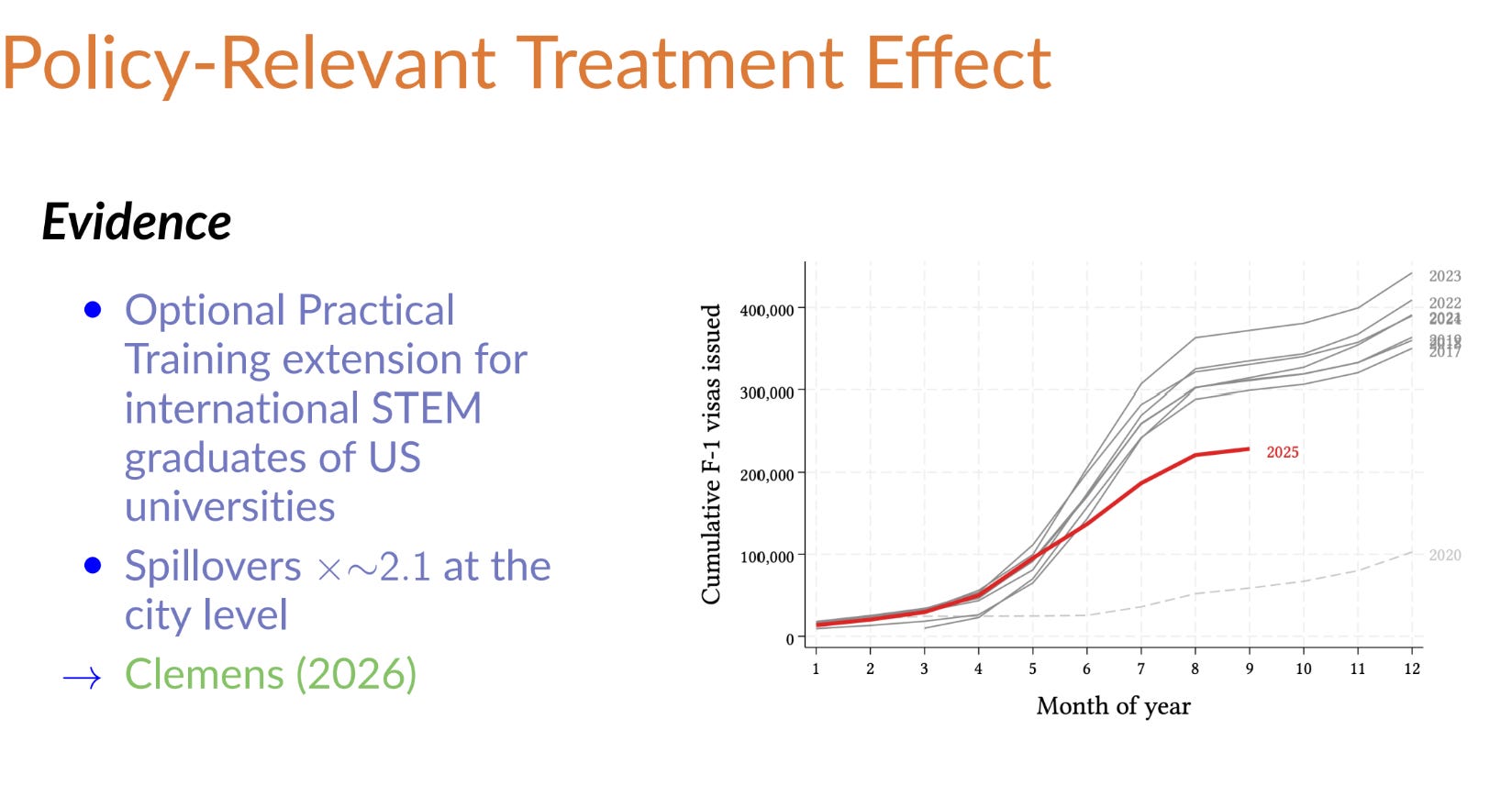
The most recent data available, believe it or not, is still September of last fall. But even up to that moment, you can see a rather drastic decline in the number of students being issued visas. Setting aside the COVID year of 2020, that’s a 32% decline for cumulative issuance as of September for 2025. I expect that gap to continue to increase. It wouldn’t be unreasonable to think that for 2025 going into 2026 we’re 40% down in international students.
I’m interested in: what is the effect of that on innovation? That’s what I’m writing a paper on now. You could think of different natural experiments to look at in the past, such as student barriers that happened after 9/11, political changes overseas that restricted students from studying in the United States, changes in Chinese policy that caused more, or fewer, or different Chinese students to come study in the United States. But the interpretation of those local average treatment effects from those natural experiments need not be the same as the effect of a policy which is currently under consideration by the White House, which is to severely restrict or even terminate optional practical training — the number one bridge between studying in the United States and staying on to work in the US labor market. It’s a temporary work permit that attaches to student visas that is now targeted for elimination.
Because I’m interested in what the effects of that policy might be, I’m specifically using a source of variation which was a large extension of that policy in 2008. Optional practical training already existed, but it was greatly extended from 12 to 29 months at first, and later on to 36 months, as the amount of time after graduation that you could stay to work at a US employer, specifically for STEM students.
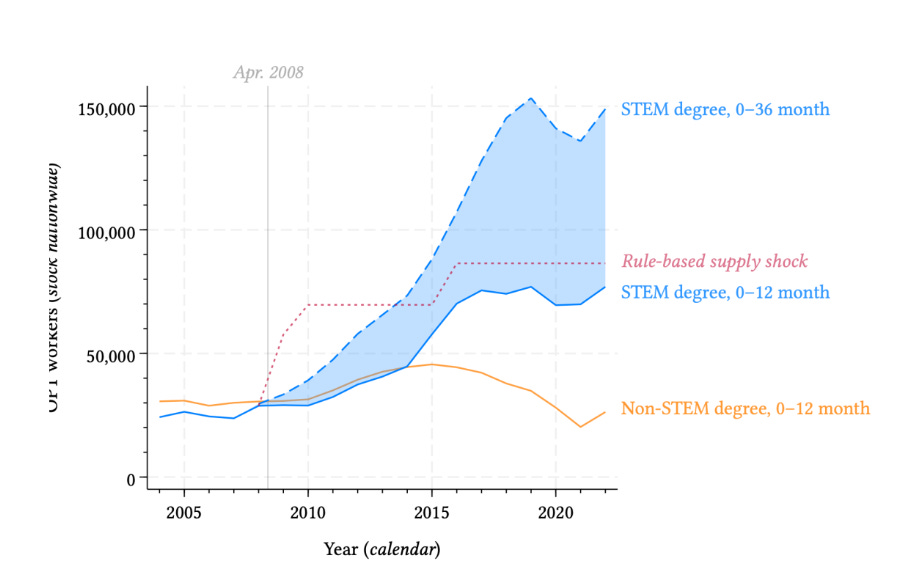
The blue shaded area in this graph is the number of people in full-universe data working on the second two years of optional practical training, which didn’t exist before 2008. It’s a substantial supply shock to the number of high-skill foreign STEM workers in the US economy. It has an exogenous component, which is the red dashed line here: if you were a firm, a city, or any other unit of analysis that was demanding the labor of STEM optional practical training workers in 2008, the red dashed line is showing the stock that you’d have if your demand didn’t change, but the stock increased simply because you are allowed to keep the people you were already demanding for a longer period.
In this sense, the national-level supply shock is exogenous to any post-2008 changes in demand, and can be used to make an interesting shift-share instrument where the national share isn’t the total inflow. It’s a kind of Maimonides rule, a policy rule determining the national supply shock. But the key thing I want to communicate about this paper is that I’m interested in the policy-relevant treatment effect. For that reason, I insist on the source of exogenous variation in supply of high-skill foreign STEM workers being itself a supply shock.
Research frontiers
I want to point out some frontiers where I think there’s not enough research at all.

A big theme in recent research that we’ve had — all of which is fantastic, and I’m not throwing anybody under the bus here; there are always more brilliant contributions to make — a big theme of modern critiques of what has come before, and attempts to expand on those, has been making the bridge between micro and macro. That is, taking studies that have established links between immigration and innovation in various forms — patents for horizontal innovation, entrepreneurship for vertical innovation — that are at the level of firms or at the level of metropolitan areas, and aggregating those effects to the national level. To what extent can we take city-level effects on patenting, for example, and argue that those measure changes in national-level patenting, and not simply a reallocation of resources across cities within a nation? That’s an area where Emi Nakamura and others have given us a lot of tools recently, and they have not been applied as much as they should have in this literature.
And not just the link between local areas and national effects for patenting or entrepreneurship, but the next step, from patenting and entrepreneurship and other of the constituents of productivity to overall changes in productivity. That’s something that Marta Prato explicitly does in her paper. It’s something that Doug Elmendorf et al. have done: they have used Marta’s results to argue for implications in terms of future economic growth and fiscal contributions caused by inflows of high-skill foreign STEM workers.
But we need a whole lot more work in this area, because it’s very important for, for example, the Congressional Budget Office, which needs to know: what will the effects on economic growth and productivity and our fiscal situation be due to current changes in US immigration policy? It’s crucial for them to know what will be the effects at the national level — not just on patenting and entrepreneurship, but the bottom-line effect on overall productivity, so that they can understand what the effects on the fiscus will be. We have a handful of studies; we need a whole lot more.
A second genre: I didn’t mean these three orthogonal dimensions of innovation — horizontal, vertical, and directed — to be an exhaustive catalog of all forms of innovation. I’m sure you’ve heard about other useful conceptions of how innovation can be thought of in economics, from Chad Jones and others. I want to point out that I’ve talked about those three types of innovation because they’ve been important in the literature, not because they comprise all ways that you could conceptualize innovation. A big missing one is innovation that actually changes the elasticity of substitution between capital and labor. That takes us from a production function combining a truck and a driver to a production function that is just the truck, and has no driver.
That innovation acts on one specific aspect of the flat-earth production function that you saw, which is actually changing the fundamental substitutability of capital and labor. In a lot of economics papers, and almost all of the ones in the literature that you’ve seen today, that substitutability is something which is seen as immutable. Coffee and cream are complements to each other. Coffee and tea are substitutes for each other. There’s no amount of innovation in terms of better creams or coffee that is going to make coffee and cream substitutes for each other. There’s something inherent about that relationship that makes them complements rather than substitutes.
What we’re seeing now is technical change of a different variety, which is fundamentally altering the substitutability of capital and labor. That’s going to be a research frontier, certainly in this area, because immigrants are contributing to technical change that is changing σ at the moment. I think not enough immigration economists have thought about in theory, or considered empirically, what that will mean for the effects of immigration now and in the future.
A last theme that I want to highlight is the interaction of innovation and migration policy. An implication of Daron’s models is that the arrival of new immigrants, a positive shock to labor supply, tends to benefit workers through directed technical change, whether that is targeted at capital or at labor. His models also have the opposite implication, which is that immigration restrictions tend to hurt labor by causing labor-displacing technical advance. Not just that, labor-displacing technical advance that arrives exogenously tends to make labor worse off, and for that reason would make labor more and more concerned about immigration, and about any increase in the labor supply that would tend to reduce the marginal product of labor even further. There’s a kind of cyclical relationship between immigration restrictions and labor-displacing technical advance that might become more and more important in the future.
Daron talks about this explicitly in a 2023 paper. Lant Pritchett has been, for many years — since a 2006 book he wrote — one of the leading big thinkers about this specific issue. There hasn’t been a lot of work, even in theory, but definitely not empirical, in this area: the degree to which immigration restrictions by themselves could alter the course of technical advance.
Daron has argued that the direction of technical change, whether it’s going to be labor-displacing or labor-augmenting, is in large part a decision. It is an effect of policy. It’s not something that’s just going to arrive exogenously. I think that there has not been enough thought in the research literature, and certainly almost absent from the policy realm, about the ways in which immigration restriction decisions that we’re making now, both for high- and low-skill workers, could themselves shape the direction of technical advance in the future, affecting all workers.
