


When I worked in international science at the U.S. Agency for International Development (RIP), I found Ina Ganguli’s work on talent and mobility exceedingly useful.1 So it was so exciting to have Ina join us to talk about the supply of innovators. One of the issues she discusses, which relates both to my previous work and to IFP’s high-skilled immigration practice, is historical evidence about the impact of a country losing some of its best scientists. She discussed a paper I really like by Fabian Waldinger which uses data from World War II to compare the impact of losing Jewish faculty members to infrastructure destroyed in bombings. Here’s what Ina said in her lecture:
He (Waldinger) estimates the effect of shocks to human and physical capital during World War II. He can look at random destruction in physical capital — university buildings in Germany — and at departments that lost star scientists. He uses the dismissal of Jewish scientists in Nazi Germany between 1933 and 1944 as the shock to human capital. He attributes about a 33% decline in publications, at the department level [to dismissals]. He contrasts that with the destruction of universities during the Allied bombing campaign...He’s able to use this as an exogenous shock — some departments were affected by these bombings and some weren’t…What’s striking about it is that the decline in publications is much larger relative to the decline due to the physical capital. He has this quote: “The dismissal of scientists in Nazi Germany contributed about nine times more to the decline of German science than physical destruction during World War II.”
On one level this might seem obvious — buildings don’t write academic papers; scientists do. But we might expect that access to working labs would be necessary for scientists to produce research (especially before the advent of personal computers and the internet). And it is important, but not nearly as crucial as having talented colleagues.
Good science (depends on) the friends we make along the way.
Here are the readings that go with this lecture:
Agarwal, R. and P. Gaule. Invisible geniuses: Could the knowledge frontier advance faster? American Economic Review: Insights, 2(4) (2020): 409-24.
Bell, Alexander M., Raj Chetty, Xavier Jaravel, Neviana Petkova, and John Van Reenen. Who Becomes an Inventor in America? The Importance of Exposure to Innovation. Quarterly Journal of Economics, 134(2) (2019): 647-713.
Ganguli, I., P. Gaulé, and D.V. Čugalj. Chasing the academic dream: Biased beliefs and scientific labor markets. Journal of Economic Behavior & Organization, 202 (2022): 17-33.
Waldinger, Fabian. Bombs, Brains, and Science: The Role of Human and Physical Capital for the Production of Scientific Knowledge. The Review of Economics and Statistics, vol. 98, no. 5 (2016): 811-831.
Thanks to William Higbie and Harry Fletcher-Wood for their support in producing this video and the transcript.
Lecture Transcript:
The Supply of Innovators
My name is Ina Ganguli. I’m a professor in the economics department and the management department at the University of Massachusetts Amherst. I was trained as a labor economist, then I got into the economics of science and innovation — my research is at the intersection of those two fields.
I’m going to talk about what I call “the supply of innovators” and knowledge production, which is at that intersection. I’ll tie it back to things that Ben and Chad talked about — going from the macro to looking very micro at the decisions that people make. Then I’ll take you back to the early days of what labor economists who worked on these topics were thinking about, going through some models and conceptual approaches. I broadly call it “earnings” and “entry into science.” We’ll go through several models and some of the empirical evidence. I’ll talk about:
Cobweb models,
Compensating differentials. One of the papers that I’ll cover looks at how much scientists pay to do science. There’s a well-known Scott Stern paper.
The Roy model, which is a way to think about selection: who self-selects into the innovative sector.
Then, getting into the broader labor economics literature, what have we started to look at in this area of the economics of innovation: biased beliefs, exposure to science, diversity and the economics of talent.
John van Reenen will talk about this too, but there’s this literature on the lost Einsteins that’s gotten to be quite popular recently — looking at what happens to talent that isn’t nurtured.
We’re going from the macro: thinking about endogenous growth models and how knowledge is produced. Those of us who work in this area on labor and innovation think very micro: what are the choices that individual people make?
Here we think of a simple Romer-type model.
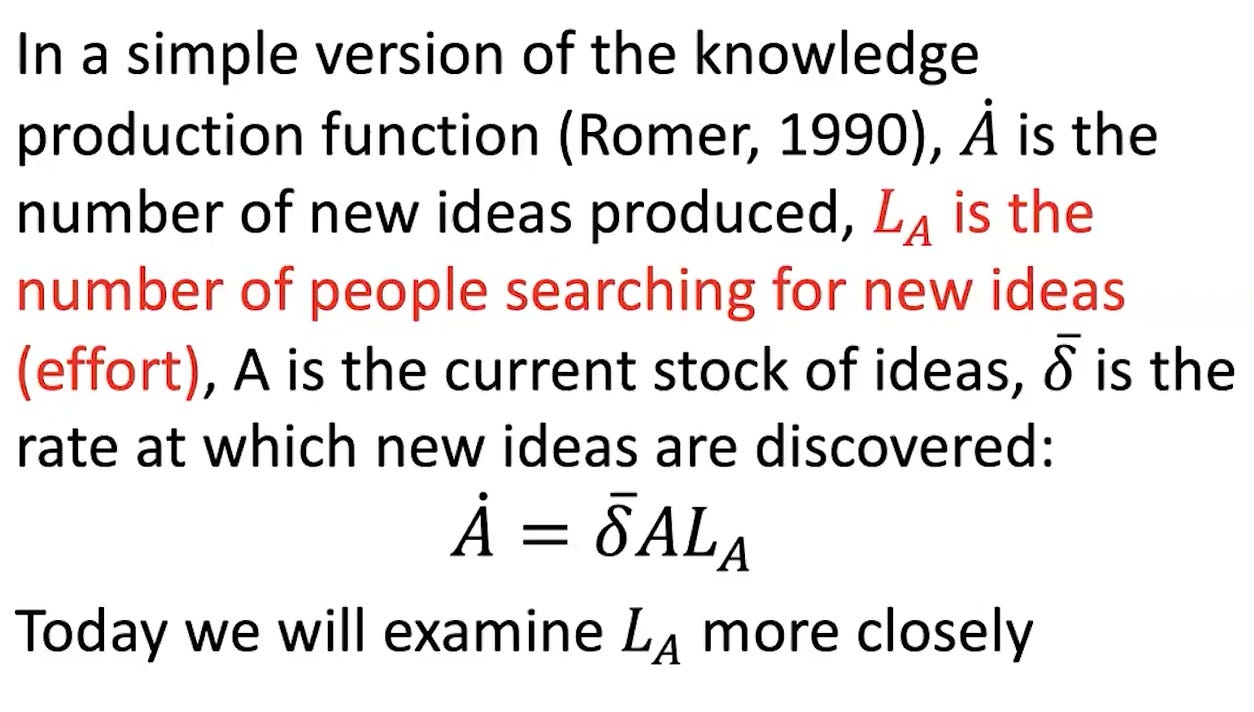
LA is the number of people searching for new ideas. If we’re going to have ideas produced, you’re going to have people who are searching for them. Things are changing now — we can think about AI replacing those people. But back to the basic model: we have LA, and if you increase LA — the number of people — then you will get more ideas produced. We’re going to examine LA. Who’s in it? The number of people.
If we think about how to measure that — who is it that’s searching for new ideas? — there are different ways you can think about it.
People who work a lot with patent data will look at inventors: people who have invented an idea that’s been patented, conditional on patenting.
A lot of my research — the research of those of us who work on scientists — will use publication data and then back out scientists from that.
This is data from different sources — an estimated number of researchers across countries.
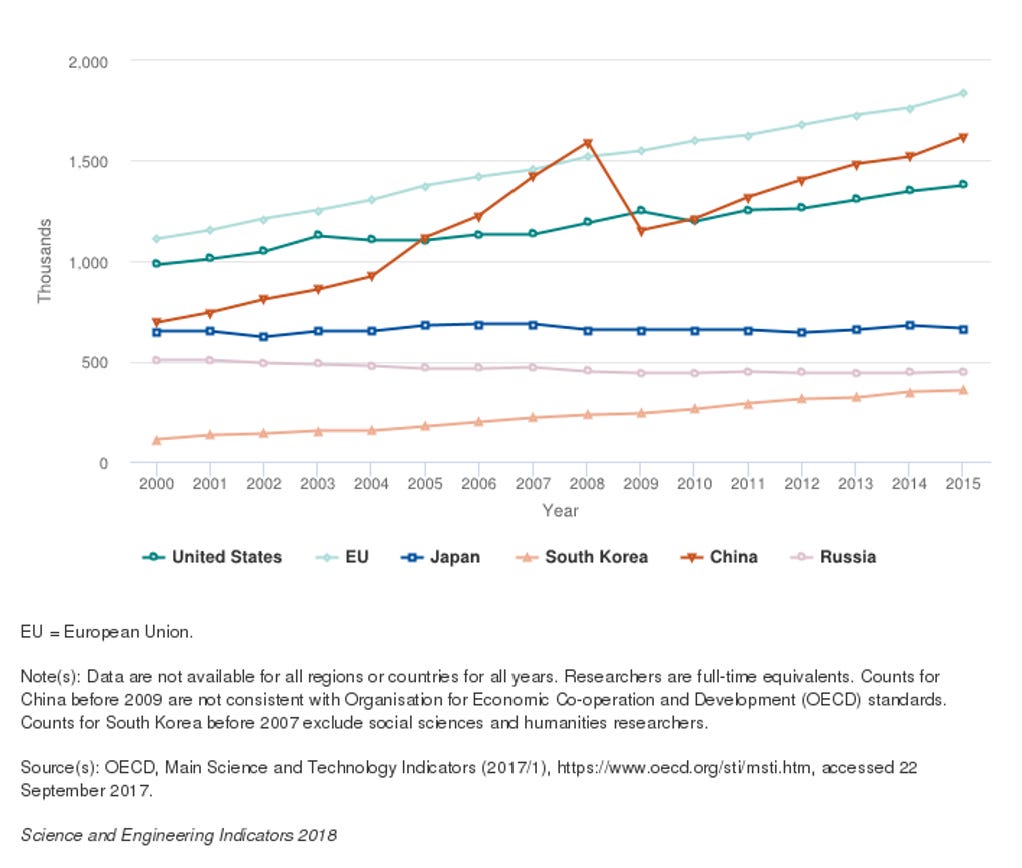
You can see that in most countries it’s increasing. I’m not going to have time to show a lot of data, but I’ve done some work recently with Megan MacGarvie where we’ve looked at international students studying in the US and trends from different countries. There’s work showing that maybe these researchers haven’t been that productive: the number of researchers is going up, but whether they’re actually producing as many new ideas is something that people have been looking at. Right now in the US — but I think in other countries too — this topic is very policy relevant. There’s a lot of focus on what’s happening to the scientific workforce.
There was a recent Science article talking about different aspects of the Trump administration’s agenda and that it’s likely to reshape the scientific workforce. Why is that? What kind of policies are we talking about?
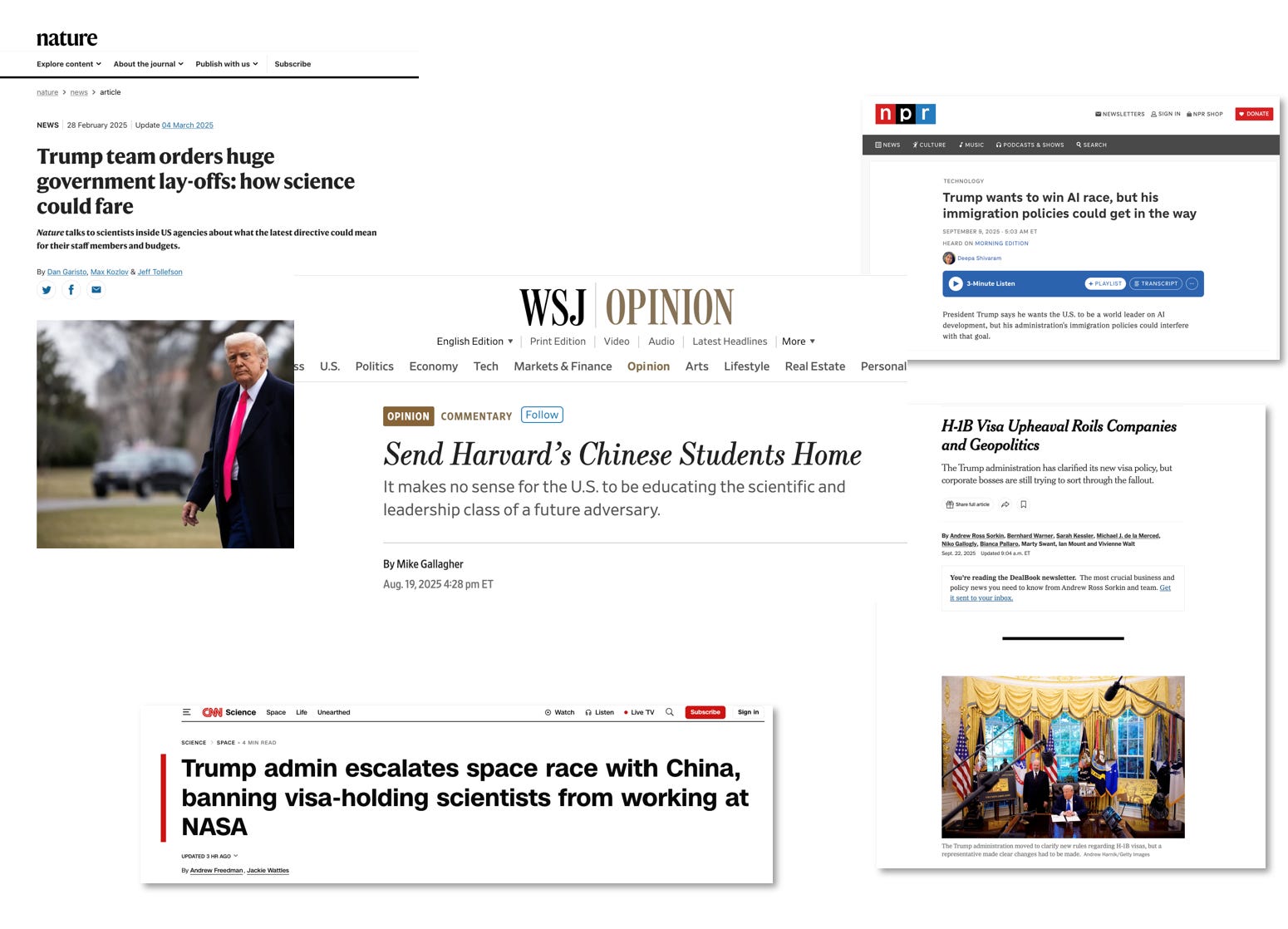
Immigration: restricting immigration from certain countries, or making it more costly to get an H-1B visa — which is what you get if you’re coming as a high-skilled worker to work in a company. Now that’s expanding to universities. Michael Clemens will talk much more about that.
There’s also government scientists — there have been a lot of reductions in the government scientific workforce. There’s funding that has been reduced, and so fewer students can be hired to be graduate students. There’s a lot going on right now. I will say, as someone who works on these topics, in the last year I’ve had a lot of journalists come and ask me: “What’s the evidence? Will there be a brain drain? What will the impacts be on US science?” Those of you who are interested in this topic, it’s an important time to be working on it, and I hope some of you will think about getting into these issues.
If we’re thinking about the different inputs into the knowledge production function, there’s human capital, but also physical capital — the lab equipment. We can think about computers, AI potentially: how do we think about that — is it human or not? Here I want to think about the people. How important are the people?
I really like this paper by Fabian Waldinger. He’s done a lot of great work on World War II and science, and in particular the emigration of Jewish scientists from Germany. This paper focuses on this question of human versus physical capital. It’s a motivating piece of evidence for me when I do my work on the decisions that scientists make.
He estimates the effect of shocks to human and physical capital during World War II. He can look at random destruction in physical capital — university buildings in Germany — and at departments that lost star scientists. He uses the dismissal of Jewish scientists in Nazi Germany between 1933 and 1944 as the shock to human capital. He attributes about a 33% decline in publications, at the department level [to this]. He contrasts that with the destruction of universities during the Allied bombing campaign of World War II. He’s able to use this as an exogenous shock — some departments were affected by these bombings and some weren’t. That’s the physical capital shock. What’s striking about it is that the decline in publications is much larger relative to the decline due to the physical capital. He has this quote: “The dismissal of scientists in Nazi Germany contributed about nine times more to the decline of German science than physical destruction during World War II.”
I’ve done a little work recently with Ukrainian researchers, looking at the impacts of the full-scale invasion of Russia in Ukraine. They’re really worried about brain drain — scientists leaving — and just measuring that. There’s this idea that yes, there’s a lot of destruction and horrible bombings, but some of the scientists say that if we can build it back, it actually can be built back better — better labs and equipment. You can build back labs pretty quickly if you have the resources, but it’s really hard to bring back the people who have left. That’s one of the takeaways from Fabian’s work.
This is a little bit small here, but this is one of the tables.
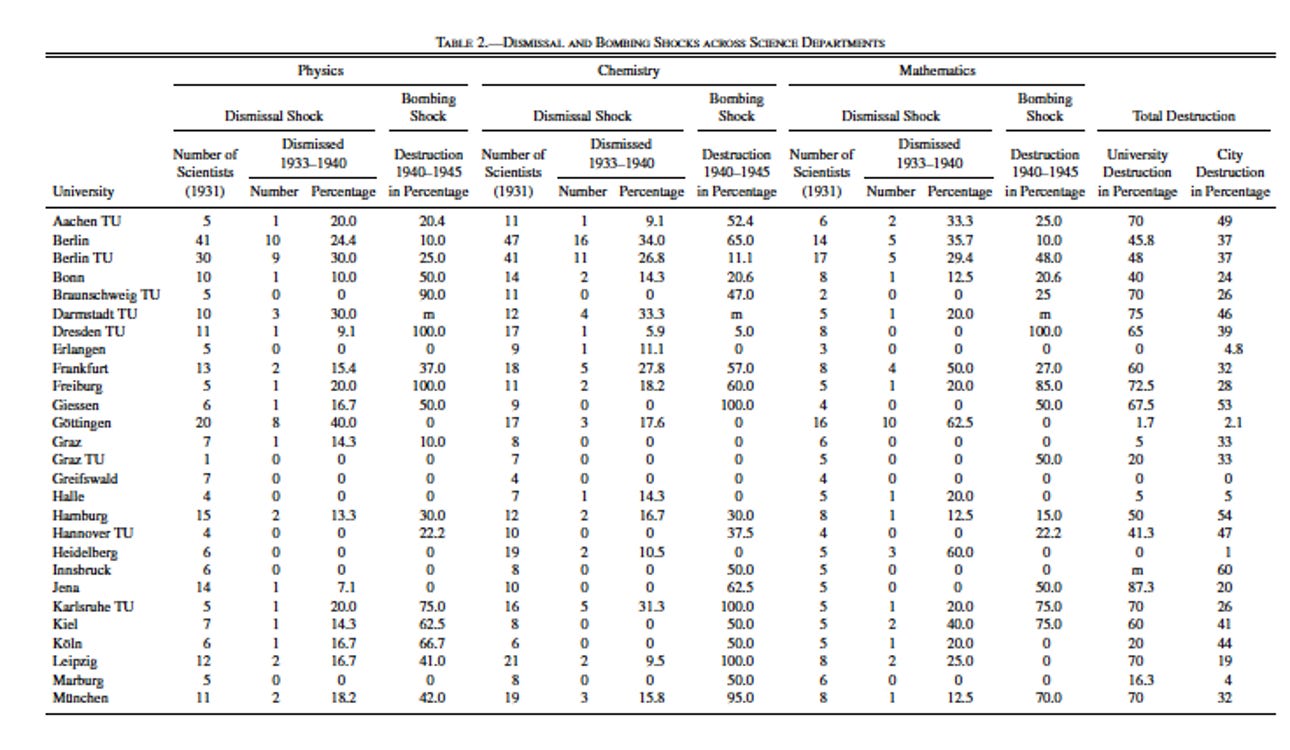
You can see that he’s got the data on universities. There’s this variation in the intensity of how many Jewish scientists left during this time. Destruction is the bombing. He has these dismissal shocks and bombing shocks, and he looks at them by field, and that’s where he’s able to back out his estimates.
One thing then to think about, when I was talking about how to measure who is an innovator — who belongs in LA — is what it means to be an innovation worker versus a production worker. That’s really the question for today: what are the factors that shape who is part of the supply of innovators?
Everyone listening either has a PhD or is doing a PhD. As you know, it’s a long process to actually get to the frontier. That’s a specific feature of this group of workers: they need to bring themselves to the frontier before they can be productive. This idea of the gestation period — it’s long, and it’s getting longer. Ben talked about his “burden of knowledge” work [in Lecture 1] — it takes a long time to get the knowledge and resources to be able to be at the frontier.
A few other features: job prospects at the time of graduation are difficult to predict in advance, because when you enter the labor market, that’s many years into the future. If we think about models that economists use where people compare expected salaries in different jobs when choosing what to study, it’s actually hard at the time you make your decision to predict that. I’ll talk about this idea of biased beliefs, and the fact that people often don’t have reliable information about job outcomes of recent grads.
Pierre will probably talk more about this, but if you’ve read much Merton, about norms in science and what motivates scientists — it may be that scientists love the subject. As economists, how do we think about those motives for doing science that are not extrinsic? Merton talks about ribbon, gold, and puzzle as things that motivate scientists. There are things that, when you’re studying this group, may be different than other models that economists have.
This is a great segue into who selects into the idea sector. The idea sector is very heterogeneous: what people are doing is going to differ. But here we’re going to think about the fact that you need to have some skill, to specialize, and to reach the frontier. Some of the questions are:
Do institutions provide the right incentives for the right people to work on innovations?
What kind of policies and shocks stimulate entry into STEM careers?
Who is in the pipeline that produces innovation?
Are there barriers limiting diversity?
I took this from Pierre — this was his image of someone who I think we all recognize.
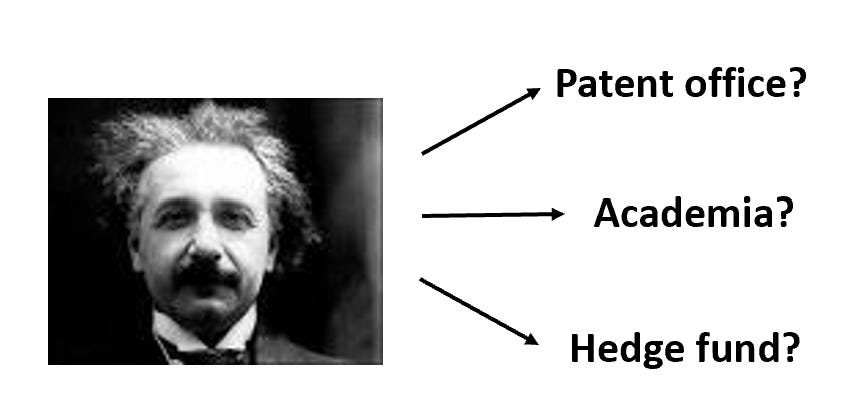
If we think about Einstein, we all know he worked in the patent office early on. What if he didn’t choose to go into academia? Today, if you look at some undergrads with quantitative skills, maybe they’re going into private equity or hedge funds. What about that? As a society, what would we want? I’m guessing most of us would probably agree we want Einstein to go into academia. But what if he didn’t choose it, or what if he actually wanted to just earn a lot of money? These get into interesting questions.

There are so many headlines, but in this time right now we have a lot of scientists — innovators — who have now left the government. What is going to happen to that pipeline in the US is a topic that’s really important.
With AI, there’s also the question about the computer science labor market and the role of AI.
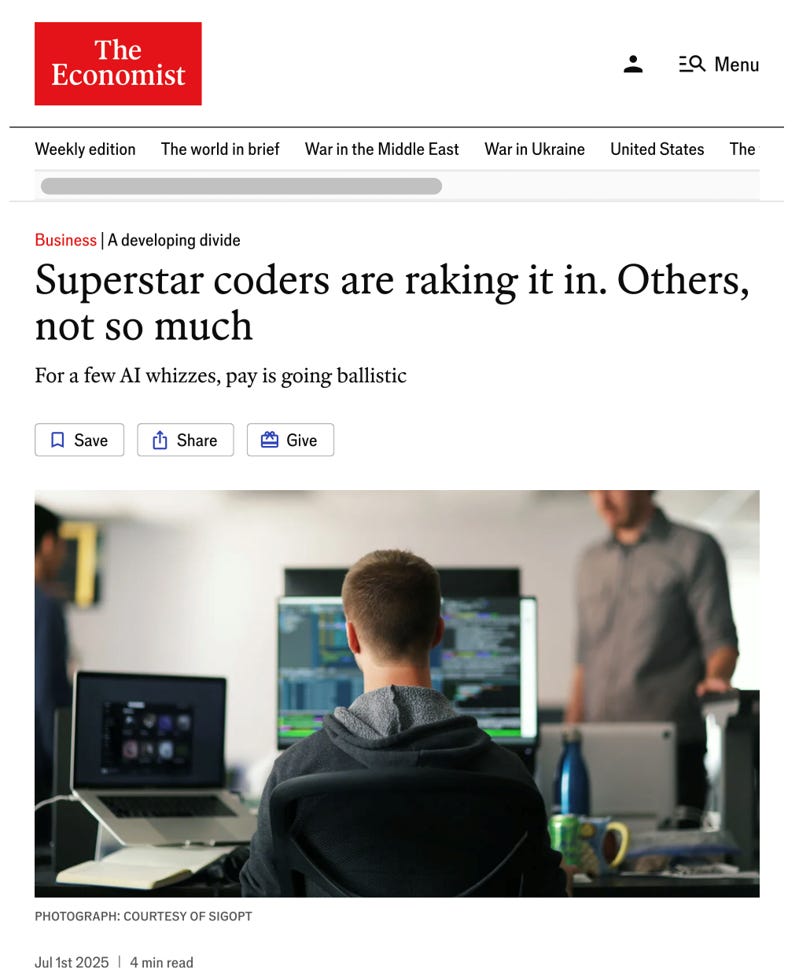
In the last year or two, things have changed a lot, and so there’s a lot to think about in this topic.
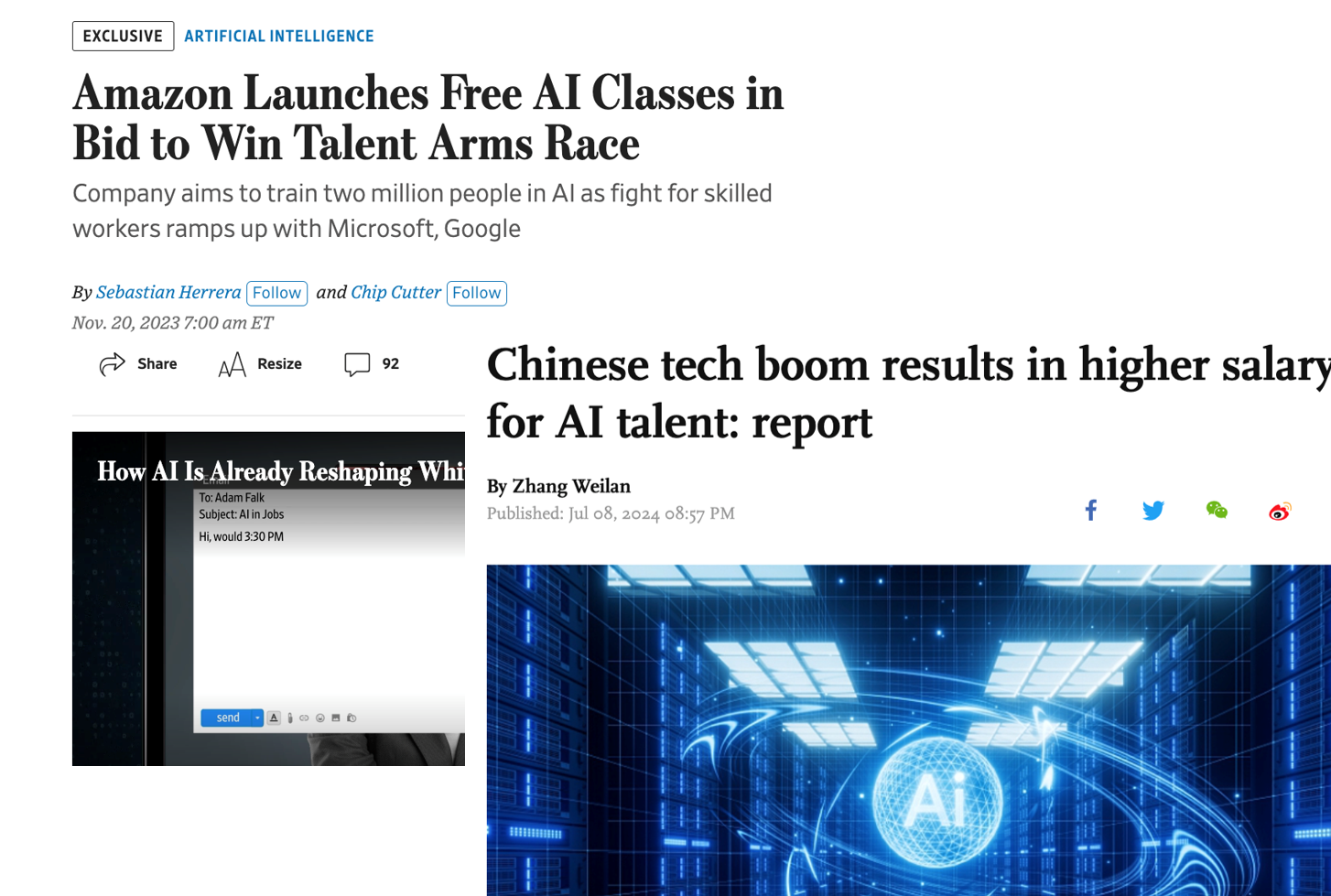
The role of China: I won’t get to talk about international mobility today, but this is a big topic — where is the talent going to go? The US used to be more or less the top destination for international students and scientists, but that’s changing as where the science is being done is changing.
This is a very interesting graph that I’m hoping someone will work on to try to understand the causal factors.
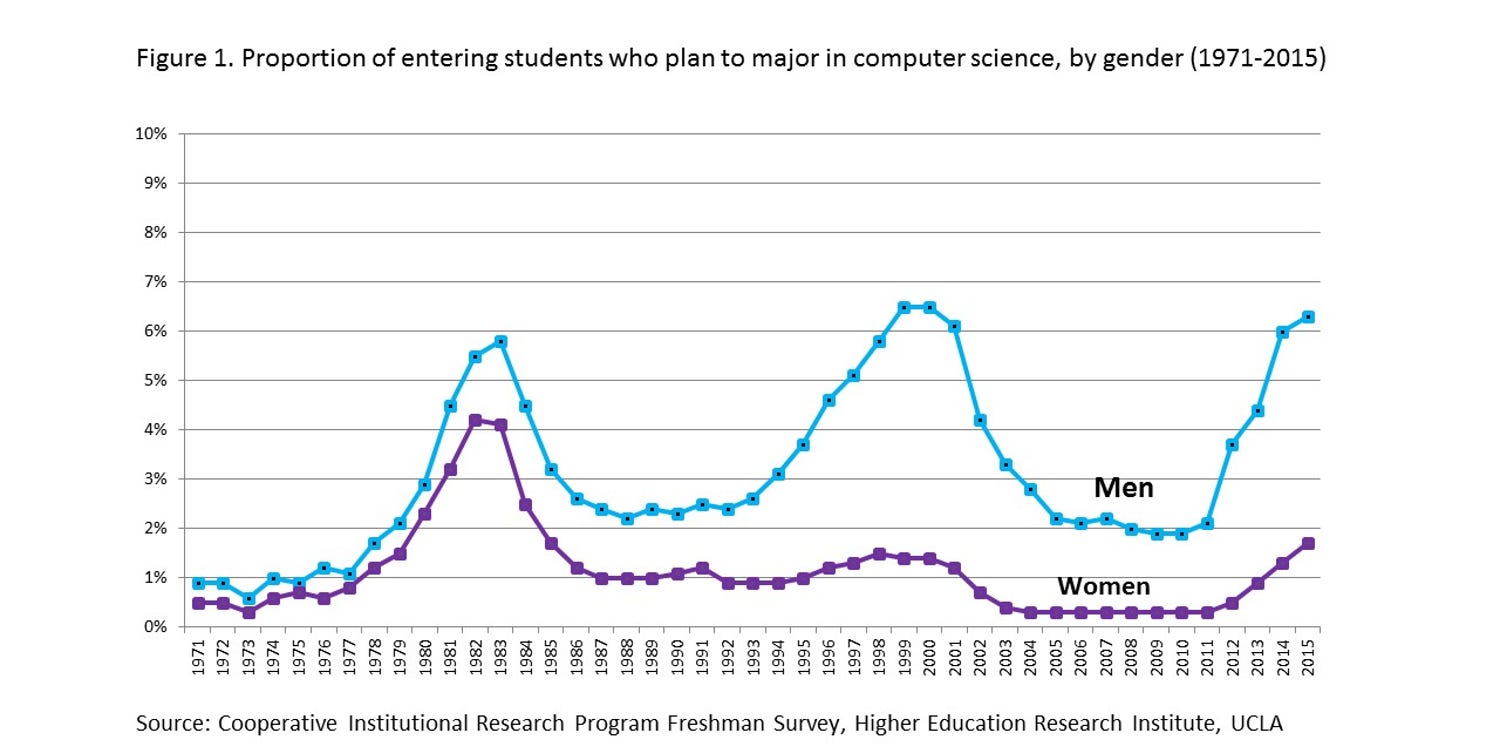
This is the share of students who plan to major in computer science by gender, from 1970 to 2015. What people always talk about is that there’s pretty much parity around the ‘80s — this is from a survey of freshmen. What you can see is that it then spreads out, and even today there’s been a bit of an uptick, but for a while there were very few women compared to men.
I’ve heard some hypotheses that it was because parents bought their sons personal computers, so when they got to college in the ‘80s they were ready to go anyway. It’s interesting, all the different factors that can play a role in who ends up being in that pipeline.
Cobweb models
I want to get into the first model: cobweb models. This is Richard Freeman, who was my adviser.
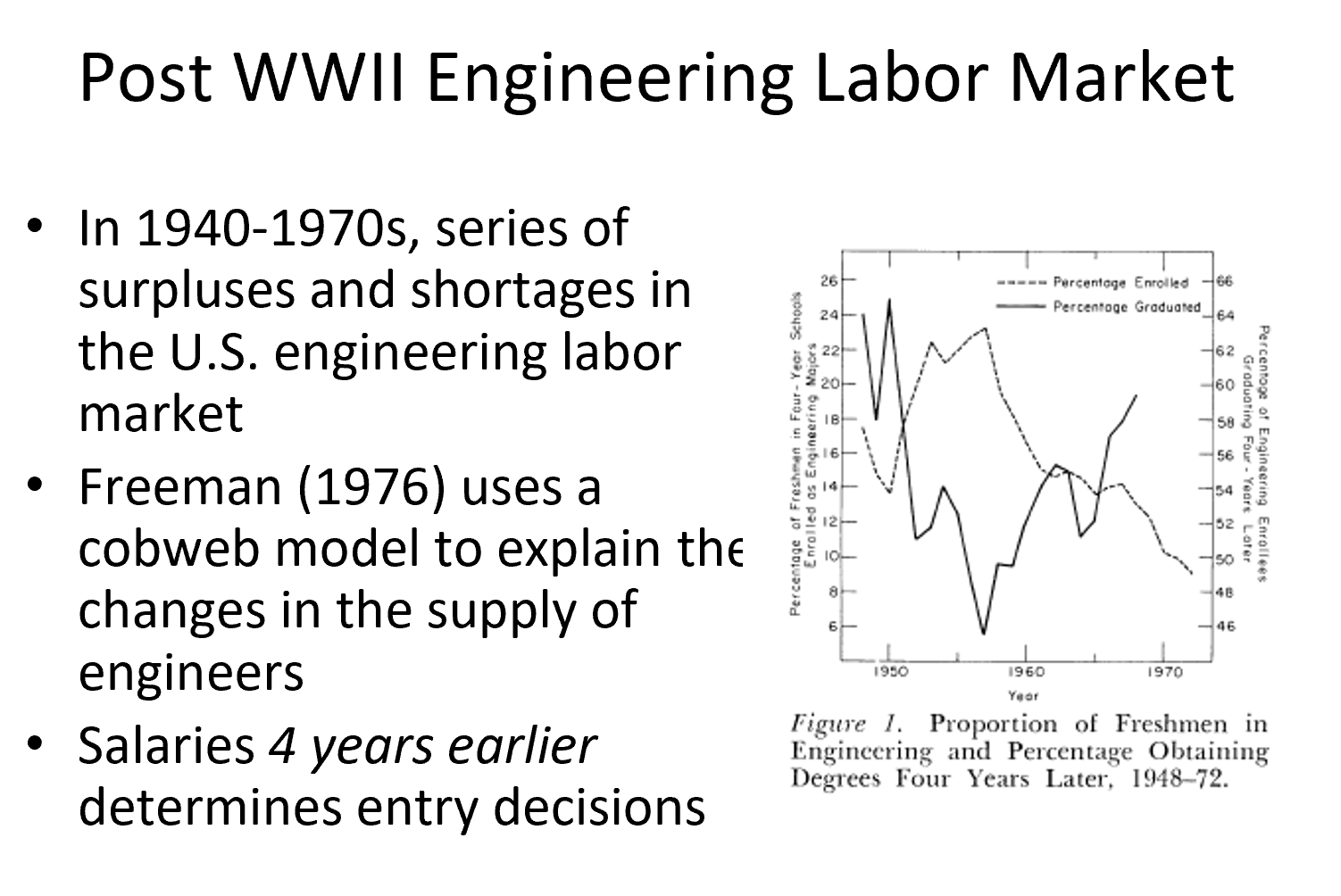
He’s a labor economist, but one of the topics that he worked on in the ‘70s is looking at the US engineering labor market. This is the post-war period. He was looking at some data — Richard is really great about understanding the data and looking at the big picture trends. Sometimes we’re so interested in the causal questions that we look very narrowly. He had been looking at freshmen in engineering majors and noticed this interesting trend of the share who were enrolling versus the share graduating. What he noticed with this pattern was an interesting feature, for which he developed the cobweb model. It’s a very simple way of thinking about the labor market, but there are some aspects that can be useful when we think about what’s going on, even today.
What he recognized is that salaries four years earlier determine entry decisions. People in this engineering labor market would look at what the salaries of engineers are and then decide, “Engineers earn a lot of money. I’m going to be an engineering major.” But by the time they graduate, the labor market conditions have changed. This is very relevant now. I don’t know how many of you have talked to people in computer science departments, but even here at UMass there have been some big changes in enrollment of undergrads in computer science, because the labor market is not very good if you’re just graduating with a computer science degree.
This was from The Economist not too long ago, where they have job postings — job openings for software developers — and you can see there’s been a decline very recently.
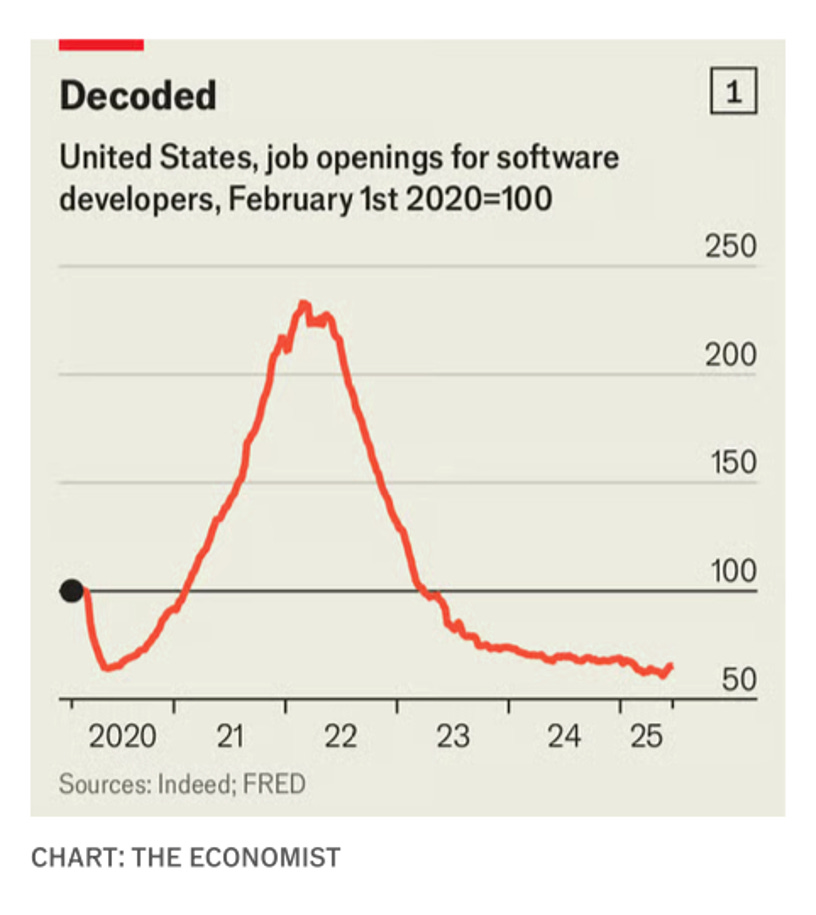
At some point a few years ago it was, “Computer science majors are earning a lot, this is a hot field,” and then things changed.
That’s the basic idea with the cobweb model: that labor markets don’t adjust quickly to shifts in supply and demand. There are two assumptions that are needed:
Time is needed to produce skilled workers. You need some time to be an engineer or be someone who’s working on AI — not working with it, but developing the AI models.
People decide to become skilled workers by looking at conditions in the labor market at the time that they enter school.
What happens is that a “cobweb” pattern forms around the equilibrium, which arises when people are misinformed. It’s really this idea of misinformation, which is a thread that runs through most of the concepts we’ll talk about today. If we look at most models, we assume that people have information about the labor market — so what happens when you don’t have that?
You might have seen this in an undergraduate labor course.
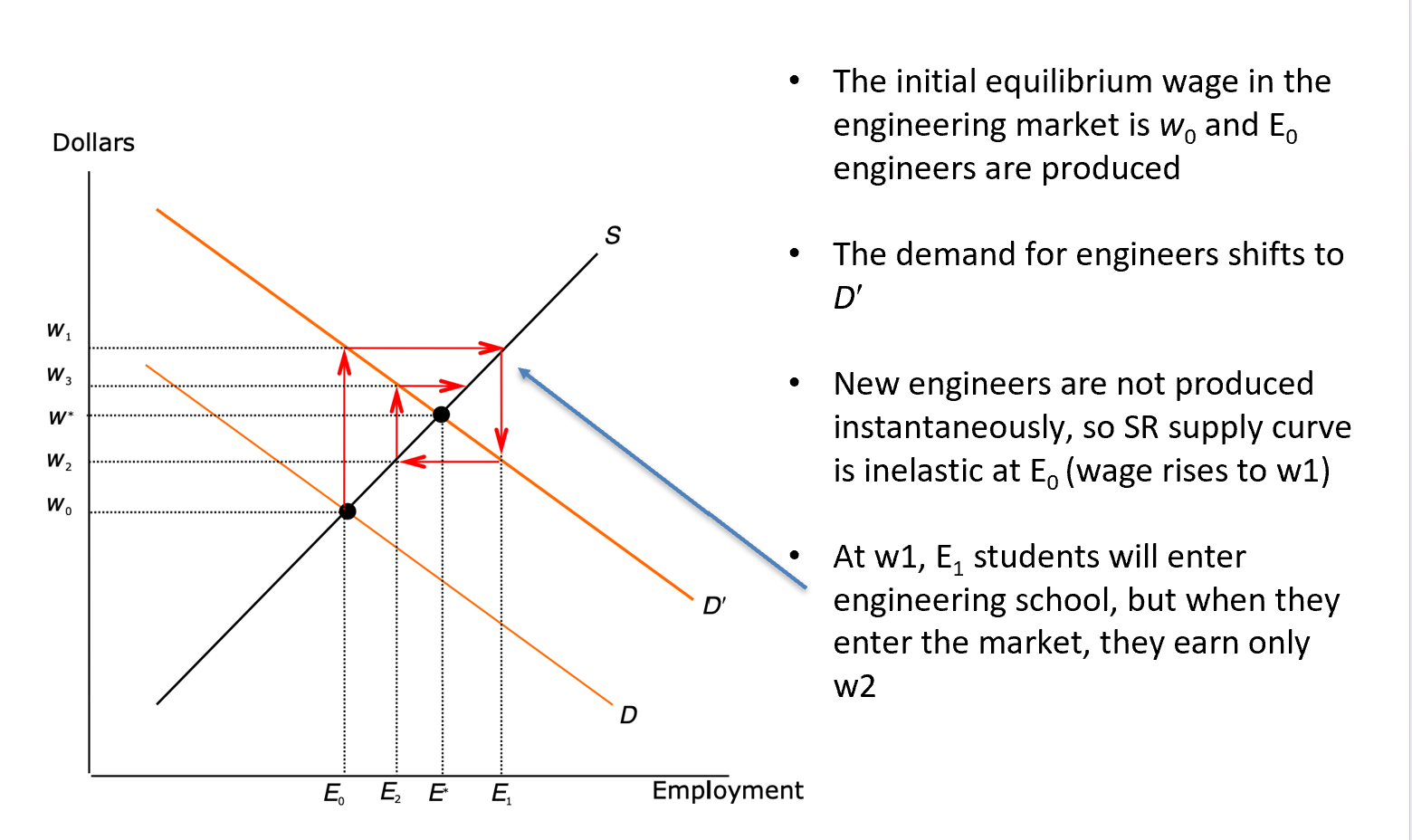
The basic idea is that you start at some equilibrium employment and wage. Then you have some demand shock. Let’s say for AI specialists there was increased demand. That’s going to shift your demand curve out. In the short run you’re going to have an increase in the wage. With the demand shock, you go up to W1. But in the short run there’s a limited supply of, in this case, engineers — they aren’t produced immediately — so you have this inelastic short-run supply curve. Students are going to see that you have this higher wage, so you’ll have more students enter. But when they enter the market they’re only going to earn this lower W2 wage. This continues for a while, and you get this cobweb pattern.
The big picture is that in the long run, that initial demand shock would lead to a higher equilibrium wage and employment, but it’s a series of booms and busts that get you eventually to that point. As students thinking about what you’re going to major in — there’s a whole literature on biased beliefs; that students often don’t even know what salaries are in different fields — but even if they did, that’s current. How can you predict what it’s going to be in the future? This is an older model, a pretty simple way of thinking about the labor market, but there are some useful features for those of you who are thinking about these topics.
Compensating differentials
I’m going to talk very briefly about compensating differentials, because Pierre will talk about this paper more. In the labor economics literature there’s been a lot of interest in this — there have been new papers in the last few years trying to understand what workers value in a job. You get your wage, but you may actually be willing to take a lower wage if there are some characteristics of the job that you value.
Going back to Adam Smith, it’s the advantages and disadvantages of the job that have to be equated across jobs. The original way of thinking about it is that if you have a firm with unpleasant working conditions — say very manual work, or very hot on the job — then those jobs should pay workers more. Jobs that offer more pleasant conditions could offer workers less, because workers are willing to give up some of their pay for the pleasantness.
There’s a whole literature on how you can estimate that price for these non-wage characteristics. It’s challenging, because if we just go to a data set — say one that shows what workers earn and the features of their job — you would actually tend to find that the more pleasant jobs are paid more, because there’s a whole bunch of things, like education, that are correlated with the kinds of jobs that people are getting.
There have been experimental approaches to try to measure this. I went from Richard to Scott Stern, who in 2004 wrote this paper, “Do scientists pay to do science?” It was an exciting paper because it was one of the first that came up with this quasi-experimental approach to measure this trade-off. He’s measuring this wage-versus-science trade-off. This goes back to what we’re talking about with Merton: that there are things that scientists value. Going back to the discussion earlier about who innovators are — in this case we’re thinking about scientists, who might have very particular preferences for doing science, or for having autonomy in what they’re going to research.
Stern’s method was a survey of postdocs in biology — within one field — and he was able to ask them about their different job offers, the wages, and the amenities. He had this data set that had a very small sample size — 66 individuals and 164 offers. Today you probably couldn’t get away with such a small sample, but at the time it was really exciting, because he could look at one individual, look at the different offers that they had, and estimate what’s called willingness to pay.
Once you put in individual fixed effects — you account for these unobserved individual differences — he estimates a willingness to pay of 20-25% lower wage to be able to do their own research. Why is this important? One of the questions that people are often interested in is who wants to go into industry versus academia? He was able to show that people really value being able to do research — if the firm permits publication, they’re willing to take a lower salary. It gets into this idea of what motivates scientists.
This was one of the regression tables.
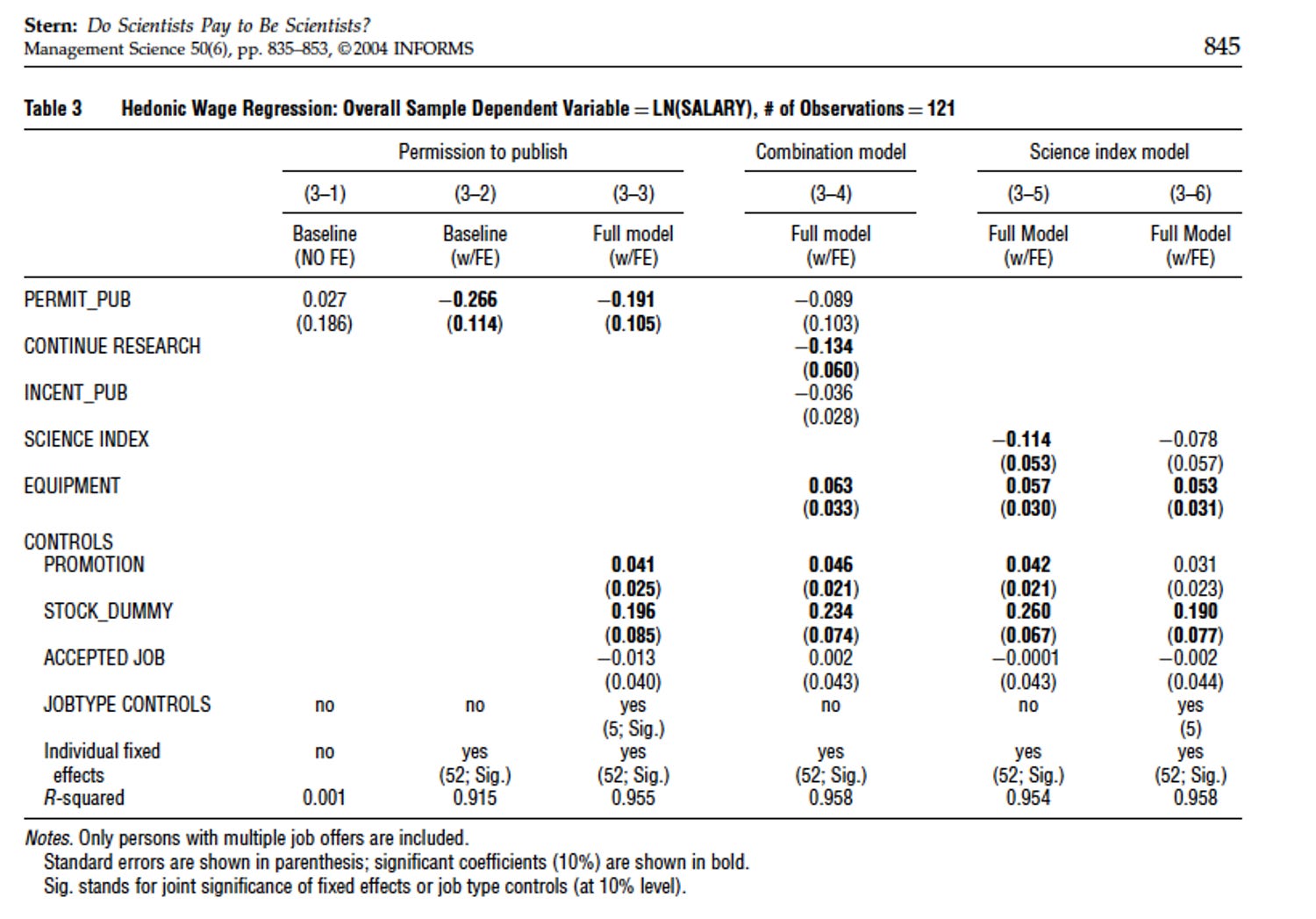
He has self-reported salary. There have been recent studies — not with scientists, but in the labor literature — where they were able to randomize job offers and salaries. Obviously the world is different in terms of what would be evidenced in this space, but this was a very important paper in terms of the approach.
Earnings & Entrance into Science: the Roy model
I don’t know how many of you are familiar with the Roy model. If you’ve taken a labor class, then you will have been exposed. Thinking back to industry versus academia, or finance versus biology, the question we’re thinking about is how workers sort themselves across different sectors. You could also think about the idea sector versus management, or whatever you’re going to choose to work in.
It’s always interesting to go back to the paper. It was all words, no equations. This is the first page of Roy.
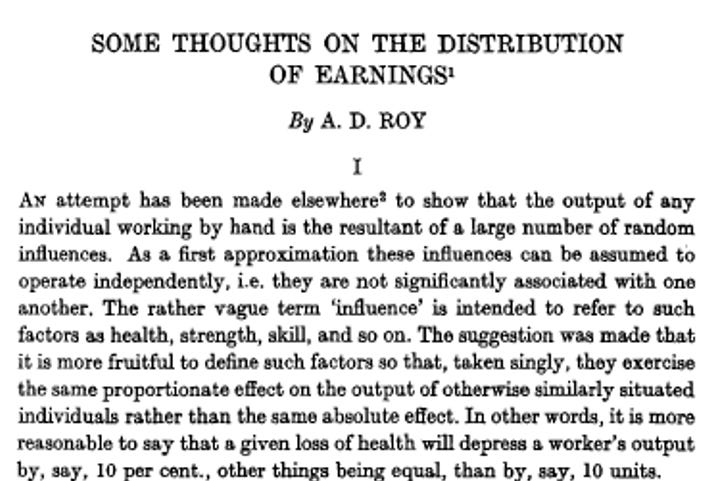
The original Roy was actually about workers choosing between hunting or fishing. You might have seen the Roy model used a lot in the immigration literature, thinking about who chooses to immigrate to different places, or not. Borjas 1986 is the reference that people often use. He essentially took Roy and wrote down the equations, so that you could have the mathematical setup to look at selection.
Here’s a very simple version.
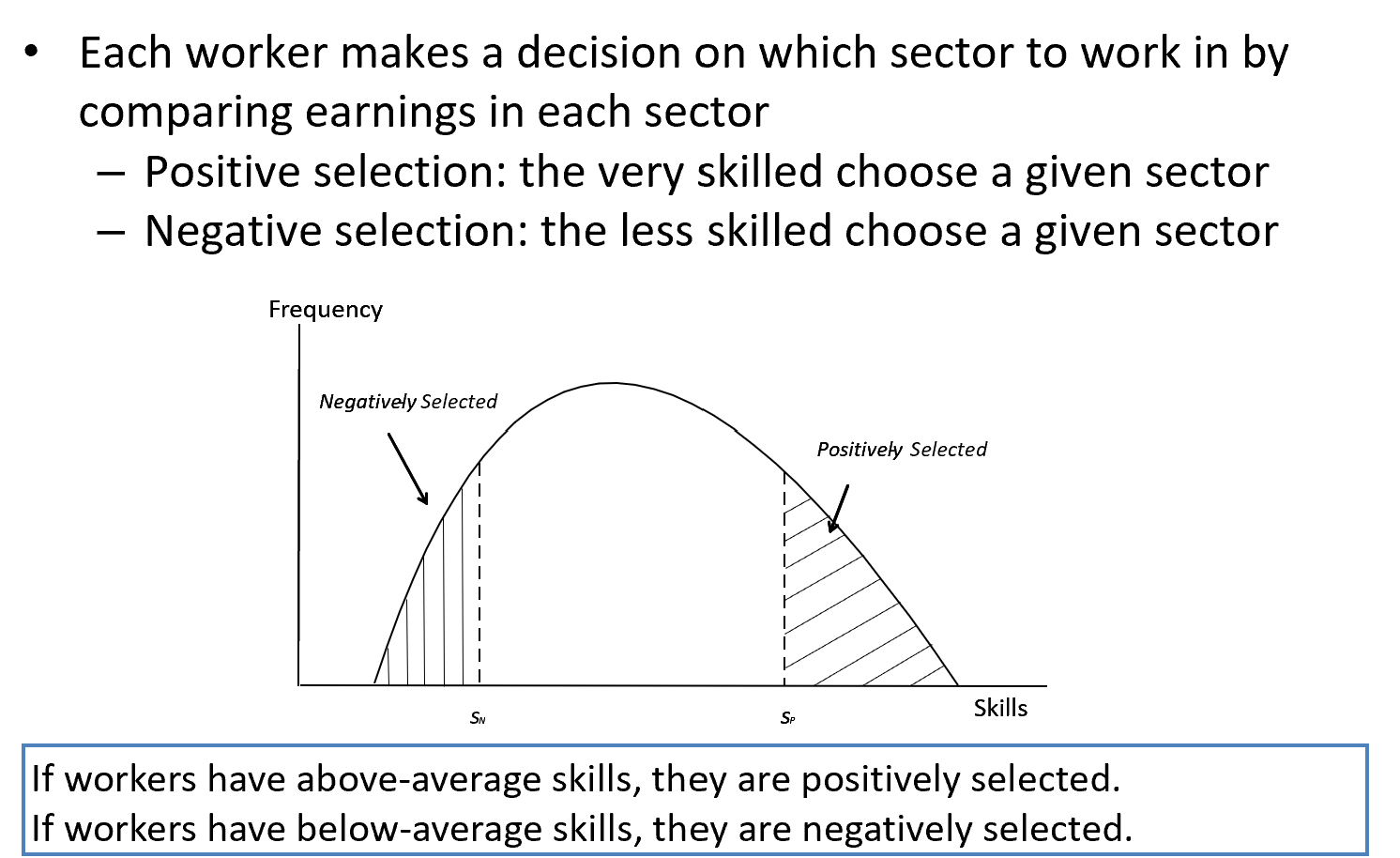
The idea is that you’re going to have workers who are making decisions about which sector to work in. It’s a pretty simplistic way of thinking about it, and obviously you can get to more complex models, but essentially workers are comparing earnings in each sector. Their objective is to maximize earnings. There’s positive selection, where the very skilled — the people in the upper part in the distribution of skills on the x-axis — if they’re going to choose a given sector, then they’re going to be positively selected. If it tends to be people from the lower part of the skill distribution, then that’s called negative selection. One of the Roy model’s predictions is whether there’s going to be positive or negative selection, based on the distribution of wages in a country — how compressed they are.
For our world, when we think about innovators, the other question becomes whether there’s correlation between the skills that individuals have in the two sectors that people are thinking about. You want to think about an individual that we’re observing choosing between the idea sector and finance. The question is: are the skills needed in finance and the skills needed in the idea sector correlated?
I wanted to point you to this paper by Shu. We were talking about different sources of data. Patents are bread and butter, but I urge you to think about sources of data that you might have access to that people haven’t used before. Shu got great data on different cohorts of MIT students, with all kinds of things like the courses they took, their GPA, even in high school, and was able to link that to patents as well. One of the papers was looking at this question of the Roy model and the decision about working in finance versus in STEM. This issue of whether the best and the brightest are actually going on to finance, and whether that’s what we want as a society, is an interesting question.
What she finds — using data on what students are doing in college and in high school — is that finance doesn’t attract the best and the brightest STEM students, but it does attract those with more finance-relevant skills. She essentially shows that finance and science and engineering demand different skills, and still finds that the best STEM students have a preference for going into science and engineering.
She finds what is called negative correlation of skills: the skills required are very different in students going into finance versus science. Those going into STEM have better academic records in high school and focus more on developing academic skills during college. This is where it’s interesting if you know the literature by David Deming on the importance of social skills — people right now are also talking about how, with AI, that people who have the social skills might be the ones who do better in the labor market. She found evidence that people entering finance had more leadership experiences in high school and focused more on developing social skills during college. The idea is people selecting into each sector have different skills.
She also has some work looking at the financial crisis in 2008 and shows that that’s a shock to the returns to doing finance.
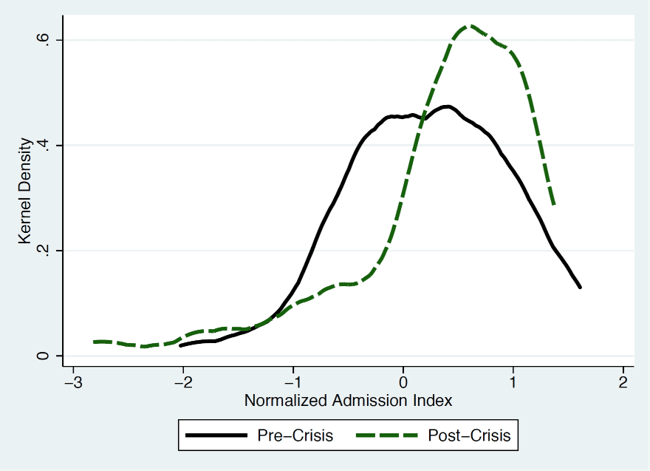
After the crisis, those who stayed in finance actually have better academic qualifications. She can look at who’s the marginal student who’s going to stay in finance versus not.
That’s just to give you a flavor of the Roy model. There have been some recent papers that also use the Roy setup. You can think about a setting where you have a change in the returns to a degree, or in the salaries, and you can look at changes in who selects. She has this admission index, which is her measure of skill — you need to observe something about the skills or the ability of the individuals, to understand who are the more qualified, choosing, let’s say, the idea sector versus not.
Earnings & Entrance into Science: Biased Beliefs
Here we’re going into the role of information. This has also gotten to be a very popular topic in general labor economics. For our world of the economics of science and innovation, there is a focus on PhD students, because in some fields, to be an innovator, you need to get a PhD, and it’s a long process. There is a lot of focus on this group: people who choose to do a PhD and then go on to do a postdoc.
Several years ago there started to be this discussion that the job market for PhD students was really bad. There were a lot of discussions around whether we have enough jobs, and whether students know. One thing we know in economics is that it’s pretty transparent — you can go and see from different departments what the placements are of PhD students. In the sciences, most people do a postdoc, and so it’s actually hard for students to see what the careers are like of people in their field.
PhD and postdoc training — if we go especially to the STEM fields — is designed to prepare individuals for academic careers. It used to be more so. Now we’ve seen that there’s much more awareness, by faculty PIs, that students are going into industry or entrepreneurship. But in STEM fields, about 10% of PhD graduates go on to get a faculty position. In 2016, there were 2,700 new chemistry PhDs, but only 152 openings in research universities.
You probably all know the PhD Comics, about how ambition changes as you go along the PhD.
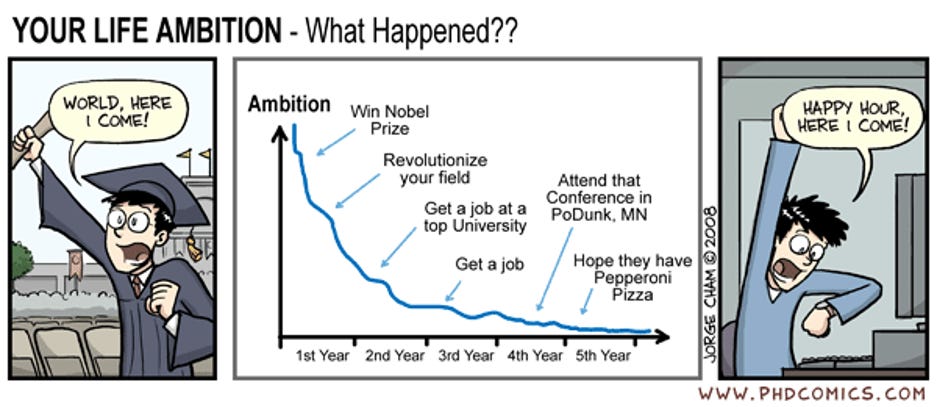
At the beginning, you think, “I’m going to win the Nobel Prize,” and then at some point you start to get more information.
How do you get this information? Some of it is through your peers, but should there be more structured effort to have data for PhDs? I’m going to tell you about a study that I did with some co-authors where we tried to look at this. There was this idea that students don’t know what the job prospects are when they’re finishing. The labor literature had grown a lot on this topic — that students are not fully informed when making educational choices. Experimentally, there were several influential studies that showed that if you give accurate information, students update their beliefs and their decisions. There was a paper by Rob Jensen giving students information on the returns. There was work by Wiswall and Zafar showing that NYU students, if you give them information on salaries in different careers, change their majors. It’s been pretty well shown, across a range of settings, that students and parents don’t have accurate information.
I wanted to talk to you about this paper because one of the things in this field of the economics of science and innovation is that there are still not a lot of papers where they’re doing experiments. I know that there are some efforts with J-PAL and the Innovation Growth Lab to try to encourage and provide resources to do experiments. If you’re thinking about doing experiments, that’s exciting. I’m happy to talk more; I’ve been involved in a few of them.
This one is still challenging to do, but it’s an easier way to do an experiment, which is embedding an experiment within a survey. We wanted to see whether our PhD students are informed about the labor market, and whether providing information can change their beliefs. We did a several-year project where we did a survey of about 1,300 PhD students in chemistry in 2017. If I had more time, I could tell you about just getting the email addresses of these PhD students. We did 54 US chemistry departments. There’s no list out there of who all the PhD students are in a field, so we had to scrape those from websites.
Then we did a randomized information intervention. The focus was providing a subset of students — since it was an experiment — actual historical academic placement records by program. We showed them a website that had, by department, what share of graduates got a tenure-track faculty job at a research university. As you can imagine, it was quite low: in most places it was 5-10%. Then, in another treatment, we also linked to scientist profiles on the American Chemical Society web page.
We did a follow-up survey one year later, and we tried to look at placement data four years later. The whole thing took about five or six years to get the paper finished. In our field there’s so much of a focus on causal estimates. This is a paper, and I have another one like this, where there often ends up being a lot of interest in the descriptive results too — just showing what the beliefs are.
There’s some related work by Henry Sauermann and Michael Roach, where they also did a big survey of many PhD students and tracked them over time in different fields. They didn’t do an experiment, but they also have some of the descriptive pieces that are very interesting. The takeaway, if you just look at the beliefs, is that people are — we called it “at times excessively optimistic.” They were probably very good. But in general, people did not seem to be informed about their actual chances. There’s some interesting variation: international students, and students earlier in the program were especially overly optimistic.
This was one of the descriptive pieces — this is the share of PhDs from their own program getting US tenure-track positions.
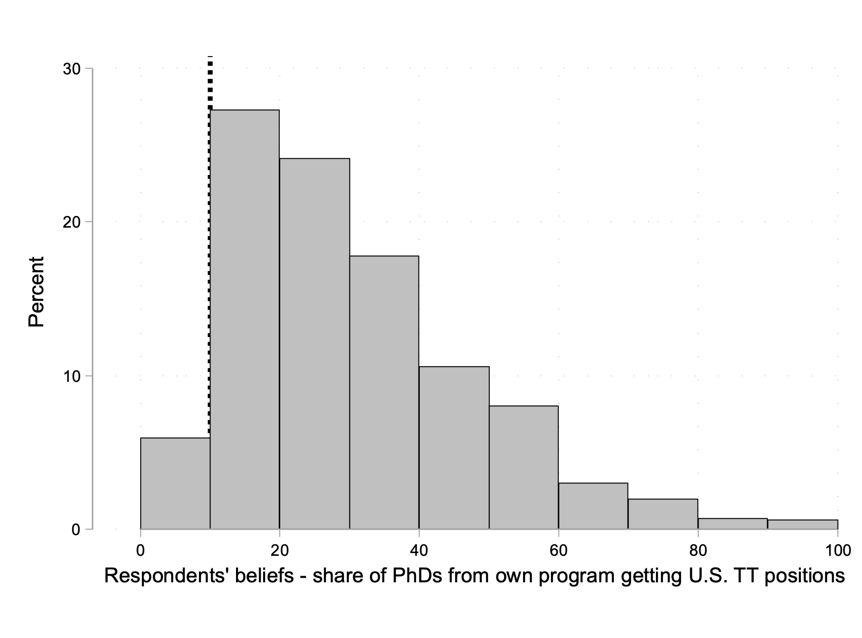
The mean was 24.5%, the median was 20%, but about 5% was the actual number. Most of the sample was reporting above that.
We did this information intervention. One of the issues with this project was that the results were a bit puzzling: we found that they did update their beliefs about their own chances of becoming faculty, but not about the market overall. It was a puzzle of why they would update. We also didn’t find any gender differences, which people are always interested in. Then we waited and collected — back in the days before what everyone’s using now, getting LinkedIn data — we looked up each person and tried to see whether they actually did a postdoc after graduation. We found no change across the treatment and control in doing a postdoc. Once people do the PhD, they’re down that path. Maybe providing this information earlier — but the issue is that so few people of the general undergraduate population would want to go on to do a PhD, so you’d have to think about what the right sample would be. That could be an interesting thing to do.
Here’s some of the data on initial and final beliefs.
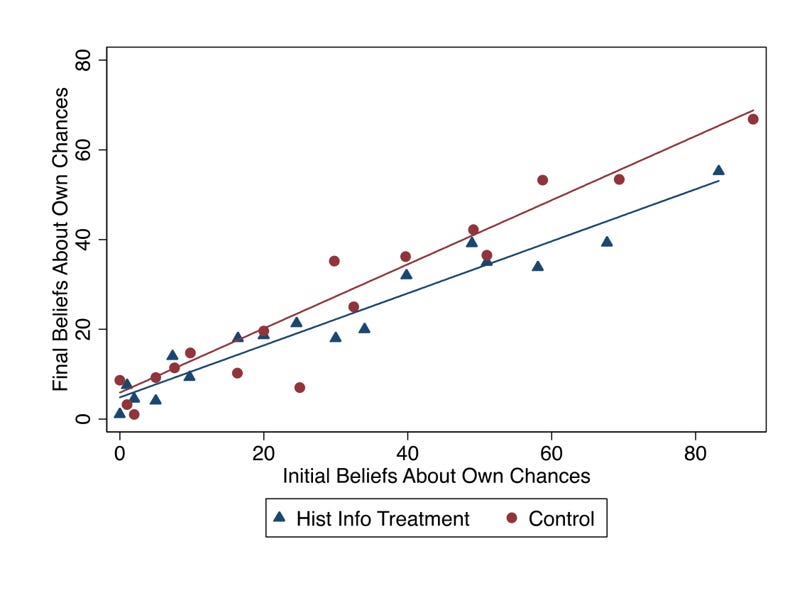
You can see that there’s a bit of a downward adjustment, and in particular the people who were the most misinformed — who had the highest initial beliefs about their own chances.
The takeaways are that there might be other reasons that people do a postdoc, thinking about international students, the fact that a postdoc can still be valuable if you’re going to choose an industry career, family reasons, and maybe their preferences are quite stable, because you’re down this path.
Earnings & Entrance into Science: Exposure to Science
This is a very recent topic I’ve gotten into, which is this idea of exposure to science. Going back to who chooses to go into this innovative workforce — you could think about entrepreneurs, or invention. What I’ve been working on is this idea of who decides to go on to do a PhD. We know that one of the biggest predictors of who goes on to do a PhD is if your parents have one. What is the reason behind it? Is it because you have more information, a role model?
What we wanted to get into is this topic of being exposed to what science is. There are a lot of stories. You probably know Jennifer Doudna, who won the Nobel Prize for her work with CRISPR, and was also involved in the last patent interference, the dispute between Doudna and Zhang on who gets the patent rights to CRISPR. If you look into her background, she talks about how she went to a smaller college, and she said, “My biochemistry professor in college gave me a chance to work in her lab over the summer, which is critical, where I really figured out, ‘Wow! I love lab work, this is really great, this is exactly what I want to be doing.’”
What if Jennifer Doudna had not gone and worked in this lab? Would she have gone into science, and would we have had CRISPR? That’s a counterfactual we don’t know, but in this paper we’re trying to get close to that.
There was a big scandal on econ Twitter when there was a discussion about the $15-an-hour minimum wage, and Jennifer Doleac said, “I’m required to pay undergrad RAs $15 an hour. I will definitely hire fewer of them. The silver lining: less paperwork for me.”
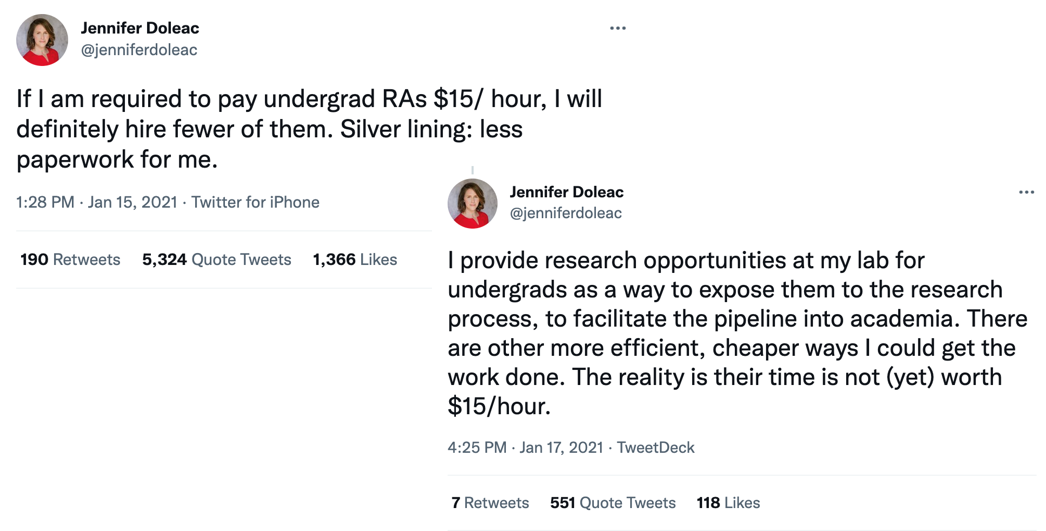
People were shocked that she would say this: “You’re not going to pay your undergrads $15 an hour.” It was interesting because these are economists. If you think about a price shock here — that now you have to pay your undergrads this much — if you have fixed budgets, you could imagine that this could be an issue, that people wouldn’t hire their RAs. She had this other tweet: “I provided research opportunities at my lab for undergrads as a way to expose them to the research process, to facilitate the pipeline into academia. There are other, more efficient, cheaper ways I could get the work done.”
That’s what we were looking at in this project: how much do those early lab experiences matter, and can something like the minimum wage also impact it? There are other policies that can play a role in this idea of who’s in the pipeline. Today it’s interesting because we think about NIH funding being cut, NSF funding — PIs are working with smaller budgets, and who they’re going to be able to train can then impact who’s in that pipeline going forward.
We found that writing a labor economics paper, and then a paper that’s interesting for the economics of science and innovation community — we could have the same results, but how we frame it mattered for who was interested. The labor economists are interested in this question, but there’s a whole minimum wage literature — trying to navigate that has been an interesting process.
We are using variation in minimum wage increases across states and time to look at whether that impacts the employment of undergrads in labs. Then we use that as an instrument for exposure of undergrads to science — their lab experience. We use that to link to career decisions of undergrads.
I also wanted to mention this paper because it uses UMETRICS data. It’s an exciting data set, but it hasn’t been used as much as it could be in our field, because you have to get approval to work on it. It provides very micro-level data — grant-level expenditures at major US universities. Bitsy Perlman has some papers using UMETRICS. They link this to other things like publications, and we also now have longer-run education data. We can observe students who worked in a lab as an undergrad, and then see what they do after they graduate from college. The trade-off with UMETRICS is that it doesn’t have names, so we can’t match it to anything else that you might want to match it to.
Our empirical approach uses the recent minimum wage literature — staggered difference-in-differences, using the timing of when you have minimum wage changes, variation in that timing but also in the magnitude, and then an IV for exposure to lab work.
What we find is that when PIs are exposed to increases in the minimum wage, they do reduce undergrad lab employment. They also increase their graduate student employment a bit, so it looks like there is some substitution to graduate students. We also see that they seem to be budget constrained. That’s a feature of why it’s interesting to look at minimum wages in a university lab setting: people are constrained. You have your grants, and they’re fixed. We do find that labs are more likely to seek supplemental funding when you have a minimum wage increase. But unlike with firms, you can’t pass the increased cost through to consumers — unless you think of the consumer as the NSF or NIH.
Going back to framing for our community, the economics of science and innovation: we show that reduced lab experience does affect careers like your Jennifer Doudnas. Students who are exposed to those minimum wage increases work 8.2% fewer quarters in labs. Then we show that those students are less likely to pursue a PhD or work in the life sciences — even just working in that sector. We see smaller effects for students with federal work-study support, which is a subsidy to pay the wage of the student.
Here you can see one visualization, the event study, where the undergrad is the orange line. The red line is the timing of the minimum wage.
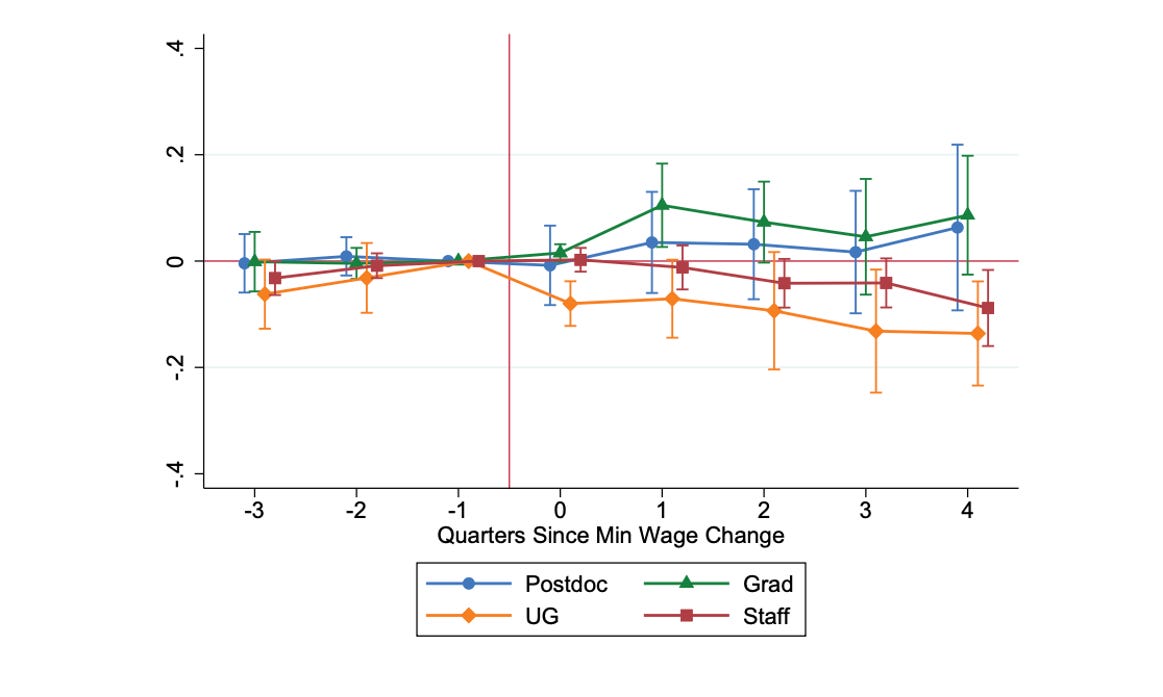
You see a decline in employment. The green is the graduate students; you see a bit of an increase. It’s a bit noisy.
This is not super compelling, but it’s just to show you the relationship — blue is students who didn’t experience any change in the minimum wage by graduation year, then we have the quarters that they worked in the lab.
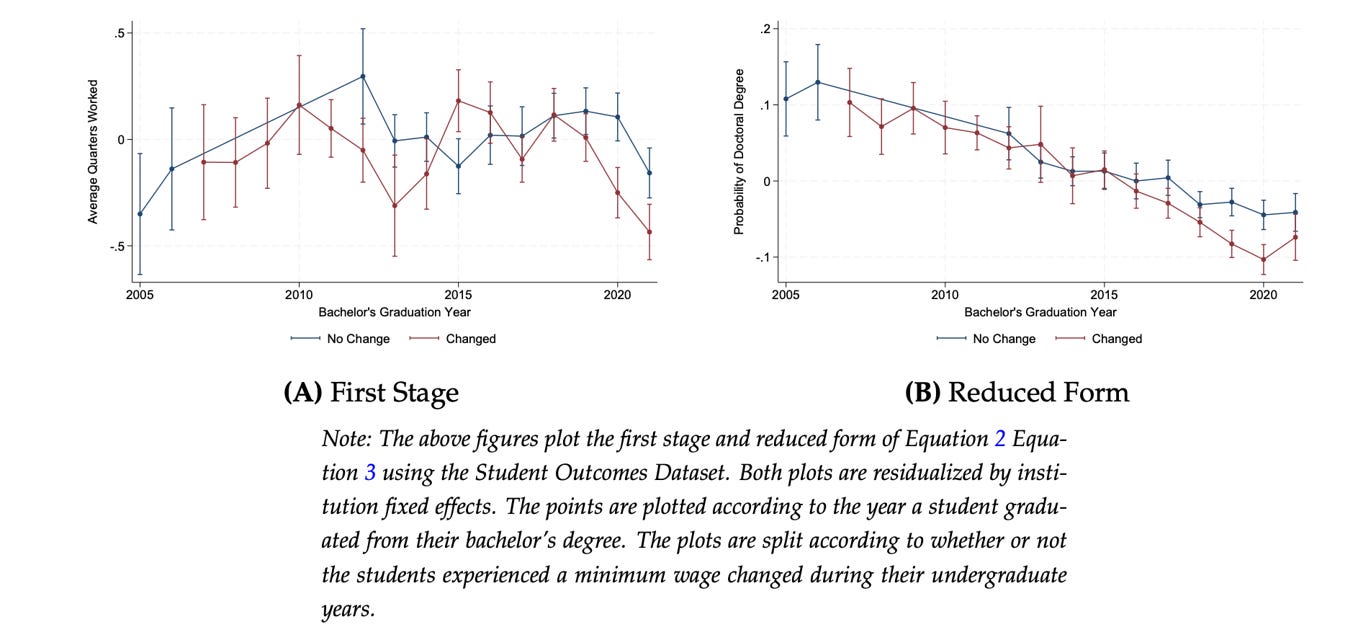
We do this in a regression framework too, but it’s suggestive that this is our first stage: if there was no change in the minimum wage when you were in undergrad, then you were more likely to work in a lab. Then this is with doing a PhD. This is just supposed to be suggestive, and then we do it in a regression.
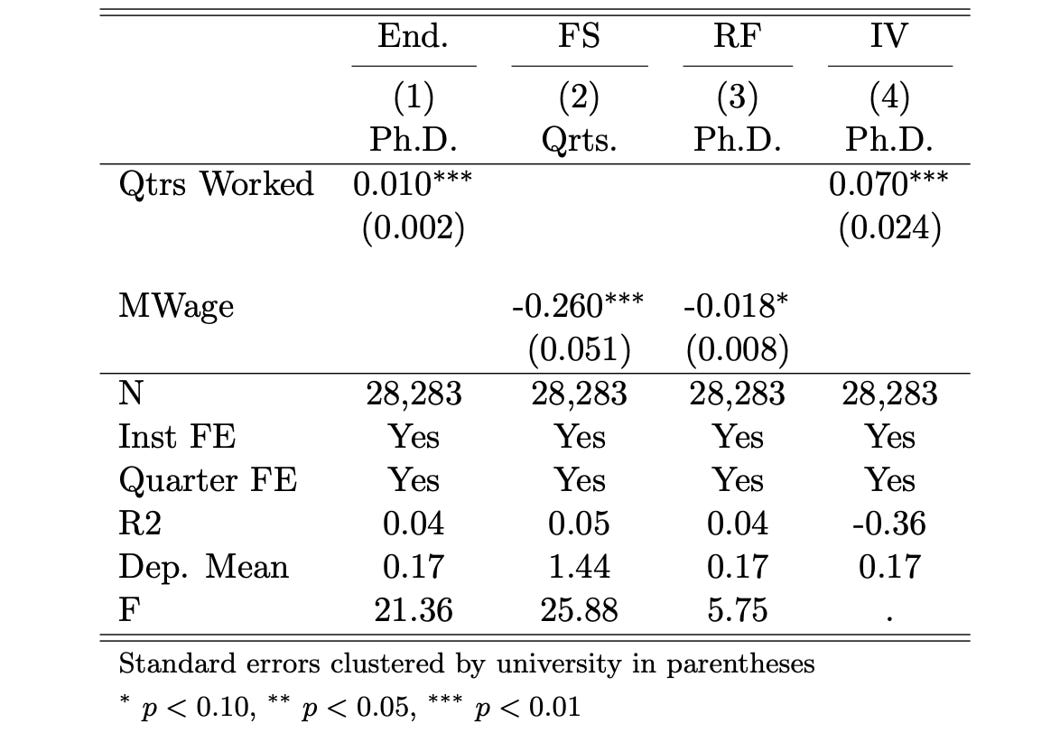
Minimum wage increase, you work fewer quarters. Then [in the right-hand column] this is the IV, that you are more likely to go on to do a PhD.
This is Richard Freeman. Richard had this piece that he called “five rules for empirical work in labor economics.” He wrote this a while ago, but I think it’s pretty good, especially for those of you who don’t have a dissertation topic yet — or maybe you do, but you’re not sure which way to take it. Some of these rules are nice to reflect on if you need some ideas. A lot of them, when he was writing this — which was probably 30 years ago — weren’t as obvious, but it’s interesting how much is still relevant today.
“Create your own variation through an experiment (field or laboratory) or study markets when they experience sufficiently sharp exogenous shocks to create ‘natural experiments’ or learn the institutional details of markets to find plausible sources of variation (policy shifts and institutional quirks).” This goes back to this focus on causality. But in our field, if you can try to run an experiment, it’s challenging — but if you also have a chance to go and work for a government agency and learn about some of the details, you can come across some interesting data. These are also ways to find some variation.
“Focus on fundamental first-order economic and behavioral principles (supply and demand; incentives; altruism and reciprocity).” Economics of science and innovation is not one of the typical fields. To get into a general-interest journal — what would a macroeconomist care about if you’re doing a very micro study on the scientists? That’s something that I often get in my referee reports or editors’ letters: “Why should I care about PhD students in chemistry?” Going back to what the big economic principles are is important.
This is now standard, “Probe the robustness of empirical findings with different data sets, different specifications, and across time and space — tension vs. pre-analysis plans, pre-specification and concerns with data mining.” The more ways you can convince readers that you have strong results, the better.
This is the one that Richard always pushed, and in the profession people have done this: “Don’t be satisfied with just standard and easily available data sets – be willing to do your own survey research, use the resources of the web to collect data (eBay; on-line newspaper archives; on-line school or arrest record data); or to work with relevant organizations to collect/gain access to administrative data (IRS tax records, matched employer-employee data, Scandinavian matched registry data, Social Security admin data, personnel data, …).” A lot of our data is patent data, so if you can get at some of these questions with new data or survey research that you’re doing, I think it makes it more exciting.
People do this, but it’s still not the case that we talk about it often in our papers: the importance of qualitative research. “Discuss issues and analyses with the participants in the markets under study – ‘In a field lacking decisive tests of hypotheses, it is worth listening to what eyewitnesses and participants have to say’ (”quarks can’t speak” but humans can tell you what they think is going on!).” In a field lacking decisive tests of hypotheses, it’s worth listening to what eyewitnesses and participants have to say. If you read the original piece that Richard wrote, he talks about how we’re different from physicists, because we can talk to people. He talks about how Richard Feynman can’t go talk to what he’s studying — quarks can’t speak, but humans can tell you what they think is going on.
I have some friends who are scientists, and they always know when I’m testing out a new idea, like with that minimum wage study. I was like, “When the minimum wage increases, what does that do to your undergrads in your labs?” Just as a check, because when we were first presenting that, I remember people were like, “Why are PIs responding to the minimum wage?” I had talked to several people who were like, “We have fixed budgets; if the cost rises, you’ve got to let someone go.” The more that you can do that — if you have some friends who are scientists, that’s always helpful.
This paper with Caroline Fry on spillovers from training scientists in the US was particularly important. The returns to training African scientists in the US are very high!