Editor’s note: In an early draft of this piece, Dan expressed sadness about the limited avenues for scientists to hype their own work. I think he’s right, but there are also professional norms that make academics hesitant to hype (or overhype) their own work and encourage them to credit scholars on whose work they build. And that’s good! For many scientists, academic scholarship is a long-term commitment to expanding human knowledge (it’s a virtuous pursuit).
The advancements that Dan describes in this piece took decades of effort and investment. We didn’t gain our knowledge about the brain in a flash of insight. Like everything worthwhile, it took work. We should celebrate the thousands of scientists and technicians who have made these advancements (even if they don’t always celebrate themselves).
Earlier this month, Eon Systems took a victory lap around Twitter after making some (incremental) improvements on a long-standing body of neuroscience literature. They claimed to have demonstrated “the world’s first embodiment of a whole-brain emulation that produces multiple behaviors,” and they had a dazzling animation that captured people’s imaginations.1 I was deeply involved in the work they built on, and was a little peeved by how they overhyped what they had done. Anyone who looks at the decades of prior work they built on will see that the improvements they made were squarely in line with what the field was already working on, and that patient, sustained effort from scientists in the field will be necessary to unlock meaningful achievements in whole-brain emulation.
Let me cash in some of my hard-earned neuroscience street cred to set the record straight on the state of the art.2 The field has made some extraordinary advancements in the last decade that are worth championing.
A primer on systems neuroscience

In the Matrix, the protagonist Neo plugs his brain into a computer that effectively installs new abilities and behaviors, including kung fu and flying a helicopter. Systems neuroscientists try to run that process in reverse. We identify a behavior — say, kung fu fighting — and try to figure out which parts of the brain are associated with that behavior and how those parts coordinate to pull it off. Successes in the field can lead to innovations like more efficient AI algorithms and more targeted interventions for mental health diseases, offering alternatives to the side-effect-heavy medications often used for today’s treatments.
To put it more technically, systems neuroscientists think about the brain as a combination of different circuits that drive different behaviors. Each circuit consists of a set of neurons and their connections. Systems neuroscientists try to link specific neural circuits to a behavior and explain how the circuit properties enable that behavior. The hope of the field is that by figuring out how the individual circuits work, we can build up a full picture of the brain.
But we ain’t there yet!
We’ve made a lot of progress in understanding individual circuits, but those circuits are mostly tied to very specialized behaviors, like how a fly determines which parts of its body to clean in what order. Our picture of how the brain works as an overall system remains very fuzzy, and we still have no idea about how something like consciousness emerges.
I was drawn to systems neuroscience by the promise of answering big questions like this, as were many physicists and engineers who became interested in the field around 2010. We were tantalized by a raft of new tools that offered the possibility of understanding the brain from first principles. Many of these folks went on to refine and expand these tools and to develop amazing ones of their own.
Recent advancements
The innovations of the last decade or so have focused on attempts to reverse-engineer the brain. Reverse engineering an electrical circuit requires identifying all of the different electrical components — the transistors, resistors, capacitors, and so on — figuring out how they’re wired together, and then measuring their electrical activity to make sense of their role in the circuit. Neuroscience tools now enable similar investigation of the brain.
The electrical components of the brain are the neurons. When I started in the field as a physicist with little biological training, I thought all neurons were the same and that the magic of the brain was the result of how neurons are connected to each other. Not true! There are hundreds of different types of neurons, which scientists organize into groups called cell types, each with their own electrical properties. For over a century, we’ve had to identify different cell types one by one, somewhat randomly. But new tools allow us to identify and categorize cell types en masse by their molecular identity, anatomical structure, and/or connectivity.
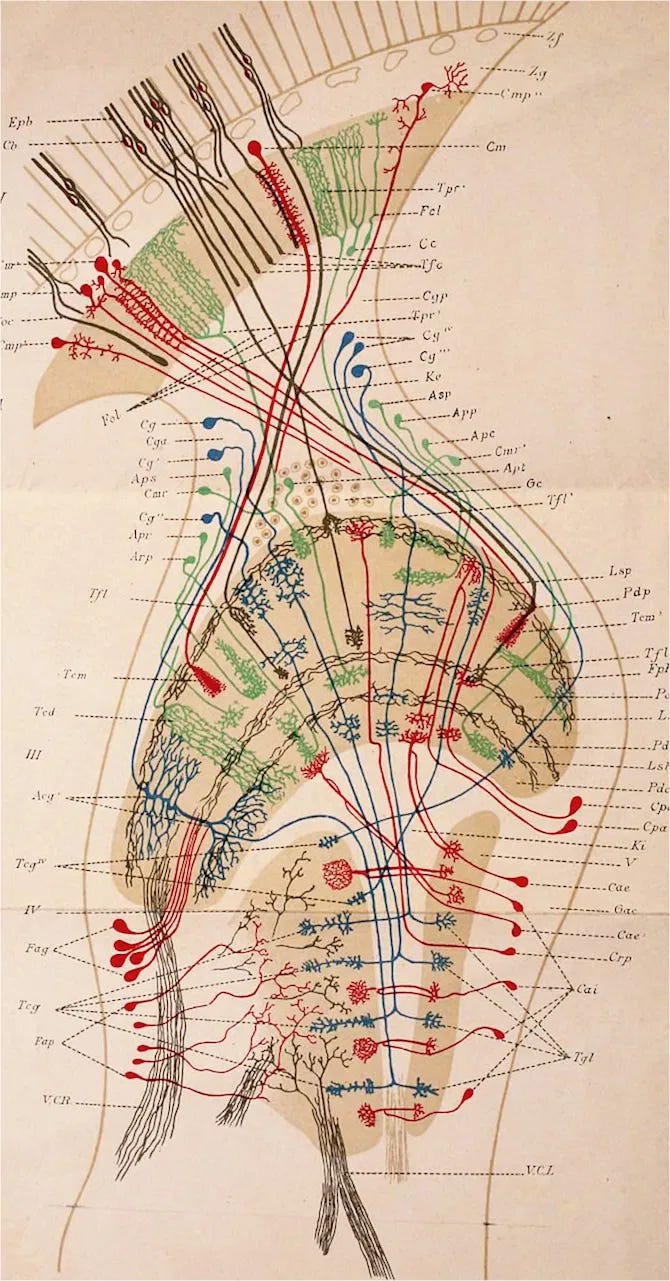
We can now also determine how hundreds of thousands of neurons are connected to each other and produce connectivity diagrams known as connectomes. The first connectome mapped all 302 neurons in the brain of a worm back in the 1980s. It took us another three decades to scale up to the brain of a fly, which has over 100,000 neurons. We can now construct the connectome of neurons in up to one cubic millimeter of tissue and have completed reconstructions of small parts of mouse and human brains. Scientists continue to improve the technology and hope to complete a full connectome of the mouse brain in the next decade. A monkey brain will likely follow, and ultimately a human one.
The final piece of the puzzle is to measure the electrical activity of lots of neurons at once. The traditional way of doing this is by sticking an electrical probe into a brain. Recent developments have led to smaller and increasingly sensitive probes that can measure the activity of thousands of neurons at once.
However, if you stick a probe in the brain, you can only measure the activity of the neurons that are next to the probe. So scientists came up with a mind-glowing way to measure the activity of neurons throughout the brain using optical probes. It’s a clever technique:
Find a bioluminescent jellyfish.
Figure out which proteins produce the glow and then determine which DNA sequence encodes that protein.
Modify the protein — and the DNA — so that it only glows when calcium ions are around. You do this by breaking the protein in half and inserting a calcium-binding domain in the middle. When calcium binds to that domain, it “heals” the protein, allowing it to glow again.
Modify the genome of a worm, fly, mouse, or monkey so that its neurons now make this special protein.
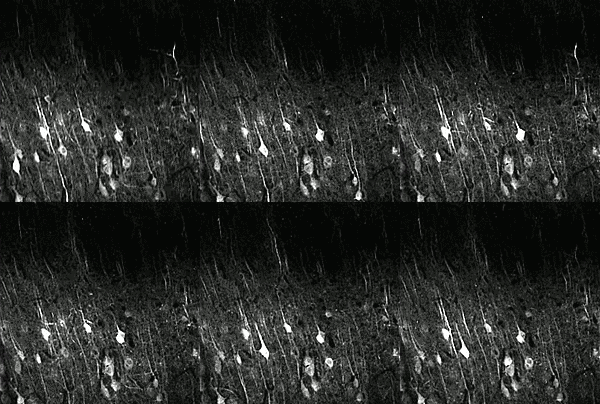
Make a window in an animal’s skull and look at the brain under a microscope while the animal performs a task.3 When neurons are silent, they have very few calcium ions and will thus be dark. When they are electrically active, they take in calcium ions, causing the proteins to glow.
This method now lets us see neurons in the brain blinking off and on when they are active. Truly wild sci-fi stuff.
Cell typing, connectomes, and electrical and optical probes now allow systems neuroscientists to figure out how electrical circuits in the brain work. But as amazing as new neuroscience tools are, there is still much we can’t measure effectively — including animal behavior, the electrical properties of neural cell types, and how those properties change in response to neuropeptides and neuromodulators.4
Given that the aim of systems neuroscience is to link neural circuits to behavior, classifying all of the different possible types of behaviors is essential. Since humans are (understandably) hesitant to let researchers stick electrodes into their brains or to modify their DNA to make their neurons glow, most fundamental systems neuroscience experiments are done on animals. But animal behavior is still largely a black box, and animals, challengingly, can’t tell us what they’re thinking.5 We can create Big Brother-style experiments to record an animal’s every moment in lab settings, or use drones and other techniques to track them in the wild, but even with AI, it’s hard to parse all of that video data to determine which exact movements count as behaviors.

The electrical input-output properties of single neurons can also be incredibly complicated, and we don’t yet have models for all of the cell types that we’re discovering. To return to the electrical circuit comparison, we don’t know which cell types act like transistors, which act like resistors, which act like capacitors, and so on. Developing these models will require substantial efforts to map the location of electrical components (such as ion channels) on each neuron, incorporate those components into single neuron simulations, and validate the simulations. A component’s electrical properties can also change in response to neuromodulators like dopamine, or to neuropeptides released by other neurons in a circuit. Understanding these changes is a whole other area of research that remains in its infancy and would benefit from further tool development.
Calibrating the hype
All of these challenges require new tools developed by multidisciplinary teams. And those tools will generate big datasets that require advanced analysis techniques. While these types of projects can be done within academia, they are often better suited to team science efforts at dedicated non-profit research centers, like Focused Research Organizations (FROs), the Janelia Research Campus, which is hard at work trying to understand animal behaviors with a neuroscience lens, or the Allen Institute for Neural Dynamics, which has been trying to crack the “electrical properties of cell types” problem.
The brain is an incredibly complex organ, and figuring out its secrets will demand sustained effort and hard work from many researchers, not just a single big breakthrough. While popular culture likes to lionize lone “geniuses“ who make groundbreaking discoveries, scientific advancement is far more often the result of the cumulative work of countless, mostly anonymous scientists who have dedicated their lives to the cause. Metascience might criticize the prevalence of incremental research, but very hard problems sometimes require many incremental advances towards a unifying vision. This is why I advocate for more roadmapping, especially in biology: we need to identify the grand challenge, break it down into smaller problems, and recruit and support the best people to solve those problems.
Overall, I’m glad that there’s so much excitement and effort being directed toward systems neuroscience. It’s a fascinating area of research that brings out the best ideas of scientists, engineers, and philosophers alike, and has the real possibility to generate better treatments for mental health diseases. But the real breakthroughs will require intentional development and patience.
More straightforwardly, they used a map of all of the neurons and the connections between them from one sacrificial fly to create a virtual brain, and the virtual brain was able to control a virtual animal.
Asimov Press and Maximilian Schons also released a nice summary of where we stand earlier this year.
For flies, we remove part of the cuticle above their brain immediately before the experiment. For mice and other mammals, researchers cut a hole in their skull, epoxy a piece of glass over the hole, and then let the animal heal. The animal then lives the rest of its life with a permanent window into its thoughts.
Neurons in the brain communicate through a mix of electrical and chemical signals. When a neuron becomes electrically active, it communicates its activity to a partner neuron through a chemical signal known as a neurotransmitter. Neuropeptides and neuromodulators are special types of chemical signals that can also change the electrical properties of neurons or the connection strength between neurons. You’ve likely heard of neuromodulators like dopamine or serotonin. The experiential effects of those neuromodulators are the result of changing electrical properties in your brain.
Species of animals that we regularly use for experiments are called model organisms. Model organisms are amazing scientific tools for some things — and terrible for others. They’re great for developing new technologies and discovering basic mechanisms, but often limited for developing drugs and treatments ultimately meant for humans.