


Of all the Economics of Ideas, Science, and Innovation lectures I joined this year, this one felt the most conceptually new. Pierre Azoulay pulls from the work of sociologist Robert K. Merton to discuss how scientific communities are different from other economic structures like firms and governments.
Merton identified five norms that he argues govern scientific communities…
Communalism means scientific discoveries belong to everyone. No one owns E = mc² the way you own a patent. Scientists give up property rights in exchange for recognition and esteem.
Universalism: claims are evaluated on evidence, not the scientist’s identity. Talented people from anywhere can contribute — that’s the theory, at least. Maybe you’re smiling when I say that. But in theory, it doesn’t matter who speaks; it only matters what they have to say, and the substance of it.
Disinterestedness: that doesn’t mean scientists aren’t self-interested, but rather that institutional arrangements reward behavior that appears selfless….
Originality is completely central. The currency of science is credit for being first.
Skepticism enables error correction and filters unreliable claims through organized community scrutiny.
This concept was both new and immediately intuitive. This was my experience in graduate school, though no one explained it. The ethical code of science is as strict as it is unspoken.
But as Pierre noted, this ethical code is imperfect, and there are challenges to some of these values. The Matthew Effect, in which famous scientists are rewarded for being successful, challenges the universalism norm. The presentation features this quote, which I enjoy.
“If I have not seen as far as others, it is because giants were standing on my shoulders.”
- Computer scientist Hal Abselson.1
This turns around the famous Isaac Newton quote about standing on the shoulders of giants, and gets at the phenomenon of the ideas of obscure or early career scientists being attributed to better known scientists (e.g. their advisors).
Learning about science as an economic institution is valuable because that’s one of the parts of economics that you can interact with regularly and one which you can (maybe, on the margins, especially if you work in policy) influence.
Here are the readings that go with this lecture (readings with asterisks were required for the class):
Dasgupta, Partha, and Paul David. 1994. “Toward a New Economics of Science.” Research Policy 23(5): 487-521.
Merton, Robert K. 1957. “Priorities in Scientific Discovery: A Chapter in the Sociology of Science.” American Sociological Review 22(6): 635-659.
(*)Azoulay, Pierre, Toby Stuart, and Yanbo Wang. 2014. “Matthew: Effect or Fable?” Management Science 60(1): 92-109.
Murray, Fiona, Philippe Aghion, Mathias Dewatripont, Julian Kolev, and Scott Stern. 2016. “Of Mice and Academics: Examining the Effect of Openness on Innovation.” American Economic Journal: Economic Policy 8(1): 212-252.
(*)Stern, Scott. 2004. “Do Scientists Pay to Be Scientists?” Management Science 50(6): 835-853.
(*)Aghion, Philippe, Mathias Dewatripont, and Jeremy C. Stein. 2008. “Academic Freedom, Private Sector Focus, and the Process of Innovation.” RAND Journal of Economics 39(3): 617-635.
(*)Furman, Jeffrey, and Scott Stern. 2011. “Climbing Atop the Shoulders of Giants: The Impact of Institutions on Cumulative Research.” American Economic Review 101(5): 1933-1963.
(*)Hill, Ryan, and Carolyn Stein. 2025. “Race to the Bottom: Competition and Quality in Science.” Quarterly Journal of Economics 140(2): 1111-1185.
Thanks to William Higbie and Harry Fletcher-Wood for their support in producing this video and the transcript.
Lecture Transcript:
Science as an Economic Institution
We’re going to talk about science as an economic institution. What is science, and how does it actually work? So far, we’ve treated scientific knowledge as an input to innovation — something that exists, gets produced, and contributes to technological progress. But we’ve mostly treated it as a black box. Today we’re opening the black box. We’re going to examine science from two distinct but complementary perspectives.
First, we’ll think about science as a type of knowledge. What makes scientific knowledge different from other forms of knowledge? Second, we’ll examine science as a social institution with its own incentive structures: what motivates scientists, and how does the reward system shape what research actually gets done?
These aren’t just academic questions. Understanding how science works has direct implications for science policy, for how we:
Organize research universities,
Structure funding agencies; and,
Think about the relationship between privately funded applied R&D and basic research.
The policies we adopt — how much we spend on science, which fields to prioritize, whether to allow academic patenting, how to design peer review — all rest on assumptions about what science is and how it operates. It lays the foundation for all those other debates. That’s what we’re doing today.
We’ll start by asking what science is: what makes science different from another type of knowledge, like craft knowledge or engineering knowledge? Once we understand what science is, we’ll examine the relationship between science and technology. Does basic research flow naturally into applied research and then into commercial products? That’s the famous linear model that has historically justified massive public investments in basic science. We’ll look at evidence for this model, but also complicate the picture by examining institutional frictions that impede knowledge flow.
We’ll dig into how specific institutional features — access to frontier knowledge, funding, IP rules, access to materials — actually shape scientific productivity. The key insight, which probably won’t be that surprising, is that institutional details matter enormously for how much science gets produced and how effectively it contributes to innovation. Time permitting, we’ll talk about scientific competition as well.
What is science?
“What is science?” seems like a super simple question, but it’s actually hard to answer precisely. If you ask a philosopher of science, you’ll get debates about falsifiability, paradigms, research programs, and epistemic communities. Ask a scientist and they’re going to say something like, “I know it when I see it.” But they’ll struggle to articulate exactly what distinguishes their work from engineering, from craft, from trial-and-error problem solving.
But Harvey Brooks provides a useful framework for understanding the relationship between science and technology.
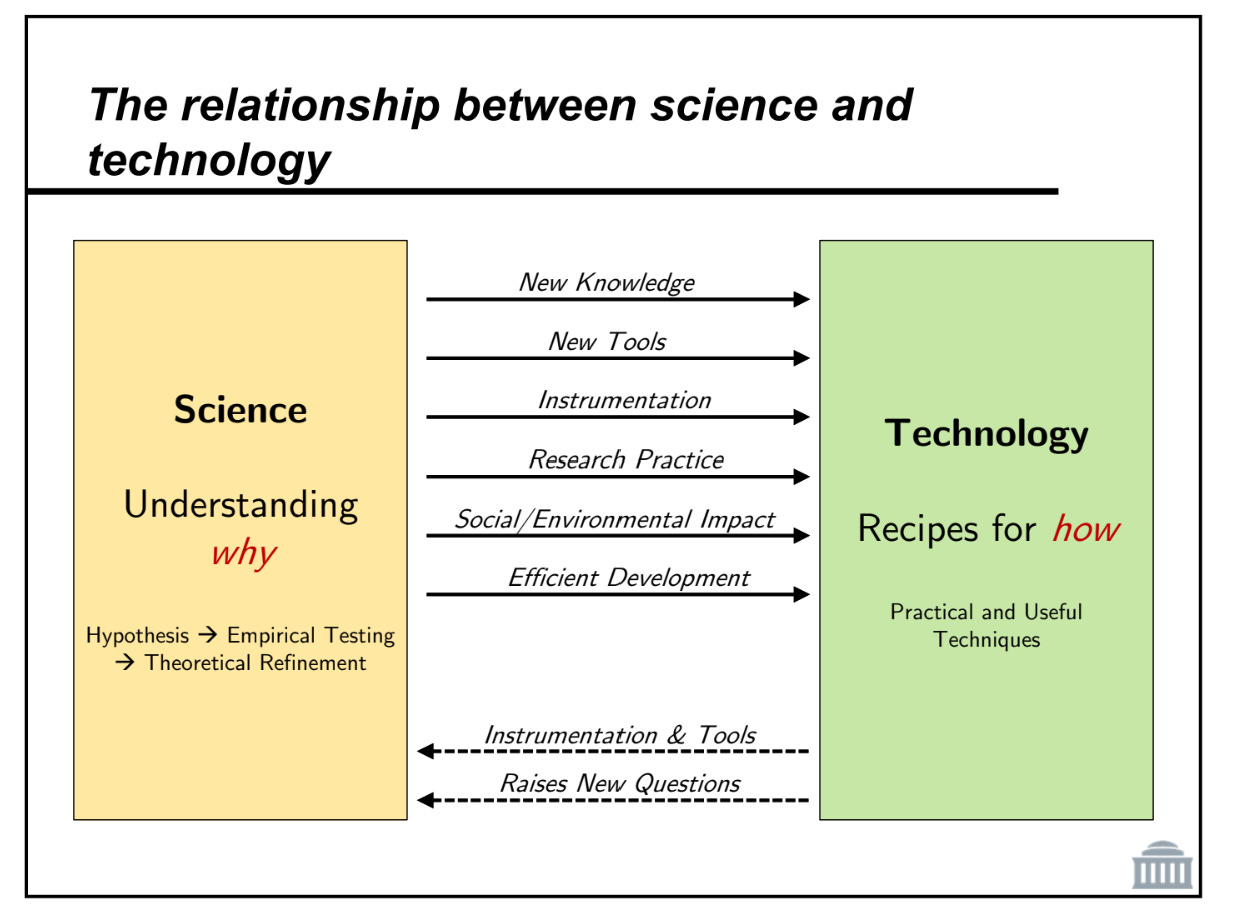
Science is about understanding why: testing hypotheses, refining theories, building systematic knowledge. Technology is about capturing and orchestrating regularities in nature to do something we believe might be useful. Brooks argues that science contributes to technology in six ways:
New knowledge provides ideas for technological possibilities.
Tools and techniques enable efficient engineering design.
Research instrumentation migrates into industrial practice.
Research develops human skills that transfer to applied work.
Scientific knowledge enables assessment of social and environmental impacts.
Knowledge bases make applied work more efficient.
But the relationship is actually bidirectional: technology contributes enormously to science, by raising novel questions and practical problems that reveal gaps in theory, and by providing instrumentation that enables more difficult research. You can just ponder the effect of Claude Code on academic research, happening right now, as an exemplar of how technology can impact the conduct of science. But the electron microscope, synchrotron radiation, superconducting magnets — all emerge from applied work and revolutionize basic science.
But Dasgupta and David ask a deeper question.
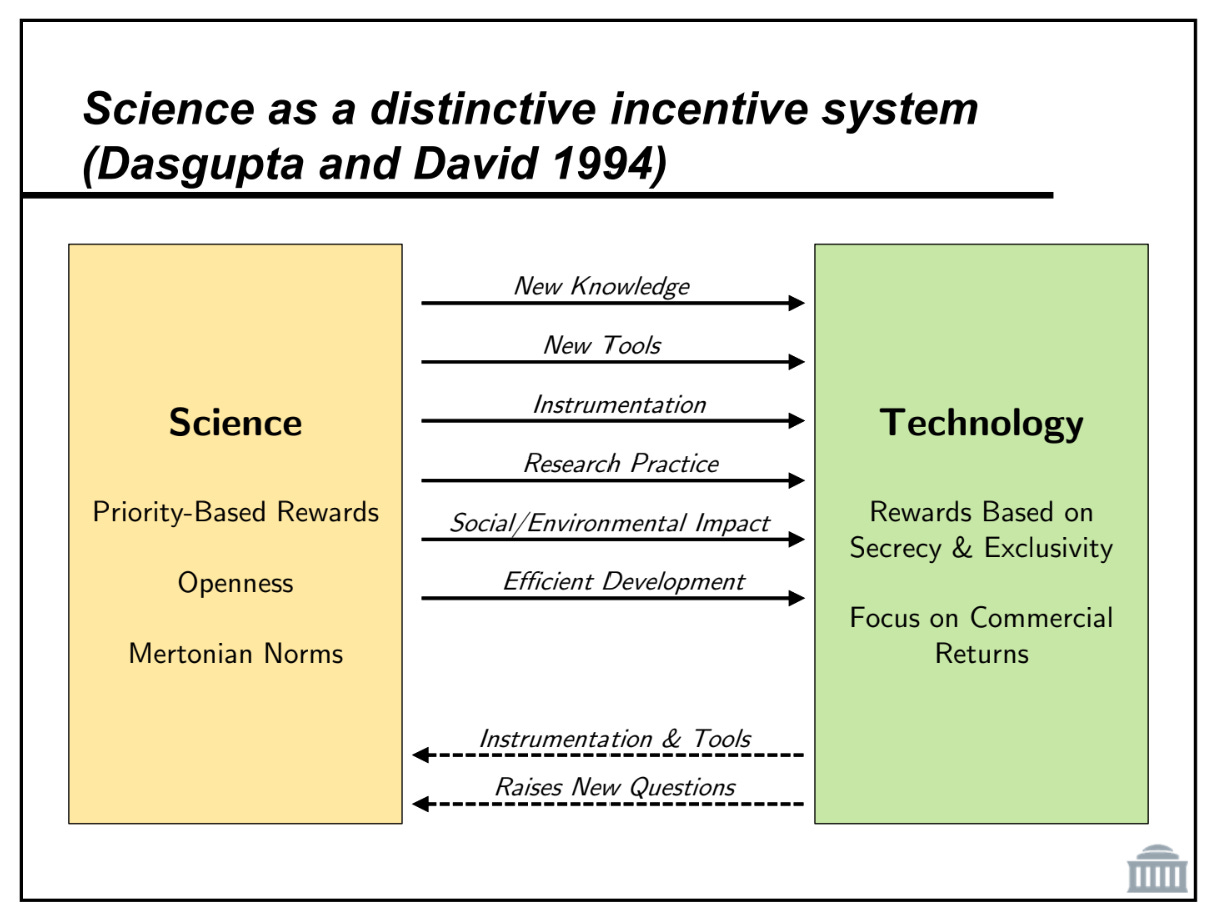
This is a classic article — if you’re into this topic you should really read it. It’s a manifesto for the so-called new economics of science. They say: given that science and technology are interconnected, why are they organized so differently? Why have universities doing open science alongside firms doing proprietary R&D? Their answer is that science and technology serve different goals, requiring different institutional structures.
Science adds to the stock of public knowledge — discoveries anyone can build on. Technology generates rents from private knowledge — innovations that provide competitive advantage to some firm. So this requires a different incentive system. Science operates under priority-based rewards and openness norms. Scientists compete to be first to publish, earning credit and reputation through disclosure. We’re going to talk about the Mertonian norms that support this system.
Technology operates under a completely different set of rules. Rewards come from secrecy and exclusivity: patents, trade secrets, proprietary know-how. You profit from being first to market and maintaining advantages — not from publishing.
Dasgupta and David argue that this duality is actually functional: both systems have internal logic suited to their purposes. But mixing these incentive systems can create tensions — when you ask scientists to both publish and patent, when universities must commercialize while maintaining academic freedom, that’s when there start to be real strains between those institutional boundaries. We want to understand this distinction to grasp how science contributes to growth, and how policy can enhance or impede that contribution.
Science as a social institution: the Mertonian norms
I want to shift from science as a type of knowledge to science as a social institution with distinctive norms and incentive structures. Robert Merton Sr., the sociologist of science — the father of the Nobel Prize–winning economist and my colleague at MIT, Robert Merton Jr. — identified a set of norms he argued should govern scientific communities.
Merton wasn’t claiming scientists actually follow these norms perfectly. He was describing an institutional ideal against which we can measure reality. The productive research agenda, for both sociology and economics of science, has been to examine who violates these norms, how, and why — and what consequences those violations have for scientific progress.
The violations aren’t just interesting as failures; they’re informative. They reveal the actual incentives that scientists face, the institutional pressures that shape their behavior, and the ways in which the system succeeds or fails at producing reliable knowledge. You can think of those Mertonian norms as a baseline model. Just as we use perfect competition as a benchmark to understand market failures, we can use Merton’s idealized norms to understand where the scientific system deviates from its stated principles, and why those deviations matter. Sometimes the violations are completely dysfunctional — they impede knowledge production. But sometimes they also reveal adaptations to real constraints. Either way, studying that gap between norm and practice tells us how science actually works, and how we might design better scientific institutions.
Merton identified five norms that he argues govern scientific communities, and there’s a cool acronym: CUDOS.
Communalism means scientific discoveries belong to everyone. No one owns E = mc² the way you own a patent. Scientists give up property rights in exchange for recognition and esteem.
Universalism: claims are evaluated on evidence, not the scientist’s identity. Talented people from anywhere can contribute — that’s the theory, at least. Maybe you’re smiling when I say that. But in theory, it doesn’t matter who speaks; it only matters what they have to say, and the substance of it.
Disinterestedness: that doesn’t mean scientists aren’t self-interested, but rather that institutional arrangements reward behavior that appears selfless. We can talk about that one too.
Originality is completely central. The currency of science is credit for being first.
Skepticism enables error correction and filters unreliable claims through organized community scrutiny.
You may have ideas about how short we fall of actually honoring them. What Dasgupta and David argue is that these norms aren’t arbitrary — they’re functional adaptations that solve coordination problems in knowledge production.
The priority system means that disclosure of results is actually a self-interested act.
Universalism expands the pool of contributors.
Skepticism filters unreliable claims.
Together, these norms create a reward structure that efficiently increases the stock of reliable public knowledge — even though they also create some problematic incentives.
The Matthew effect: a violation of universalism
I wanted to give you a sense of what it looks like to study a violation of those norms. The one I’m going to pick is the Matthew effect, which is a violation of universalism. Merton coined the Matthew effect; it’s named for a biblical verse — “unto everyone that hath shall be given” — that describes cumulative advantage in science. Scientists with early recognition get more resources, better collaborators, greater visibility, which leads to more recognition, creating a self-reinforcing cycle. The rich get richer.
The Matthew effect is a direct violation of the norm of universalism. According to that norm, claims should be evaluated based on impersonal criteria, not the author’s identity or reputation. But the anecdote you see on the slide shows this norm can be widely violated.
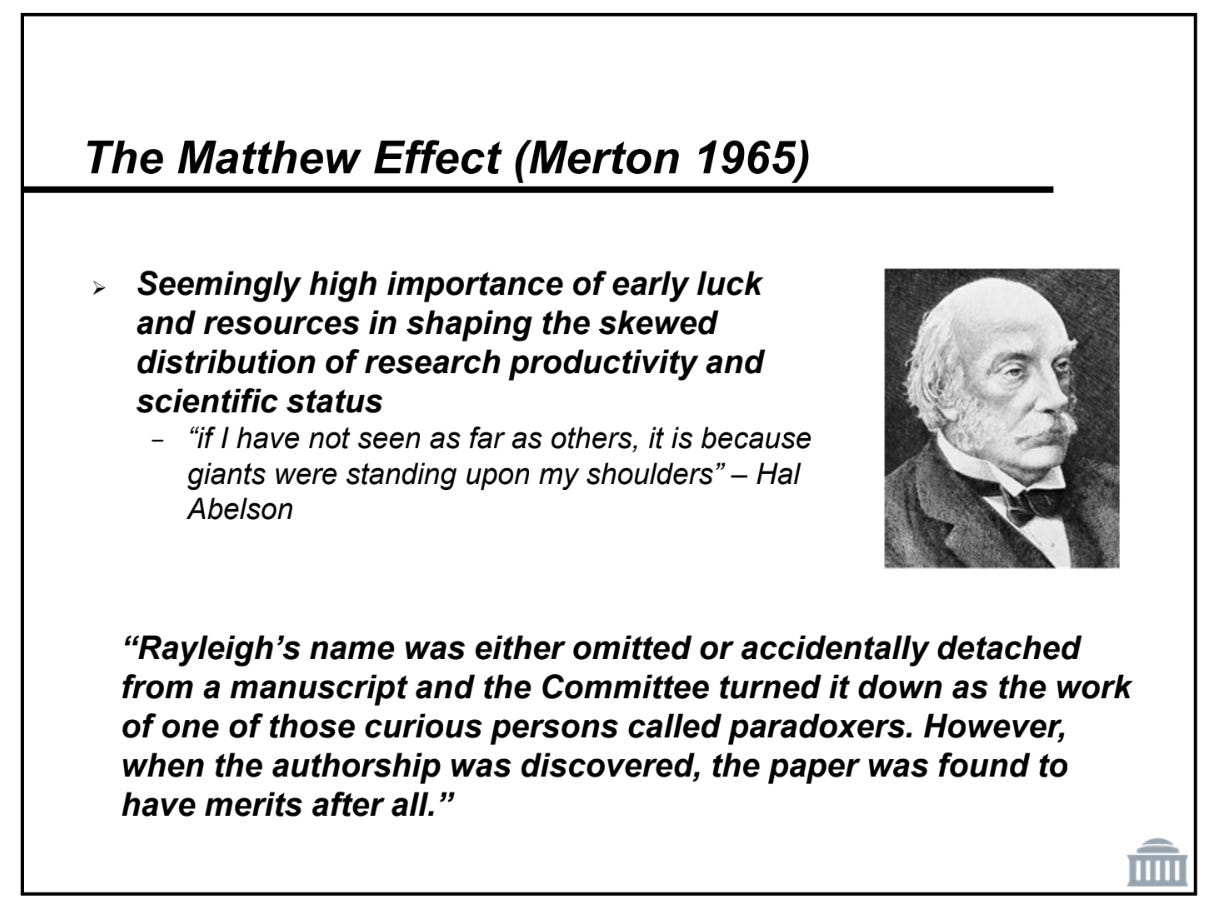
The same paper, the same ideas, different evaluation based solely on authorship.
One version of this is that it’s bias. Another version is that it’s partly rational: eminent scientists’ work gets more attention because they have proven track records, making the allocation of attention more fluid. But it also means that work by unknown scientists gets systematically undervalued. The Hal Abelson quote — “if I have not seen as far as others, it is because giants were standing on my shoulders” — tries to capture how your ideas sometimes get attributed to more famous people.
It’s an empirical fact that scientific output and rewards are extremely skewed. A small fraction of scientists produce most of the highly cited papers, get most of the funding, and train most successful students. But what explains this skew? There are two different interpretations. One is that science is fundamentally meritocratic: the most talented people just produce more and better work, and the reward system accurately reflects real differences in ability. The other is that the Matthew effect operates: early luck and accumulated advantages amplify small initial differences, so the skew reflects status effects rather than pure merit.
Those aren’t mutually exclusive, but their relative importance matters quite a bit for policy. Should we concentrate resources on proven stars, or does doing so amplify the Matthew effect and end up crowding out talent?
I’m going to tell you briefly about a paper of mine. The title is ‘Matthew: Effect or Fable?’ We were trying to make progress, understanding that it’s methodologically challenging to separate the two explanations I just outlined. Both predict the same outcome: skewed distributions of scientific success. So how do you distinguish between “good scientists get cited more because they’re good” versus “famous scientists get cited more because they’re famous”?
The setting here is biomedical scientists, some of whom receive a status shock — and the status shock is receiving a very prestigious appointment, the Howard Hughes Medical Institute investigator appointment. The way we’re going to do this is to look at the pre-appointment output of scientists that are at risk of receiving the status shock. The paper gets published; some of those scientists get appointed, so they get a discrete positive shock to their status. Then we can think about how the rate of citations to those articles treated by the appointment contrasts with what happens for articles associated with scientists that are very similar but somehow didn’t benefit from the status shock.
So it’s a classic difference-in-differences. This is, by the way, a research design we’re going to see multiple times today: we’re comparing citations to articles before and after some shock, for both a treatment group and a control group.
To give you a sense of what we’re doing: here are two papers.
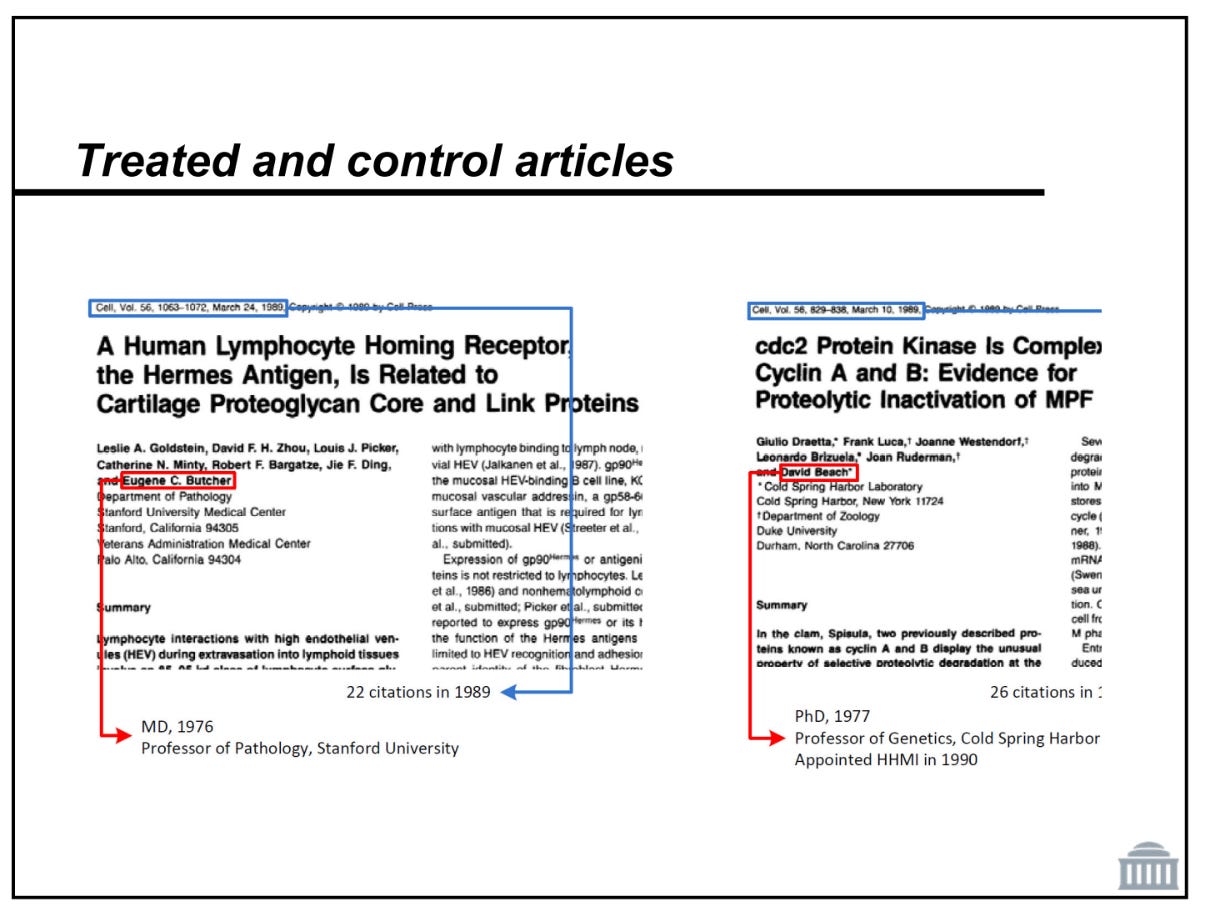
They appear in the same journal in the same month. The last-author scientist, the principal investigator, is the big honcho in the lab. The person on the right gets appointed HHMI in 1990. Those two papers in their first year have roughly equivalent numbers of citations. Then we’re looking at how many more or fewer citations the paper on the right gets relative to the paper on the left. The whole point is to be pretty transparent about the research design.
This is what we find.
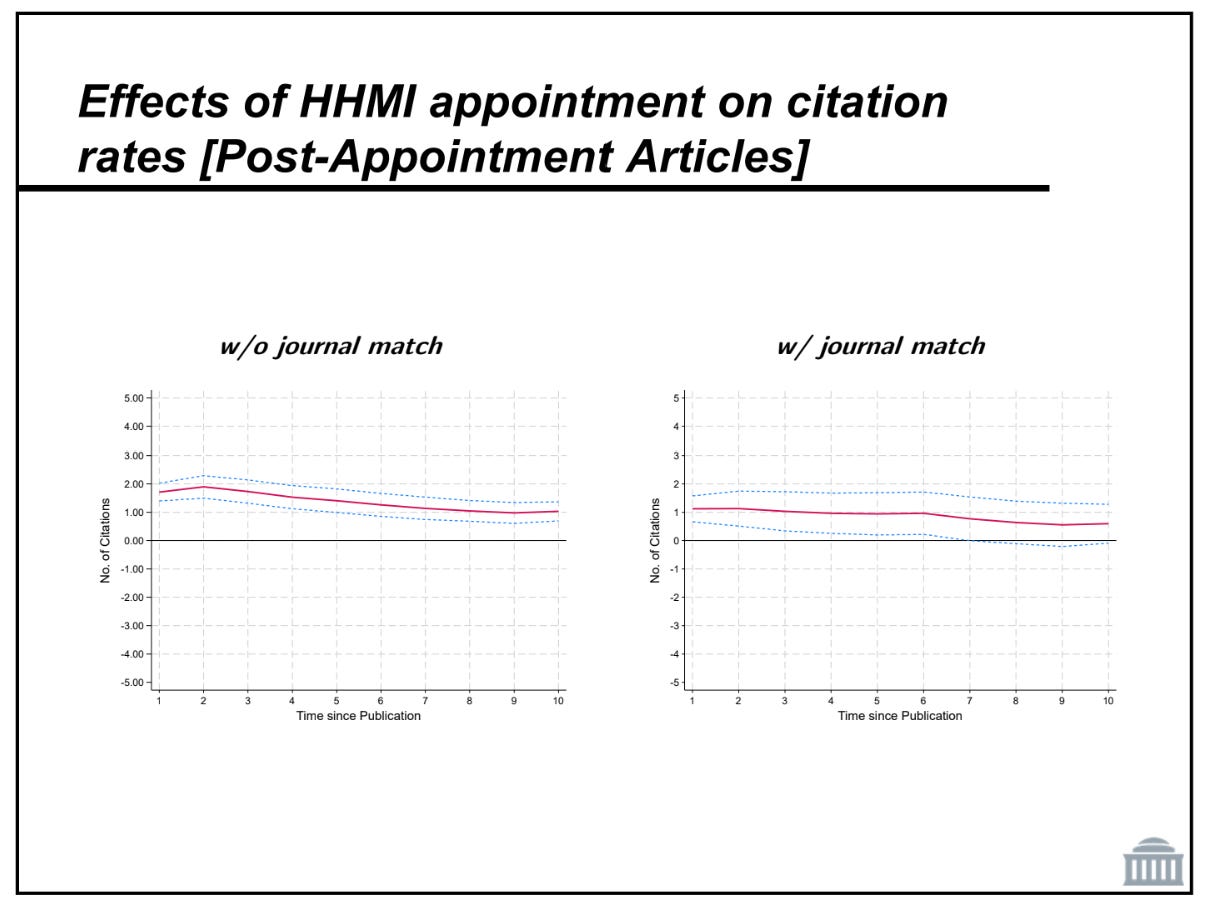
The bottom line is that there is such a thing as an HHMI appointment effect, which we interpret as evidence for the Matthew effect, but it’s not super big. It’s a few additional citations a year.
There are lots of claims about the importance of status in science, and scientists coasting on their prior reputation, that seem to imply those effects are absolutely massive. But whenever we look at them carefully — for example, in the paper by Carolyn Stein and Ryan Hill, ‘Scooped,’ they also look at the Matthew effect and find evidence for it — it’s much less quantitatively important than we might have thought. Maybe we should be slightly less cynical, in other words.
Why participate in open science?
There’s a fundamental economic question lurking beneath all this: why would anyone voluntarily participate in this system? The Mertonian framework and the Dasgupta–David model implicitly assume researchers want to be part of open science, but they don’t really explain why.
One way to think about this is from a firm’s perspective. I’m running a biotech firm. Why would I let my scientists publish? Publication spills knowledge to competitors. It takes time away from commercial work. Yet many firms, especially the most innovative ones, do exactly this. Similarly, from a scientist’s perspective, why accept a job that pays less if it means you get to publish?
This is where Stern (2004) becomes crucial. It’s a bridge between understanding science as an institution and understanding science as an economic phenomenon. That paper takes seriously the idea that there are inherent tensions between what researchers want — freedom to choose projects, the right to publish, the ability to collaborate openly — and what firms might prefer, which is to direct research toward commercial goals and keep findings proprietary.
The key insight is that these conflicts create a compensating differential in the labor market. If scientists truly value participation in open science, firms that allow it should be able to pay lower wages. Scientists are essentially paying to be scientists. But this raises a fascinating set of questions:
How large is this effect?
Does it apply to all scientists?
What does it tell us about the returns to organizing research in different ways?
My colleague Scott identifies two different economic mechanisms that could explain why firms allow scientists to publish, and they have opposite implications for wages. First, there’s a preference effect. Scientists may have what economists call a “taste for science”: they derive direct utility from participating in open science. This could be intrinsic — for example, Richard Feynman loved physics for its own sake — or it could be about career concerns: if I work for Google and publish the transformer paper, even if I leave Google tomorrow, I’ve built enormous career capital. The labor-market implication is clear: if scientists value publishing, firms that allow it can pay lower wages. This is the compensating differential.
Second, there could be a productivity effect: firms themselves might benefit from allowing publication. The classic story here is absorptive capacity, a very important concept from Cohen and Levinthal in the late 1980s. To learn from external science, you need to participate in it. If you want to be part of the scientific conversation — to know what’s happening at the frontier and attract the best collaborators — you need your own scientists publishing. This is what people sometimes call science as a ticket of admission to the broader research community. But notice that if publication makes my scientists more productive, I might actually pay them more to compensate them for the extra value they’re creating. Any amount of rent-sharing then predicts that letting my scientists do science will be associated with higher wages.
So the question is, which effect dominates? That’s an empirical question, and a tricky one, because in the cross-section you’d expect firms that allow publication to employ better scientists. That creates a thorny identification problem: are science-oriented firms paying more because of the productivity effect, or because they’re hiring better people? Scott’s methodological innovation is designed to solve that problem.
The fundamental problem is unobserved heterogeneity. Suppose I observe that biotechnology firms allowing publication pay higher average salaries than firms that don’t. I can’t conclude much, because firms that allow publication probably hire better scientists — the ability bias could be enormous. The traditional approach in labor would be to look at job switchers, people who move from restricted to open-science environments. But as studies like Gibbons and Katz have shown, switchers are selected: people switch jobs for reasons correlated with their productivity, so you still have a selection problem.
Scott’s insight is really simple but really productive. Prior to accepting a job, scientists receive multiple job offers simultaneously. These offers vary in their scientific orientation — some allow publication, some don’t — and in compensation. But crucially, they’re all offers to the exact same person. So the market has already assessed this person’s ability, and that assessment is baked into all the offers. This lets you estimate a classic hedonic wage regression at the offer level with individual fixed effects. You’re asking: holding constant everything the labor market knows about your ability, do offers that allow publication pay more or less? It isn’t just a technical fix. It’s reconceptualizing how to think about compensating differentials when ability is unobserved. The key is exploiting variation in job characteristics for a given individual, which purges all the ability confounds.
This is the key regression table.
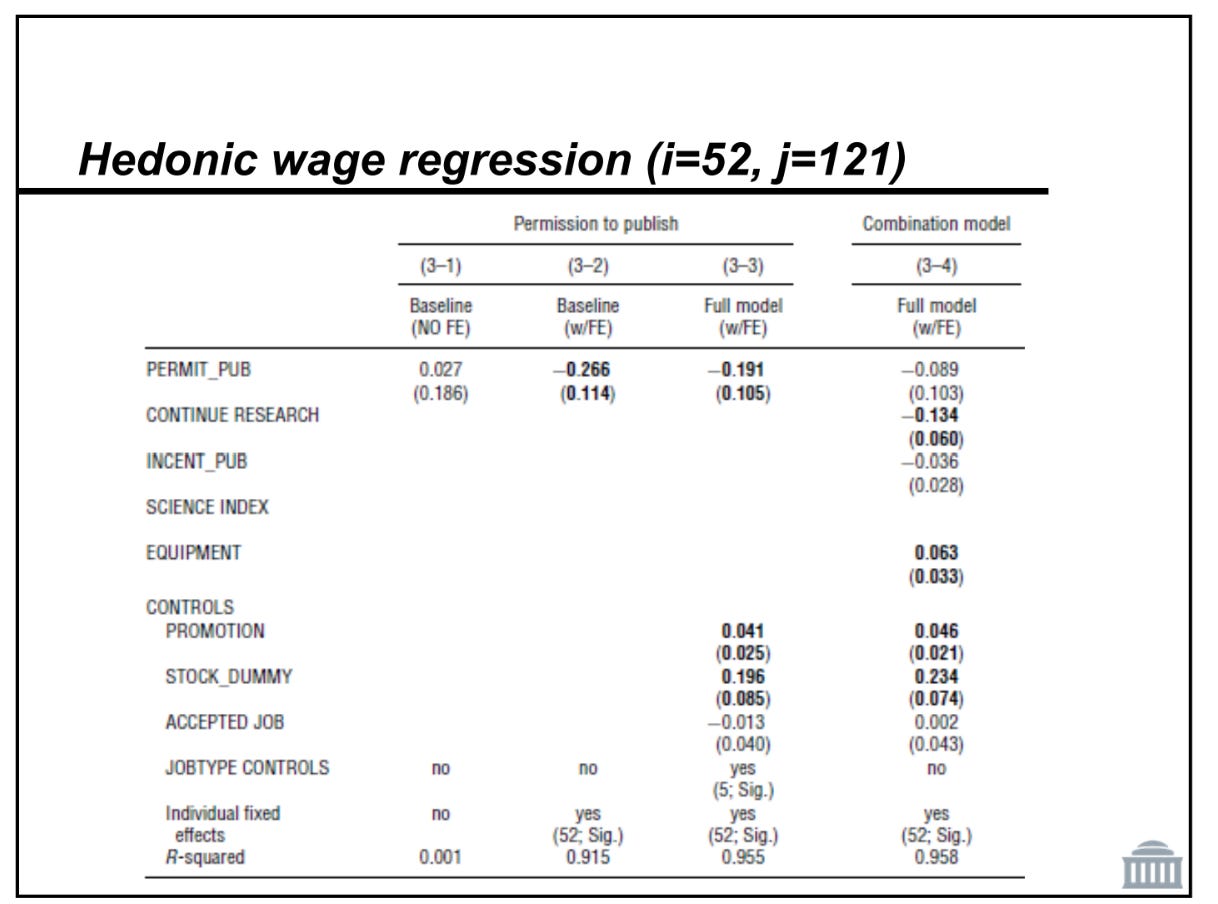
It’s a small sample — this was done at a postdoc conference. I was a grad student when that paper was being written, but it hasn’t aged. Here we’re regressing wages on whether I permit my scientists to publish. The key thing is that the sign of the coefficient flips if we control for individual fixed effects. What might have looked like a productivity effect in the cross-section turns out to be a compensating differential. Roughly, firms that allow publication pay their scientists 25% less.
Where should research happen?
That empirical result has fueled efforts to formalize Dasgupta and David and science as an economic institution. That’s the paper by Aghion, Dewatripont, and Stein (ADS). If scientists pay for freedom, who’s going to give them freedom? Because this subsidy from scientists to society is what makes open science economically viable. But that only works if scientists are actually getting what they’re paying for.
That leads to very standard questions: given that scientists value freedom, when should we organize science in academia versus the private sector? That’s what Aghion, Dewatripont, and Stein look at. They take the Stern compensating differential seriously and ask what it implies for when research should happen in academia versus the private sector. The traditional answer — if you read Arrow (1962) — to the question, “Why does academia exist?” relies on appropriability: if you can’t patent basic research, firms won’t do it, so we need universities.
That explanation is a bit problematic given how much intellectual property protection has expanded, especially under things like Bayh–Dole. So ADS 2008 offer a completely different rationale, based on control rights. Think about what fundamentally distinguishes academic from private-sector research. It’s not about funding sources or subject matter. It’s about who decides what to work on and how to work on it. In academia, scientists choose their own projects. That’s not just a nice feature — it’s definitional. That’s what tenure protects. In firms, managers can and do tell scientists what to work on. That’s also definitional. That’s what ownership means.
Now we can connect this with Stern. We know that scientists value creative control and will accept lower wages to get it. That creates a fundamental trade-off. Academia’s advantage is that you can hire scientists cheaply, because you’re giving them what they want: freedom. The disadvantage is that they might work on things that they’re intellectually interested in but that are economically useless. Private-sector firms can direct scientists toward high-payoff projects, which is valuable, but they have to pay scientists more to compensate for taking away their autonomy.
The question becomes: when does the benefit of cheap labor outweigh the cost of misdirected effort? ADS formalize this trade-off in a very elegant model that generates sharp predictions about the optimal organization of research.
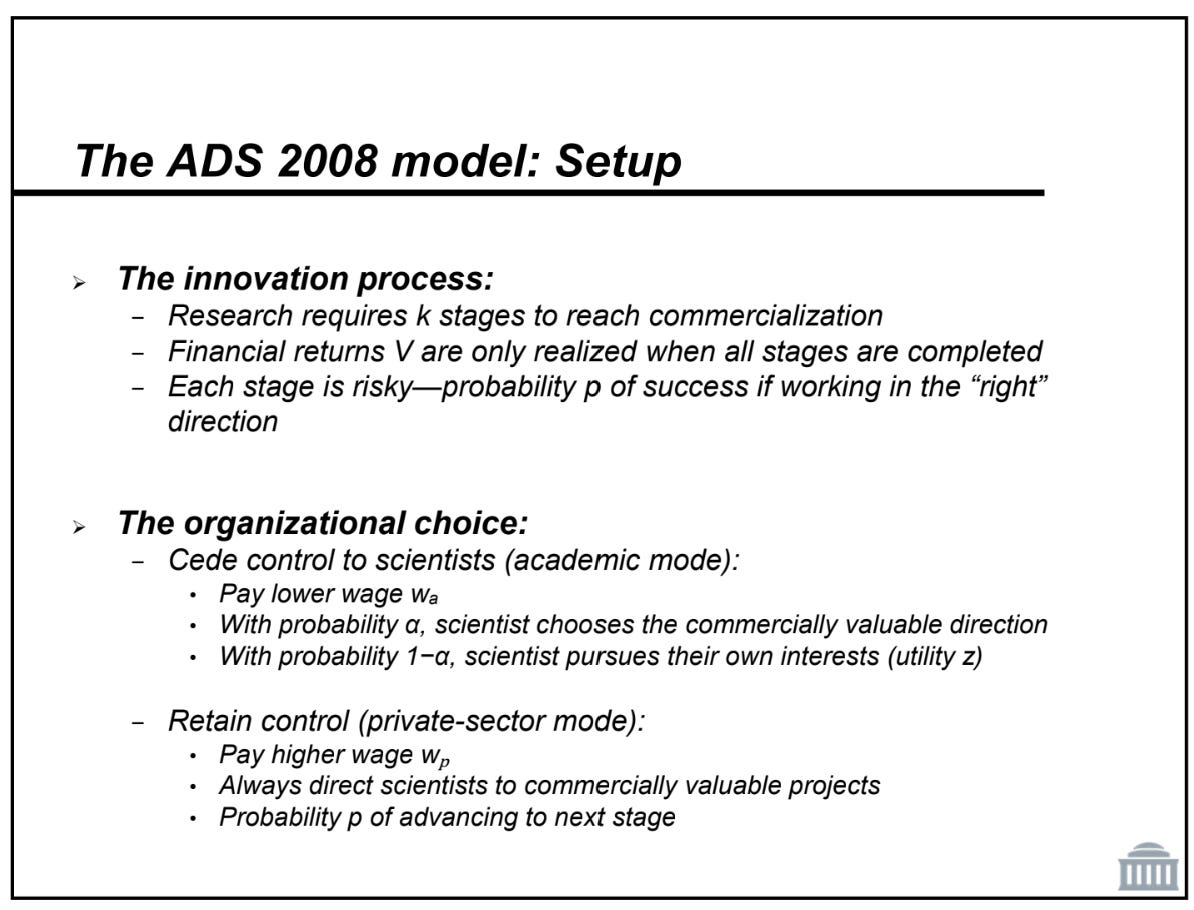
Imagine you’re trying to develop a new drug or technology. That requires going through a number of stages — let’s say k stages: maybe basic science, then proof of concept, then clinical trials, then manufacturing. You only get paid when you complete all the stages. Each stage is risky, even if you’re working on the right thing.
Here’s the key choice. You can organize research in two ways. In the academic mode, you cede control to scientists. They choose what to work on and how. The advantage is you pay academic wages — let’s call that Wᴀ. The disadvantage is that scientists sometimes choose directions that serve their own interests rather than commercial goals. With probability α, they happen to choose what you’d want anyway — their interests align with the commercial value. But with probability 1 − α, they go off and do their own thing. They still get utility Z from pursuing their own research agenda.
In private-sector mode, you retain control. You tell scientists exactly what to work on. They always work in a commercially valuable direction, but you have to pay higher wages — let’s call this Wᴘ — to compensate them for giving up autonomy. The cool thing about this model is that it captures the Stern compensating differential, but embeds it in a sequential, cumulative innovation process.
The question becomes: at what stage of the research process should you switch from academic organization to private-sector organization? Should early-stage research happen in the university and late-stage in firms, or vice versa? The model gives us a clean answer, and I think it has a really cool intuition.
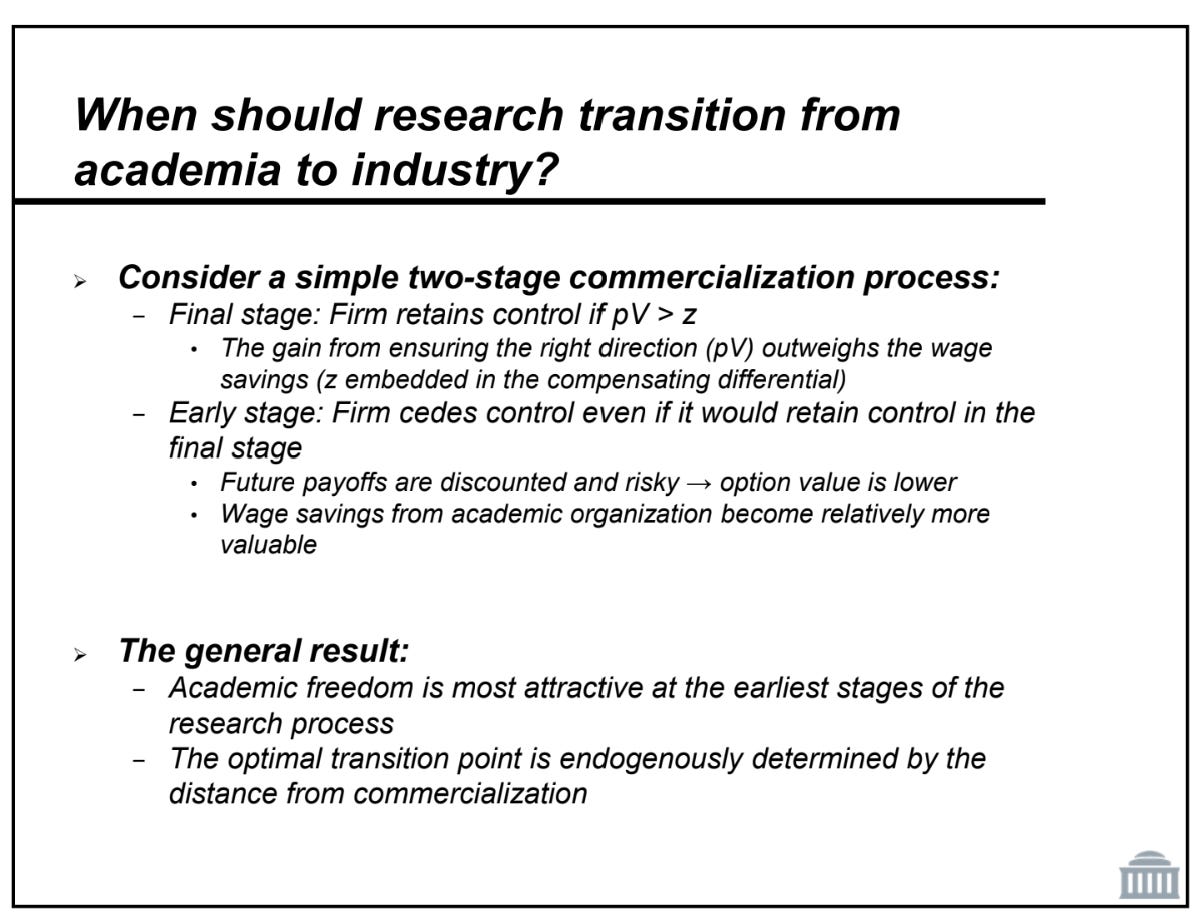
You start with the very last stage. You’re one step away from commercial payoff V. Should you organize this as academic research or private-sector research? If you cede control to scientists, with probability α they do what you want and you get pV; but with probability 1 − α they pursue their own interest and you get nothing. On the other hand, you save money on wages. If you retain control, you always get V, but you pay more. The firm retains control when expected benefits exceed the wage savings, which is basically Z, the utility scientists get from autonomy.
Now step back one stage. You’re two stages away from commercialization. Should you retain control or cede it? Here’s what’s changed. The benefits from control are now further away and more uncertain. You’re not getting V next period; you’re getting the option value of maybe reaching the next stage, which then gives you another option value. These option values are smaller than direct payoffs because they’re risky and discounted. But the wage savings are immediate and certain — you’re paying academic wages right now.
So at earlier stages, the wage advantage of academic organization becomes relatively more important, and the focus advantage of private-sector organization becomes relatively less important. The result is an endogenous cutoff point. Early stages should happen in academia — that’s where wage savings dominate and where you want exploration anyway. Later stages should happen in firms — that’s where focus becomes valuable enough to justify the wage premium. The model tells you exactly where this transition should occur, based on the parameters P, V, Z, α and the wage differential. There are really cool extensions as well — for example, when a research line can branch into multiple projects.
Does science matter for technology?
Understanding how science works as a social institution is important, but there’s an elephant in the room we haven’t addressed: does this matter at all for technological progress? Could we just fund applied R&D directly and skip the whole scientific enterprise?
Vannevar Bush, writing his famous 1945 report ‘Science, the Endless Frontier,’ articulated what we now call the linear model: the idea that basic science flows naturally into applied science, which generates technology, which produces economic growth. It’s an elegant story, and it provided the intellectual foundation for massive public investments in basic research. In the US, the NSF, the NIH, the growth of research universities — all of this was justified by appeal to the linear model.
You might ask: is Bush right? That’s what we’re going to examine in this section. We’ll look at evidence for the linear model, but we’ll also complicate the picture considerably by examining how science and technology interact. Spoiler alert: it’s messier than what Bush thought, but it’s also more interesting. The key insight we’re going to develop is that science doesn’t just generate specific findings that get applied; it provides something more fundamental — a map of the technological landscape that helps innovators search more effectively.
Let me tell you my favorite example of the linear model in action: Thomas Brock and the discovery of Thermus aquaticus.
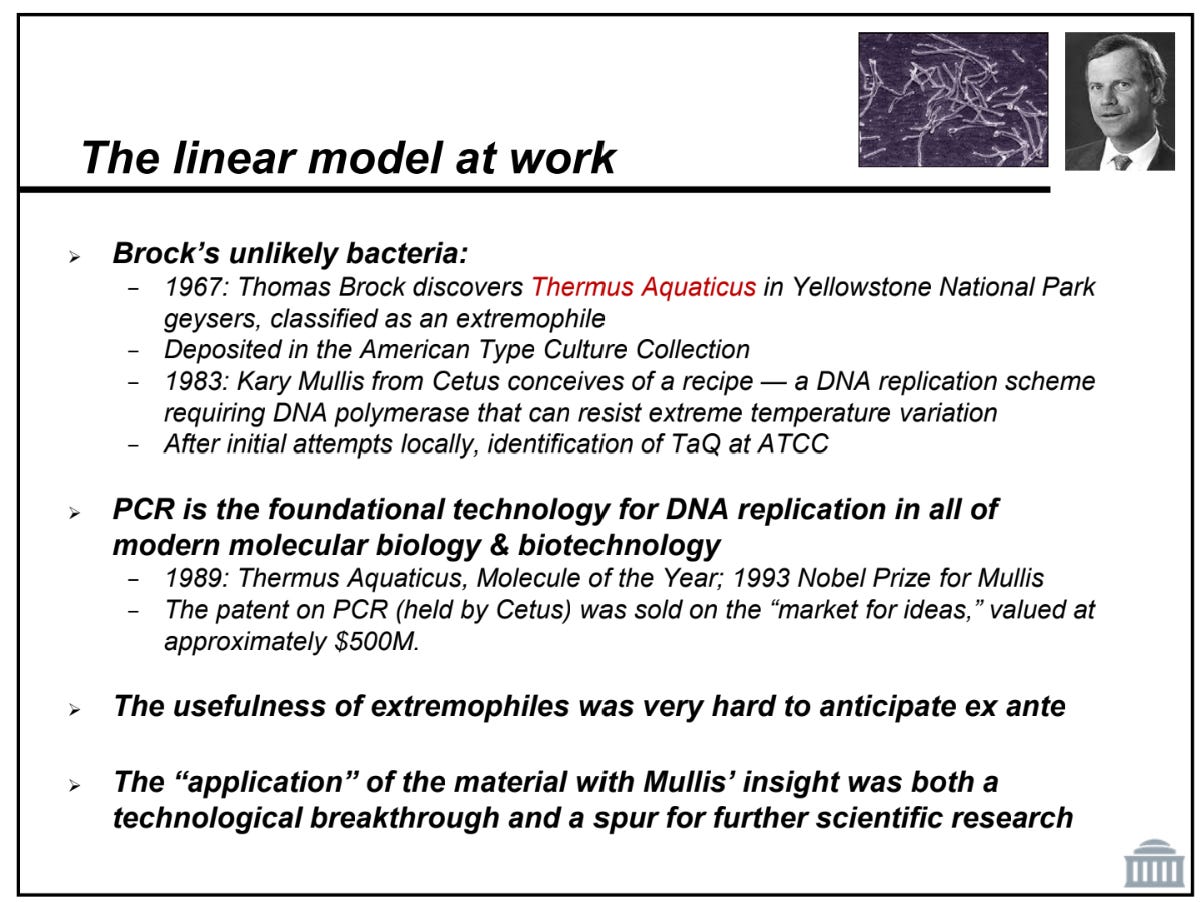
It’s 1967, and Brock was literally hunting around Yellowstone National Park studying extremophiles — organisms that survive in extreme environments. In the hot springs of Yellowstone, where water temperature fluctuates widely, he discovered the bacterium Thermus aquaticus, which could survive extreme temperature variation.
This was pure curiosity-driven research. Nobody was thinking about practical applications. Brock published his findings, characterized the organism, and — crucially — deposited it in the American Type Culture Collection (ATCC), a research-materials repository. He got tenure. Great. That’s how science works.
Now fast-forward 16 years. Kary Mullis, working for Cetus Corporation, was trying to develop a technique for amplifying DNA. The problem is that you need a DNA polymerase enzyme that can withstand repeated temperature cycles. This was hard — most enzymes degrade at high temperature. After considerable searching, someone (accounts differ on whether it was a graduate student or someone at a seminar) pointed Mullis to Thermus aquaticus, sitting in the ATCC repository. Its DNA polymerase, Taq, was exactly what was needed.
This led to the Polymerase Chain Reaction, which became absolutely foundational for all modern molecular biology and biotechnology. When you see the show CSI, every time someone gets genetic sequencing, it all depends on PCR. Mullis won the Nobel Prize, Thermus aquaticus was named molecule of the year, and the patent on PCR was worth about $500 million.
That’s the linear model in its classical form: curiosity-driven basic research generates knowledge that, 16 years later, becomes the foundation for a transformative technology. The usefulness of extremophiles was completely impossible to anticipate ex ante.
Science as a map
Here’s a puzzle. More science leads to more technological progress. Yet only a minority of patents directly cite scientific papers. So how is science helping?
An important framing point for the papers I’m about to talk about: they all examine science as a type of knowledge, as an input into technological production. They’re not about science as an incentive system — the priority system, the Matthew effect, compensating differentials. None of that is front and center here. Instead, these papers ask: what does scientific knowledge do for inventors? What is its functional role in technological search?
We’re going to begin with Fleming and Sorenson. Their answer is: science provides a map. Scientific knowledge tells us how the world works — underlying principles and mechanisms. Technology captures and orchestrates these regularities to do something useful. But new technology steps into the unknown, either using novel processes or combining existing ones in novel ways. Science can help inventors navigate the uncertain, unknown terrain. It provides an imperfect map of the space. It tells you where to look, what combinations might work, which are likely to fail. Science reduces search costs by providing cognitive guidance.
Here’s the key insight: not all technologies benefit equally. Some technologies are forgiving — you can combine components many different ways and things still work. Think modular systems: for these, trial and error is fine; you don’t need deep scientific understanding. But other technologies are what you might call fussy: components must combine precisely, or everything falls apart. Small changes can cascade into big problems. For these tightly coupled systems, trial and error is prohibitively expensive. So having a scientific map becomes valuable, because it lets you avoid the vast space of failed combinations and directs you toward the narrow space where success is at least possible.
That’s what Fleming and Sorenson test: does science matter more for fussy technologies? That’s the key result. It’s an interaction effect in a cross-sectional regression.
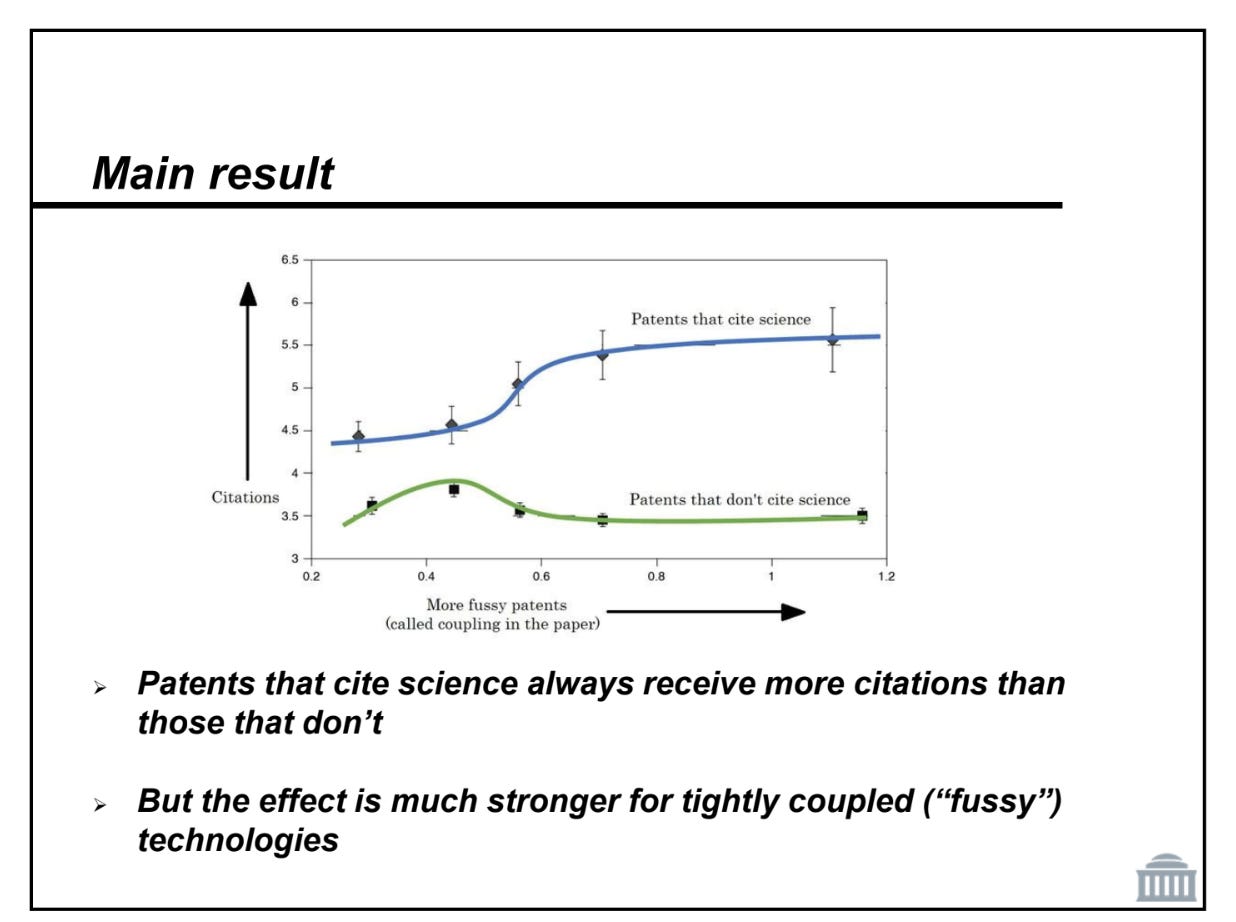
Patents that cite science always tend to receive more citations than patents that don’t — that’s the baseline science premium we’ve known about for a long time. But what they show is that the gap between patents that refer to science and patents that do not is actually much wider for those so-called “fussy” technologies.
Let’s try to unpack what that means. If you’re inventing something where components are loosely coupled — modular, flexible, forgiving — you can afford to do a lot of trial and error. Having scientific understanding helps a bit, but the gains are modest; you’ll probably figure it out eventually through experimentation. But if you’re inventing something where components are tightly coupled, where small changes in one component cascade through the system and break everything, trial and error is very expensive. The search space is huge and most of it leads to failure. So having a scientific map, which tells you which regions of that search space are worth exploring, becomes really valuable.
There are follow-on papers that do this much better. One is the paper by Ahmadpoor and Jones called ‘The Dual Frontier.’ But Fleming and Sorenson was the first paper of that type, and it’s been very influential.
Pasteur’s Quadrant: basic and applied at once
We’ve seen evidence that science matters for technology through multiple mechanisms. That raises a natural follow-up question: how should we organize the boundary between the activities of science and the activities of technology? What kinds of institutional arrangements best support research that connects scientific understanding with technological application?
The linear model gave us a clean answer: keep them separate. Universities do basic research; firms do applied research and development; knowledge flows from universities to firms through publications. Simple. But is that how the world works?
To tackle this question, we need to rethink some categories. The linear model treats basic and applied as sequential stages: first you do curiosity-driven basic research, then someone else does goal-oriented applied research. But as it turns out, that’s too simple, because research can live in both worlds simultaneously. It can be both basic and applied. So you get an inherent tension between the scientific norms and the commercial norms. Let’s explore that.
What you’re getting in this lecture is a bit of a greatest-hits of examples. We keep coming back to those examples because they can really help tell the story. Thermus aquaticus was one. Another is the OncoMouse.
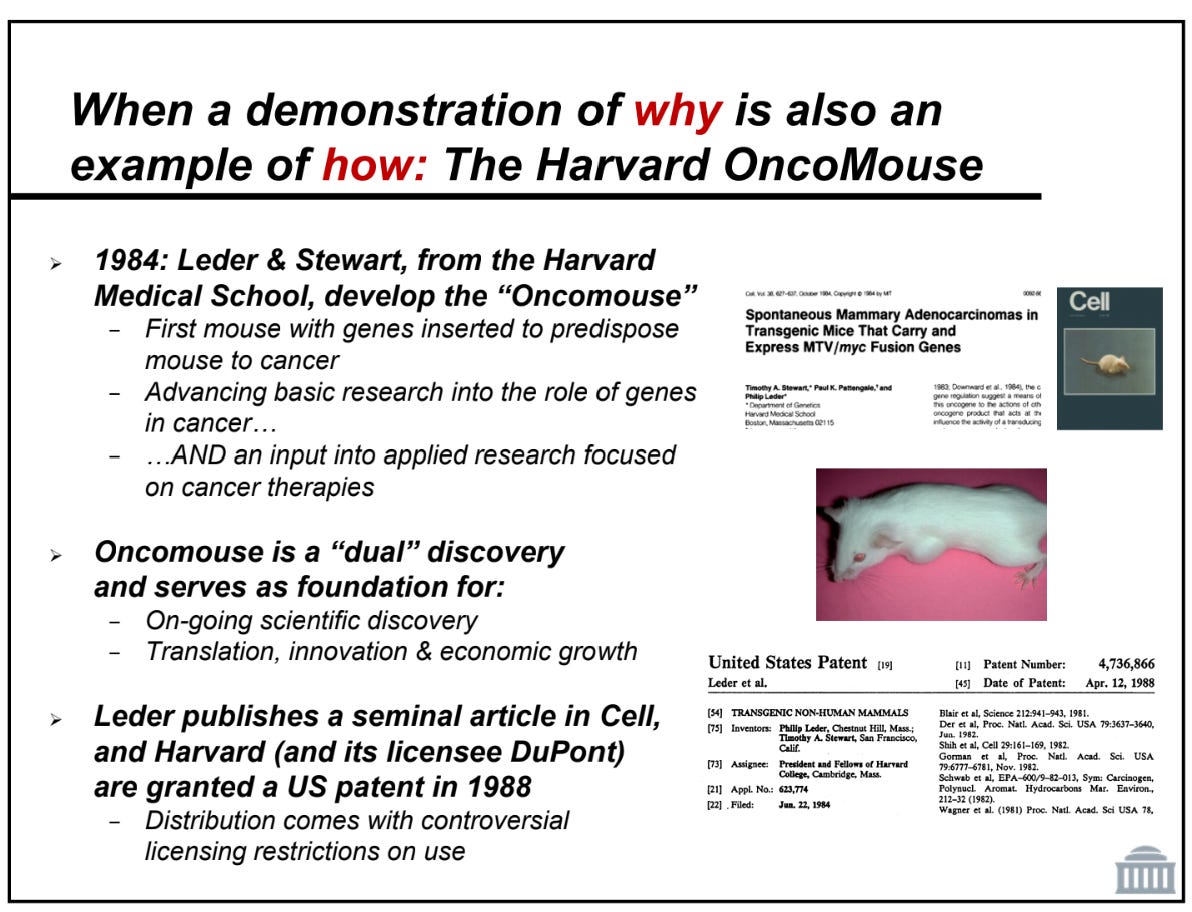
In 1984, Philip Leder and Timothy Stewart at Harvard Medical School developed the first mouse with genes inserted that predisposed it to cancer. They used an oncogene — a gene that, when activated, promotes tumor development. This is simultaneously a scientific breakthrough and a very practical tool.
On the scientific side, it demonstrates that you can insert specific genes and produce predictable effects on cancer susceptibility. They’re testing a fundamental hypothesis about the genetic basis of cancer. It’s advancing our understanding of why: why do organisms develop cancer? What’s the role of specific genes?
At the same time, it’s a how. How do you test potential cancer therapies? If you want to develop new drugs, having mice that reliably develop particular forms of cancer is enormously valuable. You can test whether your drug prevents tumors, shrinks existing tumors, extends survival. So this OncoMouse is simultaneously answering a scientific question and providing a very practical research tool.
Leder did what good scientists do: he published in Cell, one of the top journals. The scientific priority is established. But Harvard also did what universities increasingly do post Bayh–Dole: they filed for a patent, which was granted in 1988, and licensed the patent exclusively to the firm DuPont.
This is where the friction starts. DuPont didn’t just want to sell mice. They wanted reach-through rights: the idea is that if you use the OncoMouse to develop a therapy, DuPont gets a piece of the action. They wanted the right to review publications using their mice. This created enormous tensions with the research community. Scientists felt these restrictions violated the norms of open science. But from DuPont’s perspective, they’d made a major investment and wanted to earn a return on it.
This framework, developed by Donald Stokes, reconceptualizes the basic/applied distinction in a way that’s much more useful than the linear model.
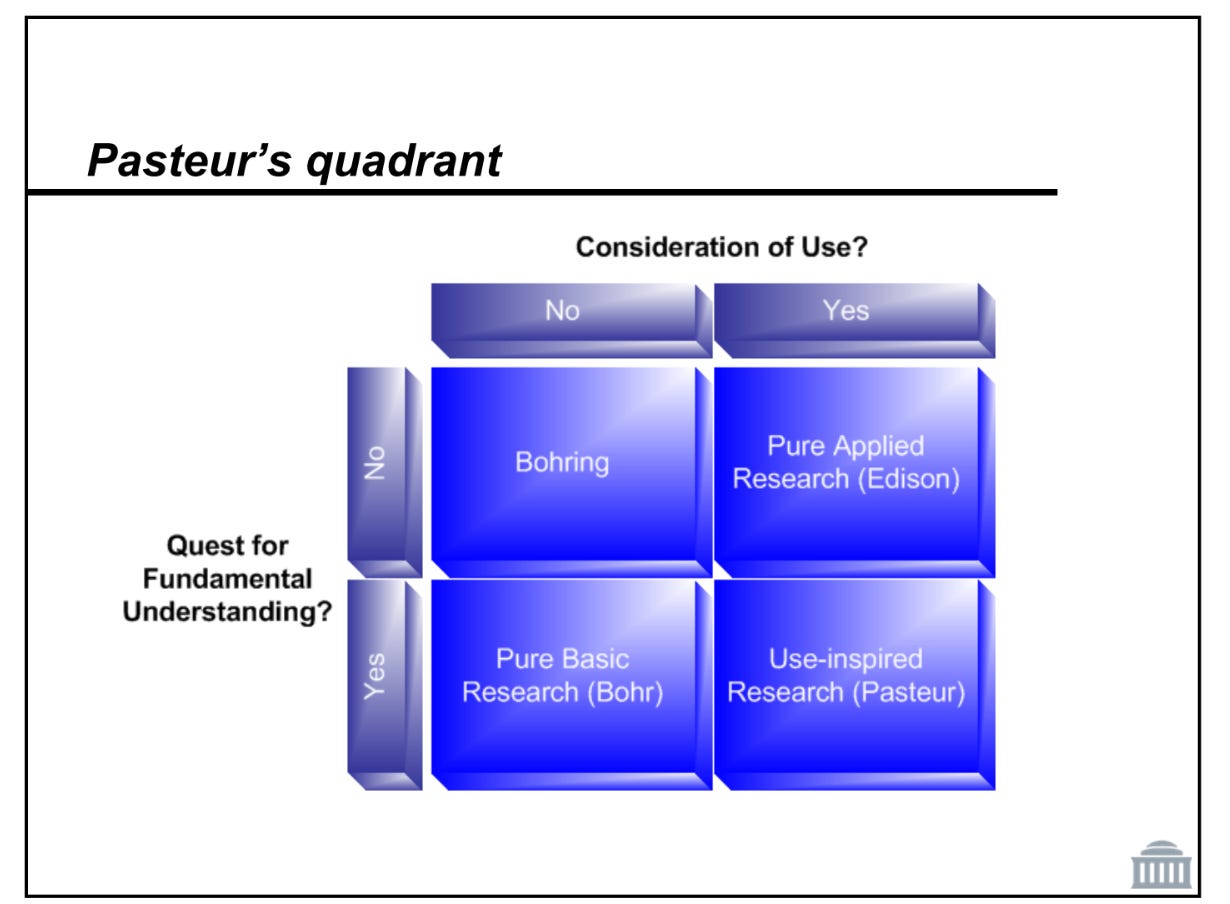
Instead of treating basic and applied as sequential stages, Stokes says they’re independent dimensions. On one axis you have quest for fundamental understanding: are you trying to advance scientific knowledge about how the world works? On the other axis, considerations of use: are you motivated by a practical problem? Are you trying to develop something useful?
This gives you four quadrants:
Pure basic research — high on fundamental understanding, low on considerations of use. We could call it Bohr’s quadrant. Niels Bohr wanted to understand the structure of the atom; he didn’t care about applications. Thousands of papers, zero patents.
Pure applied research — low on fundamental understanding, high on use. We might call that the Edison quadrant. Thomas Edison ran thousands of experiments at Menlo Park trying to make better light bulbs, better phonographs, better everything. He explicitly didn’t care about publishing scientific results; he refused to let anyone publish about the Edison effect, even though it was named after him. Thousands of patents, zero papers.
Use-inspired basic research — high on both dimensions. This is the Pasteur quadrant, named after Louis Pasteur. Pasteur was working as a consultant for the French wine and dairy industries — very applied problems: why does wine ferment? How do we preserve milk? But his investigation led to the germ theory of disease, one of the fundamental scientific breakthroughs of the 19th century. Pasteurization is simultaneously an industrial process and a profound scientific insight.
The most important research often lives in Pasteur’s quadrant. It’s simultaneously advancing fundamental understanding and solving a practical problem. The OncoMouse and most modern biotech live in Pasteur’s quadrant. This creates inherent tensions, because you’re trying to satisfy both scientific norms and commercial incentives at the same time.
Openness as a natural experiment: Of Mice and Academics
The next study is Murray et al., poetically named ‘Of Mice and Academics.’ These authors — you can notice the author overlap with the ADS 2008 paper — examine a natural experiment in openness. They’re testing the ADS framework empirically using the OncoMouse story.
The theoretical framework from Aghion, Dewatripont, and Stein suggests two distinct effects of openness. Vertical exploitation means more follow-on research: if access costs are lower, more people can build directly on existing work. But there’s also horizontal exploration: openness might enable entirely new researchers to enter the field and pursue novel research directions that wouldn’t have been explored under restricted access.
Here’s the natural experiment. By the mid-1990s, DuPont held patents on two crucial mouse-engineering technologies, Cre-lox and OncoMouse. These patents covered hundreds of different engineered mice, and access was highly restricted — complex licensing agreements with reach-through rights on anything you discovered using the mice, which created significant delays and costs. The research community lobbied for years for more open access.
In 1998 and 1999, the NIH director Harold Varmus — who had won the Nobel Prize and understood the scientific stakes — negotiated memoranda of understanding between the NIH, DuPont, and the Jackson Laboratory, the mouse repository. These agreements dramatically reduced access costs for academic researchers: simple one-page material transfer agreements replaced complex licensing, and the Jackson Lab was committed to distributing mice openly.
The point is that this memorandum was largely unanticipated in its timing and its scope. There had been lobbying for decades, so researchers couldn’t time their work around it. The agreements covered the entire population of DuPont-controlled mice, so there’s no selection bias. Crucially, there’s a natural control group: knockout mice and spontaneous-mutation mice were created using different methods and weren’t subject to DuPont’s restrictions, so their access costs didn’t change. This lets Murray and co-authors implement a very clean difference-in-differences design.
This is the key result for vertical exploitation.
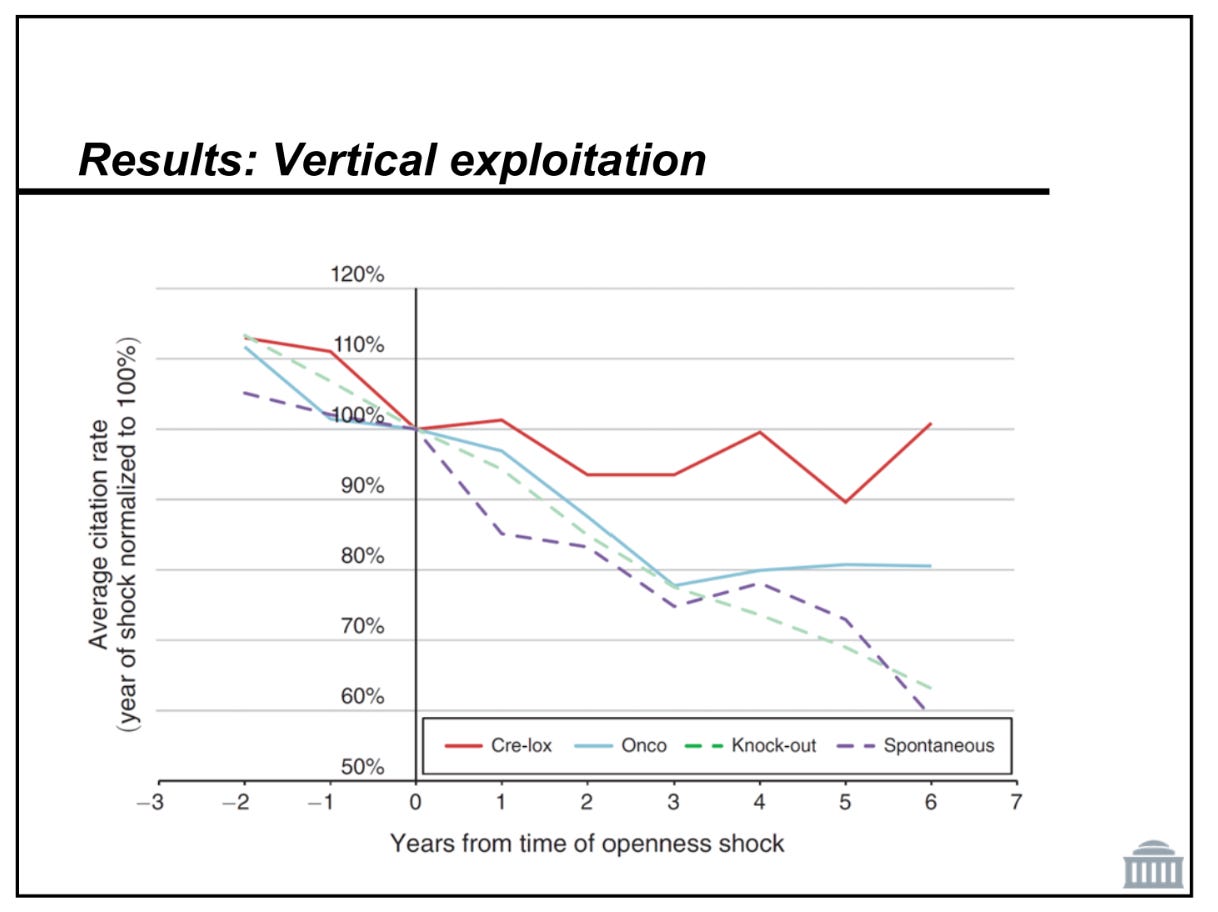
Here again, I’m not doing full justice to the paper — but it’s a great paper, you should absolutely read it. The figure shows annual citations to mouse articles over time. What’s a mouse article? Each time you create an engineered mouse like this, there’s a paper associated with the mouse. You can then think about the extent to which follow-on researchers cite this mouse in their own research. You can do it for treated mouse papers and for control mouse papers — hence the diff-in-diff.
The figure shows the annual citations to mouse articles over time, comparing treatment — OncoMouse and Cre-lox — to control: knockout and spontaneous. The vertical line marks the NIH agreements in ’98-’99. Before the agreements, the two groups track each other relatively closely. Citations to both treatment and control mice are declining over time, which is natural: all papers get cited less as the field moves on. But the rates of decline are parallel. This validates the parallel-trends assumption.
After the agreements, you see a clear divergence. Citations to treatment mice increase substantially relative to the control group. The boost is 20-30%, depending on the specification. So that’s vertical exploitation: more follow-on research using these now-open research tools. This makes intuitive sense. Before the agreements, many researchers who might have wanted to use OncoMouse or Cre-lox mice were deterred by access costs and licensing restrictions. They either used different tools, chose different research questions, or left the field entirely. After the agreements removed the barriers, more researchers could access the tools they needed, and follow-on research accelerated.
Notice one thing that didn’t happen: citations to the control group don’t decrease. This isn’t researchers substituting from knockout mice to OncoMouse. If that were happening, you’d see the control group decline when the treatment group rises. Instead, both increase, with treatment increasing more. The openness shock expanded the total amount of research; it didn’t just redistribute research across tools. This is important, because it suggests the pre-agreement restrictions were genuinely blocking research that had positive social value, not just creating a queue that would have happened anyway. There are additional findings that are very interesting in this paper. There’s also the horizontal exploration effect: they provide evidence of much more diverse experimentation.
Funding design and tolerance for failure
We focused on one particular institutional friction with this paper: what happens when scientific and commercial incentives collide at the frontier, especially in fields like biotech that live in Pasteur’s quadrant. But there are many other ways that institutional design affects productivity within science, independent of commercialization. How do scientists access frontier knowledge produced elsewhere? How do funding agencies decide which research to support? How do scientists access physical research materials they need to build on each other’s work?
This is where I’ve done most of my research. I’ll tell you about just one paper. It’s about science funding, tolerance for failure, and scientific exploration. It has been and will continue to be a very fertile area of research. It’s called ‘Incentives and Creativity: Evidence from the Academic Life Sciences.’ We want to think about whether what explains scientific productivity at the individual level is not just the amount of funding people receive, but how they’re funded — the incentives inherent to the funding contract.
What we want are scientists that are at risk of receiving grants with different incentive structures. We want to see if particular types of grants are associated with greater scientific creativity. To do that, we study the Howard Hughes Medical Institute (HHMI) investigator program. I talked about it earlier with the Matthew effect study. HHMI is the most important private funder of academic biomedical research in the US, and probably the world.
Roughly every three years they select 50 youngish biologists from elite institutions. It’s very prestigious — that’s why we studied it as a status shock. If you get appointed to HHMI, it becomes part of your institutional identity: you might be MIT and HHMI, or Sloan Kettering Institute and HHMI. But it’s also a major source of funding for those scientists.
What does HHMI tell people? They say: “Your job is to change your field.” Here is a pot of money; in five years we’re going to ask whether you’ve used that pot to change the nature of the questions being asked in your field. It’s not just a prize. A prize would be: “You won, we give you money, and then our job is done.” This has real bite, meaning an HHMI appointment is something you are at risk of losing.
What’s important and interesting is that I said it’s five years — that’s not true. It’s really ten years, because at the end of the first five years as an HHMI, what HHMI wants to know is: have you used the freedom you were granted? Have you at least tried? The axe is really going to fall at the end of the second five years. So ten years in, they start asking, “You’ve had ten years to try to change your field, have you?” At that point lots of people are being discontinued — kicked off the program. But that’s a much longer time horizon relative to the NIH R01 grants, which are the standard government grants in biomedical research in the US, where it’s 3-5 years. It’s really not forgiving of failure — people are going to scrutinize all the stuff you’ve published in the last 3-5 years.
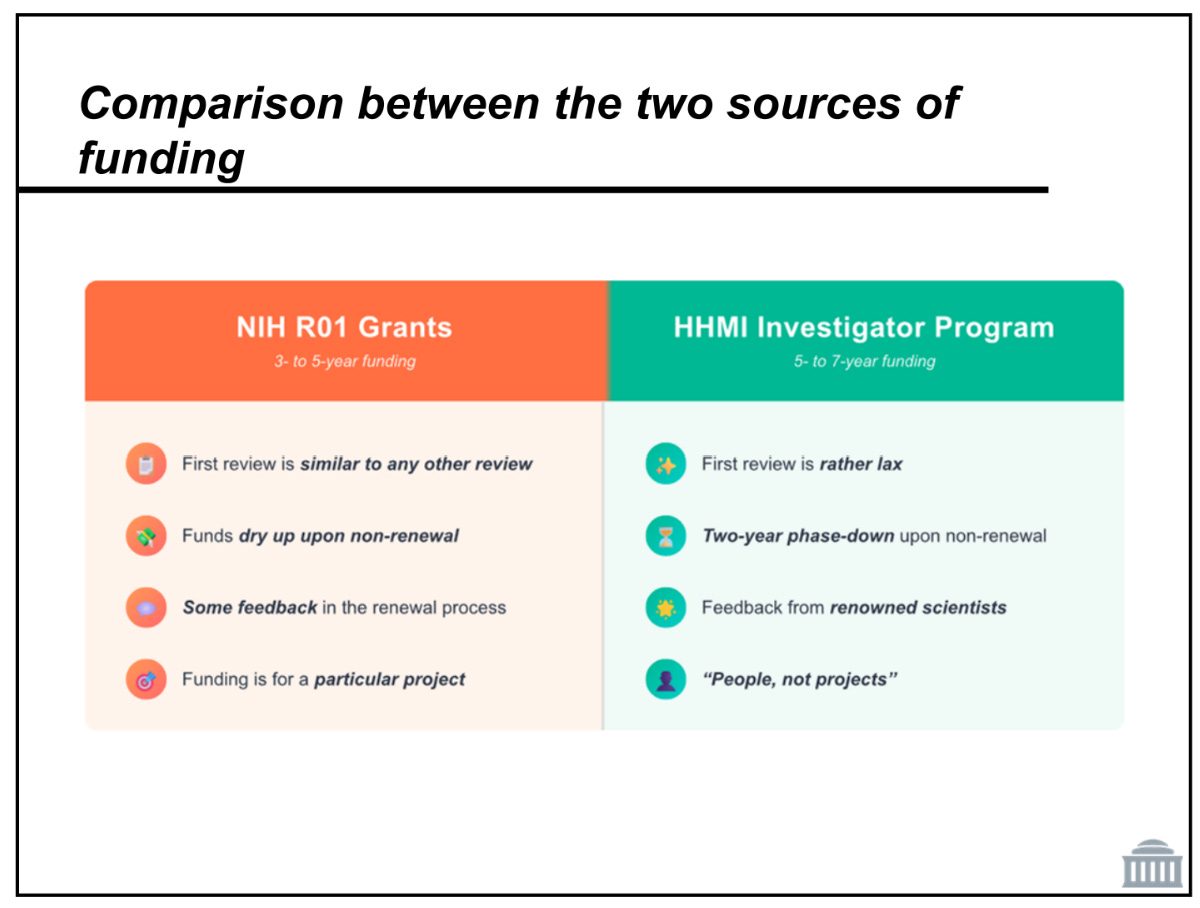
Importantly, the NIH funds you for a particular project, whereas HHMI funds the person. That means if, in the middle of your 5-10 years, you decide that the idea you had isn’t going to work, you can just use the funding to do something else instead — which is not possible at the NIH.
What we did in this project is — we’d have loved it if HHMI were ready to randomize after a first cut of selection into their program. They’re not willing to do that. They also don’t really have a regression-discontinuity design — a hard cutoff. What we ended up doing is selection on observables. This is the picture.
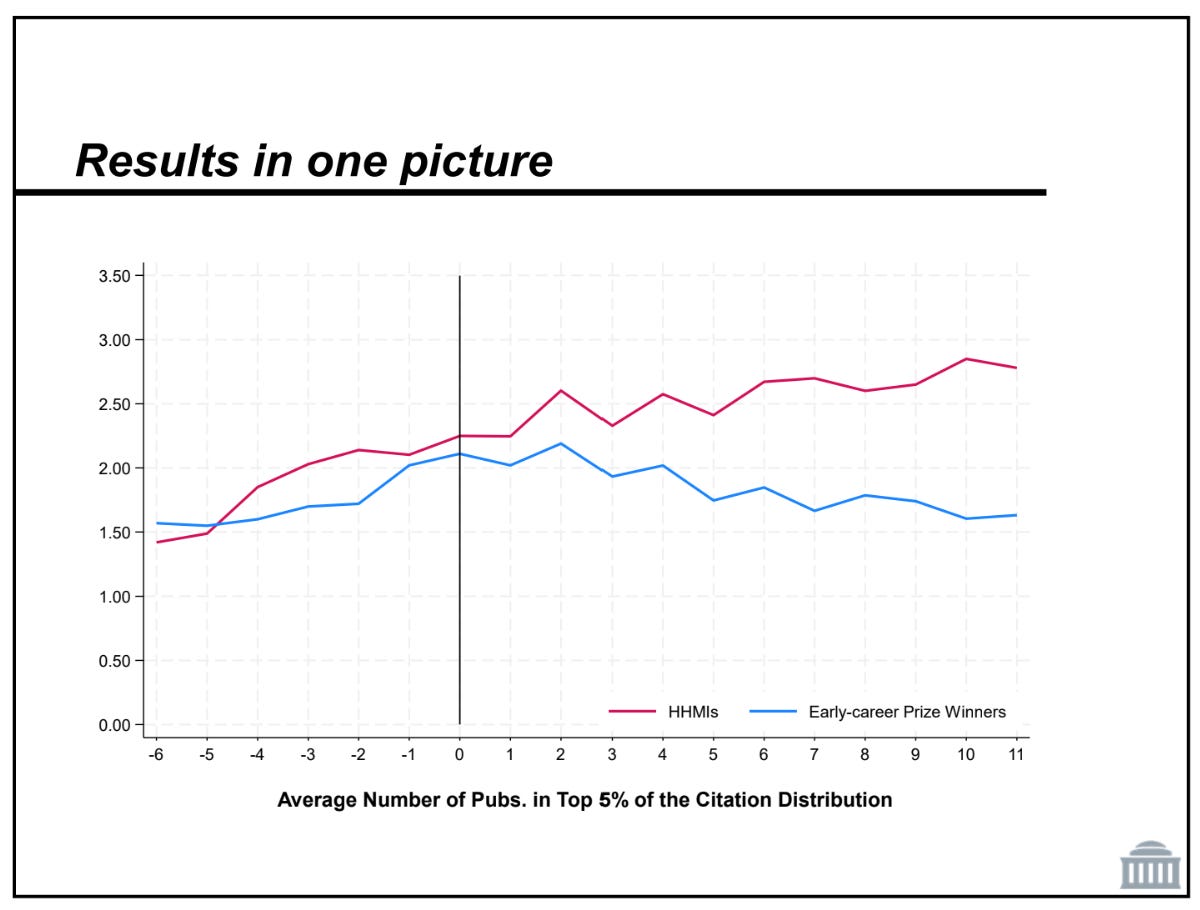
It’s a kind of synthetic-control study, if you want to place it in the methodological landscape. We have lots of different outcomes, but relative to the controls, the HHMIs don’t produce more papers — but they produce more important papers. They also fail more often, meaning they produce more papers that are complete citation duds. They swing more for the fences than the controls. The controls revert to their mean, whereas the treated scientists really expand and enlarge an impactful research agenda following selection into the program.
I’m papering over lots of details, and you can read it. This paper was published in 2011. There are tons of things that are wrong with it, and we try to level with the reader on that. It’s totally possible to do much better than what we’ve done. But today it’s my second most highly cited paper, and that’s because it was the first one that asked that type of question.
Synthesis
Let me try to synthesize what we’ve learned.
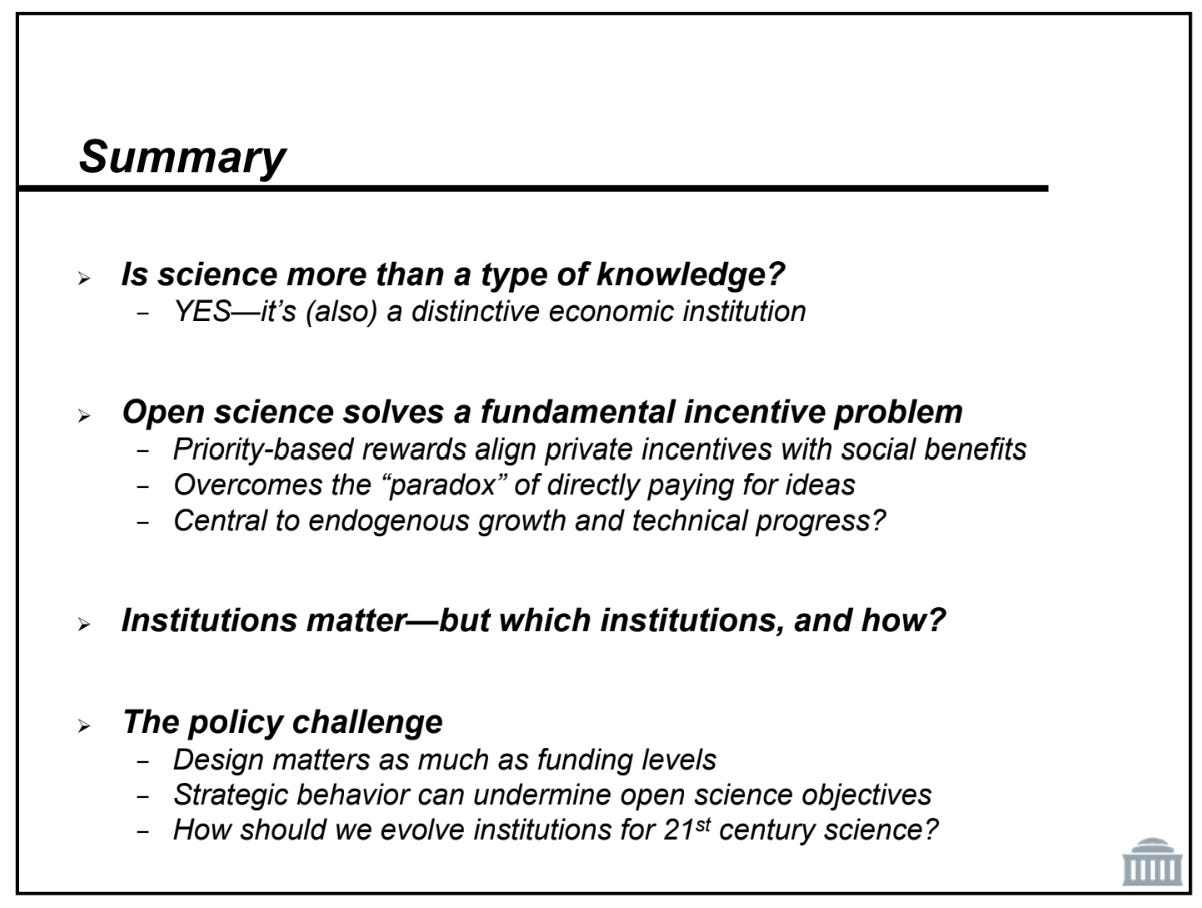
We asked whether science is more than just a type of knowledge, and the answer is yes. Science is a distinctive economic institution with specific incentive structures that solve market failures in knowledge production. The priority-based reward system, where scientists compete to be first to publish, creates incentive compatibility: it aligns private incentives with the social benefit of rapid knowledge disclosure.
This solves what we might call the paradox of directly paying for ideas. How do you reward discovery when knowledge is non-rival and hard to exclude? The priority system does this by turning knowledge production into a winner-take-all race. Actually, it turns out it’s not winner-take-all, but maybe winner-take-most, where the reward is reputation rather than control rights over the knowledge itself.
The question you want to ask is: is science really central to endogenous growth and technical progress? We’ve seen some evidence today that disruptions to open science reduce both scientific productivity and downstream technological innovation. Institutional design matters just as much as funding levels. The details — how we structure access to knowledge and materials, how we design funding mechanisms, how we balance openness against IP — those are first-order policy instruments. Strategic behavior can undermine open-science objectives, and the institutions that worked well in 1950 may not be optimal for 21st-century science. The big question is: how should we evolve them? That’s one of the frontier questions for both policy and research.
Also a founder of Creative Commons!
After I discovered and researched the true science of macroeconomics (in opposition to its prior pseudo-science that is commonly taught), my book "Consequential Macroeconomics--Rationalizing About How Our Social System Works", was published in 2015, along with two short working papers, all related to my findings. I would like to share this work with economists but somehow they do not appear to be interested. There is a saying about new science, that can only be acceptable after there is a funeral. That is to say, when the upholders of the old explanations can no longer have the power to reject the advance.