


Editor’s Note: My mental model of the American science ecosystem did not provide much space for the National Labs until I met Jordi Cabana, the author of this piece. I both underestimated the scale of the Labs (over triple the size of DARPA) and their scientific output. Not everyone suffers from my blindspot, though. In meetings with congressional offices about IFP’s X-Labs model over the last few months, I’ve heard versions of: “why can’t we do this through the National Labs?”
As I said to the congressional staffers, I think there are meaningful differences between new scientific institutions, such as Focused Research Organizations and X-Labs, and the National Labs. That the Labs are massive, old, and federally-owned really is important when comparing them to institutions that are small, new, and free from regulatory and bureaucratic buildup. And it’s good to try new things; when the National Labs were set up in the middle of the 20th Century, they too were new scientific institutions.
I hope that some of the proponents of new institutions referenced in this piece (Caleb Watney and Ben Reinhardt) and anyone else with a take or a stake will respond. What can new institutions learn from the Labs? What can the Labs learn from new institutions? And how can metascience better integrate the Labs into our collective mental model of science?
Disclaimer from the author: This piece represents my personal opinions, and not the opinions of either of my employers.
Metascience proponents have produced a flurry of think pieces arguing that new institutions are needed to accelerate innovation in R&D. They contend that academia, government, and industry are “ill-equipped to solve” important challenges because they “don’t provide the engineering teamwork needed to produce the platforms, datasets, or tools” required.
I agree with metascience’s emphasis on continuously reevaluating whether we are maximizing scientific progress. But many of these think pieces fall prey to a common pitfall in academic R&D: novelty bias. While it’s understandable to be excited about novelty, this tendency can lead to reinventing the wheel, where we ultimately recognize we had the tools we needed all along.
I hesitate to pick on my hosts, but the X-Labs described by Caleb Watney sound a bit like the National Labs. To quote Watney, “X-Labs would fill a longstanding structural blind spot in the US research ecosystem: work that is infrastructure-intensive, team-based, exploratory, or oriented around critical bottlenecks.” They “would provide stable, full-time roles for staff scientists, engineers, and technicians, enabling institutional memory and technical depth more typical of industrial R&D.” Sounds familiar.
Though they differ in size, nimbleness, and specificity of mission, Focused Research Organizations (FROs) are pitched with similar features and an added dose of Bell Labs nostalgia.1 While we might want to recreate the creative spirit of Bell Labs in new institutions like FROs, the infrastructure and personnel structure actually survives within the National Labs.
Does the call for new institutions describe what the National Laboratories already do? As I discuss in this article, the answer is that sometimes metascience writers are describing what the Labs already do and sometimes they’re describing what the Labs aspire to (but don’t always achieve). It’s worth revisiting the role of the National Labs. The metascience discourse neglects them in favor of new models for understandable reasons, but we risk leaving massive value on the table if we fail to make National Labs a central component of efforts to accelerate progress in R&D.
What are National Labs, exactly?
DOE National Labs are part of the broader category of Federally Funded Research and Development Centers (FFRDCs).2 Their mission is both to advance fundamental science and to occupy a missing middle: research that is too complex for a single principal investigator grant, but too risky or oriented on public goods for a startup or a large industrial incumbent to take on. National Labs shine precisely when the scale of a challenge demands approaches that are infrastructure-intensive, team-based, and motivated by critical bottlenecks, to borrow from Watney.
National Labs are a significant portion of the federal R&D budget. As of fiscal year 2024, the government invested over $31 billion in R&D at all FFRDCs, and DOE National Labs are a substantial portion of that investment. DOE contributes nearly $18 billion to the Labs. This figure is significantly larger than the budgets of other R&D funders, such as the intramural investments by the National Institutes of Health (~$5 billion) or the entire National Science Foundation (~$9 billion). Granted, ~40% of DOE’s overall spending is in the National Nuclear Security Administration (NNSA), whose programs in national security and non-proliferation makes the separation between “fundamental science” and “weapons maintenance” fuzzy. But NNSA directly manages three of the largest National Labs (Lawrence Livermore, Los Alamos, and Sandia), which house some of the flagship large R&D infrastructure and carry out plenty of fundamental science, so they cannot be dismissed simply because of their nuclear weapons maintenance function.
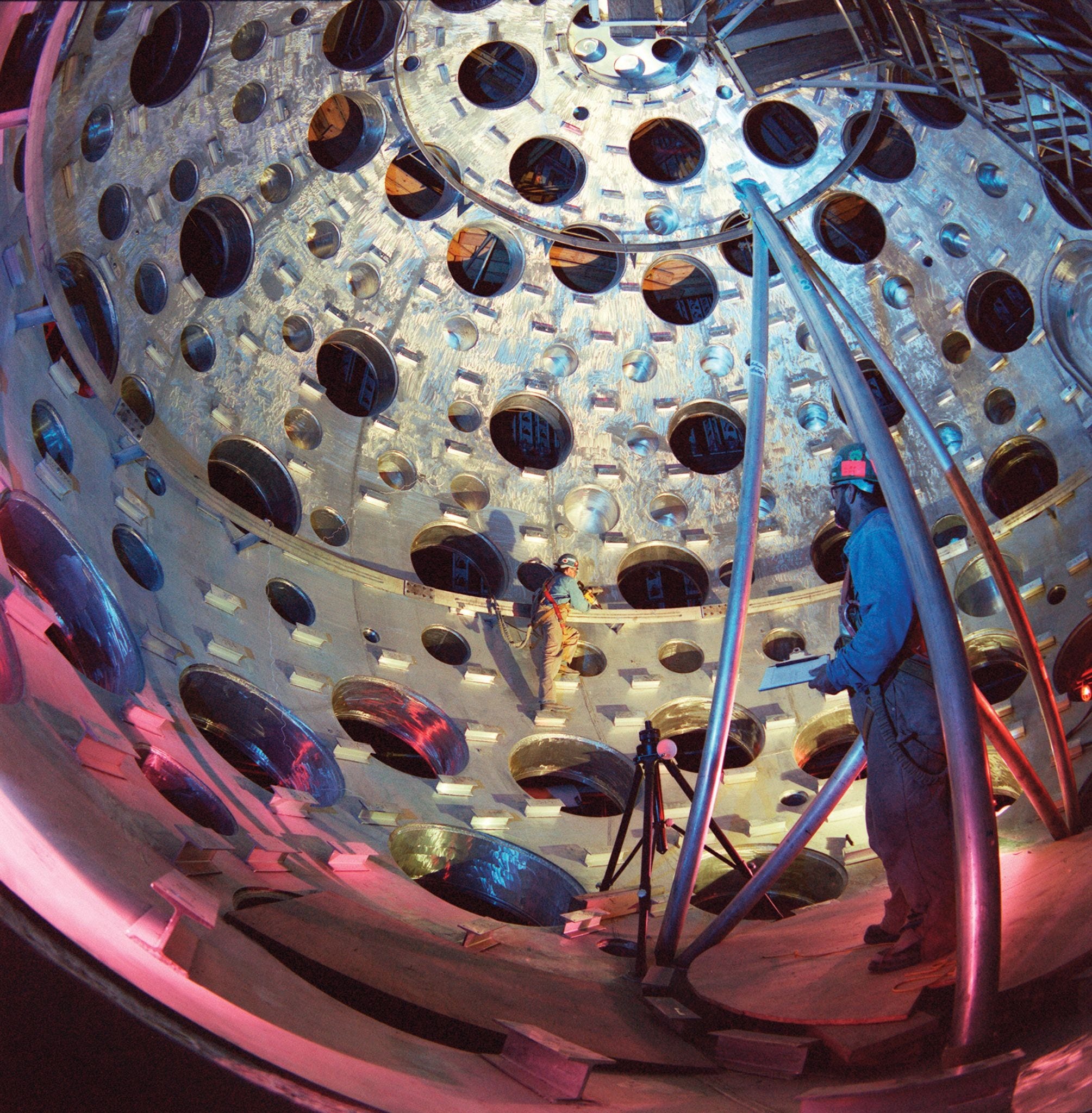
By design, National Labs house a lot of infrastructure. It is economically inefficient for every university or firm to have a particle accelerator, so that sort of equipment makes sense as a long-term federal investment. This practice holds true across fundamental–to-applied capabilities and scale, ranging from massive facilities to decentralized advanced instrumentation scattered across an institution’s buildings and campuses. The best-known examples of the former are the various X-ray light sources (synchrotrons) or the exascale computing facilities. On the NNSA side, they include the National Ignition Facility, which is important given renewed federal interest in fusion energy.
On the applied end of the basic-to-applied research spectrum, we find examples like facilities to accelerate manufacturing scale-up and nuclear test reactors. Many of these facilities have a mission to attract external users, which allows tens of thousands of scientists outside the National Laboratory complex to use them for their own research.3
Complex, multi-year engineering loops require experienced, permanent staff who are not splitting time with coursework or dissertations. National Labs are explicitly built and staffed for this kind of long-term team science. Their emphasis on problems that span from basic to applied forces cross-disciplinary collaboration and removes silos that are typical of academic institutional structures. This structure builds multidisciplinary density. It co-locates, say, domain scientists, computational experts, and process engineers and organizes them into a stable, long-term team to solve large challenges. Staff permanence reduces loss of tacit knowledge inherent to the passing of generations of students.
While universities have departments that cover a vast constellation of topics, National Labs are more narrowly focused on energy technology (albeit broadly defined). And while universities have a dual mission of education and research, National Labs are primarily focused on research. As a result, universities have a high proportion of graduate students, who are on a roughly five-year clock, compared to the primacy of the permanent (not to be confused with tenured) staff scientist model of National Labs.

What does this structural design buy?
The structure of National Labs allows them to perform many of the functions associated with new institutions for science: taking on ambitious, focused initiatives; collaborating on pre-commercial technology; and crafting the future of AI for R&D.
National Labs are arguably the original FROs. There are many examples of “time-bound, technically ambitious efforts” at National Labs designed to unblock whole domains of technical progress (the Manhattan Project might be the most famous one). And although it’s not their primary focus, the National Labs played important roles in biomedical research: the Labs were crucial to the Human Genome Project, for instance, by hosting unique, large omics facilities that were accessible to users nationwide. In addition, the Protein Data Bank, the foundation on which AlphaFold was built, was founded at Brookhaven National Lab and contains data measured at the US synchrotrons.
National Labs also offer an alternative to academia for scientists who need access to “equipment, skills or status” to advance their pre-commercial idea. In “Unbundling the University,” Ben Reinhardt writes that “it’s very hard for individuals and organizations to avoid interfacing with academia if they have an ambitious pre-commercial technology idea.” They can interface with the National Labs instead! Universities largely focus on basic generalizable principles and industry focuses on commercial deployment. National Labs are uniquely positioned to bridge this gap because they house both basic and applied R&D programs and can facilitate collaboration on pre-competitive research between academia and industry. Some of the applied programs at National Labs are explicitly tasked with taking a concept derived from a lab and piloting it, including through partnerships with industry.
The National Lab model is also uniquely suited to using AI and autonomous experimentation to accelerate science. Many of these facilities are centralized and operate year-round, so they can generate the massive, standardized datasets required to train foundational models, something a decentralized network of university labs cannot do. Moreover, the National Labs can host the repositories needed to curate large sets and make them widely accessible.They are also good hosts for large cloud labs that require millions of dollars in investment and upkeep. It is much harder for universities to serve this role because you cannot build a self-driving lab or a long-term AI-supported research loop if context is lost every time a student graduates. Institutions with staff permanence hold the substantial tacit knowledge needed for initiatives like the Genesis Mission, so it makes sense that the National Labs are central to their implementation.
So are National Labs the answer?
Although National Labs have many of the capabilities and staff needed for, say, an X-Lab, I must partially agree with the metascience writers: while the Labs can play the role that FROs and X-Labs are intended to, they often serve different functions and therefore require distinct strategies to maximize our return on R&D investment.
More specifically, the institutional dynamics of National Labs deviate from the model of X-Labs and FROs in four ways:
The current National Lab model may lead to mimicking the academic approach to research, structurally and culturally, rather than fulfilling the goal of complementing and augmenting academia. There is a tension between serving users at a large-scale facility carrying out their own R&D mission, competing for broad-based grant calls, and seeking scientific publications.4
Access to large facilities at National Labs is not as smooth as many in the private sector would want, and it can be expensive. But there are ideas to address barriers to using facilities.
Intellectual property agreements and security clearances create friction points to starting close partnerships with industry. But the Labs remain the only entity with the scale and neutrality to play this role, making the bureaucratic hurdles worth navigating.5
National Labs are subject to high overhead costs, which inspire questions about whether they are the most efficient use of tax dollars to achieve a desired R&D outcome.
Some of these issues are a result of institutional design. After all, DOE is a government agency that also uses the National Labs to manage nuclear weapons. It would be tough to get a National Lab to operate with the nimbleness and scrappiness of a start-up. Nevertheless, the Labs really do have many of the characteristics that proponents of new institutions say we need, and they have achieved impressive scientific feats. National Labs can be optimized, and metascience analysis and reform should consider how to refresh these institutions, rather than only angling to build new ones.
Direct metascience analysis at the National Labs
For infrastructure-intensive, engineering-heavy, decadal science, there is no substitute for the National Labs. No FRO is ever going to build a synchrotron or anything like the portfolio of delocalized, cutting-edge instrumentation that a National Lab offers. Metascience’s reform portfolio misses an opportunity to put the impressive National Labs infrastructure to better use. Rather than ignoring the Labs, we should use metascience approaches to investigate the following questions (to start):
How can we further activate the significant potential of the National Labs? What more can we get out of the existing ~$30 billion per year National Lab network? We need a better answer than just “National Labs are too slow.” How do we make them fast(er)?
What falls outside the National Labs jurisdiction and institutional design? Those should be the target for new institutions (X-Labs, FROs, BBNs…).
How do university and National Labs’ rewards for performance differ? Are the incentive structures at National Labs sufficiently different from universities to meet their distinct roles in the R&D landscape?
Attention to these questions will allow us to more tactically target interventions to fill the gaps that National Labs fundamentally cannot close. The new institutions envisioned by metascientists may differ from National Labs in some aspects, but National Labs certainly belong in the toolkit. It’s time to consider how to use them better.
Nothing like not having to worry about money to spur creativity!
In addition to the DOE-funded National Labs, there are labs managed by the military, NASA, and other agencies. For the purposes of this post, I will focus on the “classic” National Labs funded by the Department of Energy, since I know them best.
Yes, a professor at a small university can run experiments on a billion-dollar synchrotron!
National Lab scientists must cover their salaries from research grants. A small fraction are centralized at the Lab level and have a long-term commitment (so-called “hard money”), but most scientists today are on “soft money,” meaning that they have to compete for grants lasting 3-5 years just like faculty at universities.
This is an explicitly stated aim of the Genesis Mission, proving that there is serious interest in removing barriers.

Great article! You’ve convinced me that National Labs are closer to FROs than your typical government research orgs. I’ve been trying to map and categorize these alternative structures for research institutes here: https://structuresforresearch.com
The pressures to publish and apply for grants were my main reasons for grouping it that way, though maybe the pressures are much lower than I had thought.
Fraunhofer and Helmholtz research centers in Germany are similarly under represented in the metascience discourse and IMO warrant more analyses on the impact of their structures / incentives / outcomes.
I wonder if the issue will always be access to government resources - even internally there are probably problems with access to the use of equipment (depending on what it is) and for "outsiders" there is an additional problem of prioritisation - who gets first call on the equipment/lab, how much does access cost, how long do you have to wait?