


Governments should incentivize and support innovation.
Maybe this isn’t a surprising sentence to see at the top of a Macroscience article. But once governments decide to, how should they actually go about incentivizing innovation? This week’s Economics of Ideas, Science, and Innovation lecture is about the policy levers that governments have available to them.
Society gets three times more return on R&D than a firm is able to capture. As Flaubert put it, inventors “all die in the poorhouse. Someone else profits from their discoveries.” Or, as another Economics of Ideas, Science, and Innovation lecturer Matt Clancy stated in the title of an excellent blog post, knowledge spillovers are a big deal.
John Van Reenen, the Ronald Coase Chair in Economics at the London School of Economics, is one of the authors of the legendary (at least in my circles) lightbulb table that grades innovation policies on the evidence behind them, the payoff they have, and how fast they work.
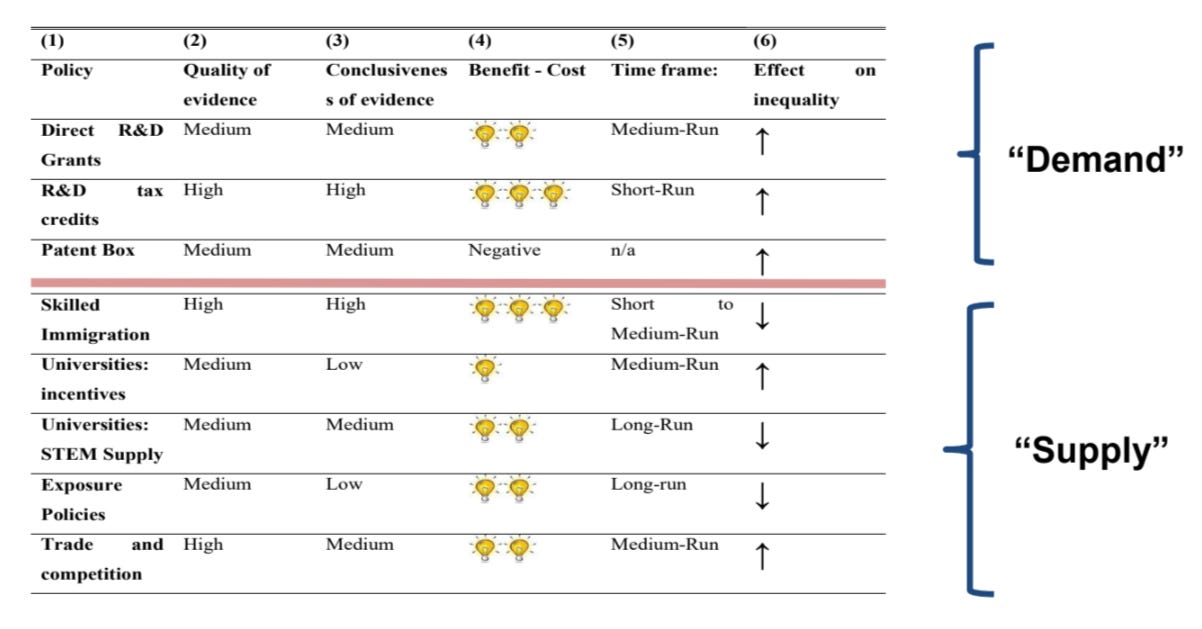
In covering the different policy angles for R&D, John brings us back to the economics underlying it all: how to get more effort into innovation, and how the previous lectures connect in the policy arena. From the supply of researchers, to who becomes an inventor, to tax credits that shape what research firms do, policy often sets the terms.
Earlier this year IFP released the Atlas of Innovation, which walks through a selected set of policy tools, and in this lecture, John goes deep on some of the same ones and many more.
Which levers actually work? Working at an innovation policy think tank, I ask myself this question nearly all day, every day, and I feel lucky we have the expert to tell us more.
Here are the readings that go with this lecture:
Akcigit, Ufuk, and Stefanie Stantcheva. “Taxation and Innovation: What Do We Know?” In Innovation and Public Policy, edited by Benjamin Jones and Austan Goolsbee, Chicago: University of Chicago Press (2022).
Bloom, Nicholas, Mark Schankerman, and John Van Reenen. “Identifying Technology Spillovers and Product Market Rivalry.” Econometrica 81, no. 4 (2013): 1347–1393.
Bloom, Nicholas, John Van Reenen, and Heidi Williams. “A Toolkit of Policies to Promote Innovation.” Journal of Economic Perspectives 33, no. 3 (2019): 163–184.
Dechezleprêtre, Antoine, Elias Einiö, Ralf Martin, Kieu-Trang Nguyen, and John Van Reenen. “Do Tax Incentives Increase Firm Innovation? An RD Design for R&D, Patents, and Spillovers.” American Economic Journal: Economic Policy 15, no. 4 (2023): 486–521.
Kerr, Sari Pekkala, and William R. Kerr. “Immigration Policy Levers for US Innovation and Start-Ups.” In Innovation and Public Policy, edited by Benjamin Jones and Austan Goolsbee, Chicago: University of Chicago Press (2022).
Thanks to William Higbie and Harry Fletcher-Wood for their support in producing this video and the transcript.
Lecture Transcript:
Innovation policy
I’m really pleased to be able to talk about innovation policy, because I think it’s one of the most exciting areas of innovation. I’m going to start off by asking why not do what we do with most markets and leave it up to the private sector? Then I’m going to get on to the meat of the lecture: assuming the government should intervene, how should it stimulate innovation?
Heidi Williams, Nick Bloom, and I have tried to frame the whole thing around ways government could intervene. We put them broadly into two buckets:
Demand-side buckets: things which increase firms’ demand for innovation;
Supply side: things which can stimulate the supply of inventors and innovation in the economy.
On the demand side there are direct subsidies, R&D grants, and subsidies. I’m going to focus more on indirect approaches, in particular talking about research and development tax credits and the way the tax system could influence innovation. On the supply side, I’m going to focus on what Raj Chetty, myself, and others have called the “lost Einstein” effect, which is how you could potentially create more inventors by exposing people to the possibility of becoming an inventor at a younger age.
Why should the government subsidize innovation?
Why should the government subsidize innovation, if at all? There are many potential market failures which could give reasons for governments getting into the innovation space, but the main one is the knowledge externality, arising from the fact that research and development is at least partially non-excludable. There’s a public-good nature of knowledge, which means that those who do the research and development only get a relatively small part of the social benefit; it spills over to many other agents in the economy. Therefore, the incentives a researcher has are much lower than the benefit that society gets.
Ideas and innovation are hard to hold. You try to hold them, they slip through your fingers. Knowledge builds on the shoulders of giants, and this creates spillover effects — this non-excludability reason for subsidizing R&D. This was best encapsulated by this quote from Gustave Flaubert in 1911, in his ‘Dictionary of Received Ideas’, where he defined inventors. They, “All die in the poor house. Someone else profits from their discoveries, it’s not fair.” That more or less summarizes this idea of the benefits from innovation being much wider than what accrues to the firms or inventors who put in the research effort.
That’s the primary market failure. But there are many other potential market failures, and broadly you could think of these as frictions in other markets. A particular market failure people have emphasized is in the financial markets. If you think about research and development, there’s an upfront research cost. It can often be large and uncertain; there’s asymmetric information. By definition, the person who’s doing the research knows a lot more about it than the potential investor who’s providing the research finance. The potential investor is always worried, “How do I know, when you’re spinning me the story about how great this invention is going to be, that it really is going to be that great?” On the inventor’s side, they’re worried, “If I tell an outside investor what I’m going to do with it, they may take the idea and run away with it.”
For a whole variety of reasons, from at least Arrow onwards, we think that there may be frictions in financial markets. We know there are in general, but it may be particularly a problem for an intangible investment like research and development, and this will mean that we tend to get too little R&D finance. This may be a particular problem for startups and small and medium-sized enterprises.
You could broadly think about the spillover effects being multiple.
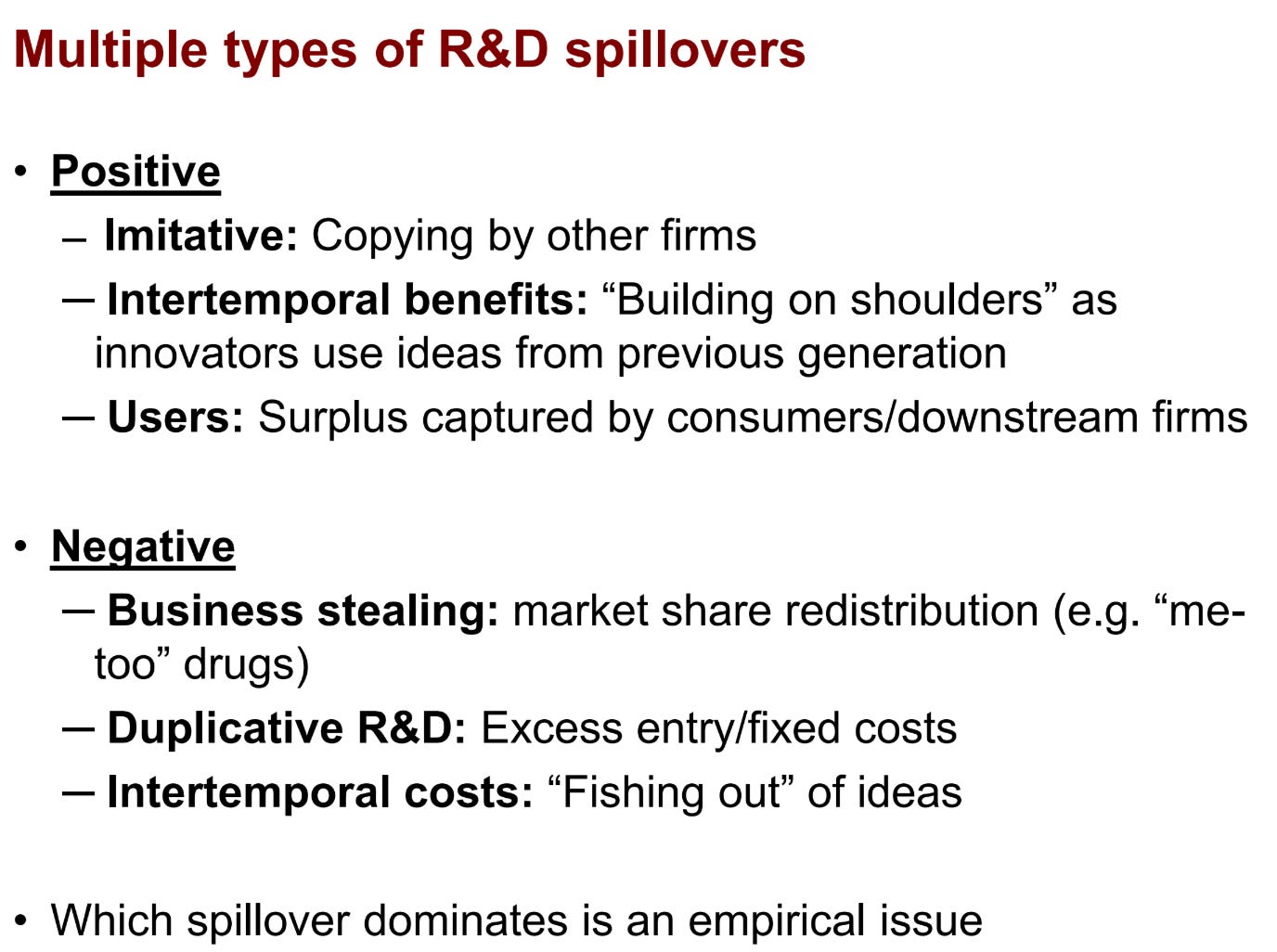
I’ve emphasized the positive effects.
Spillovers can occur because others can copy the inventions of a firm — that’s the Flaubert quote.
There could be these intertemporal benefits: even if you have a patent which gives you some intellectual property protection, future inventors can build on your shoulders using the ideas from previous generations. Those benefits are not fully captured by the person who has the intellectual property. That’s a similar kind of spillover benefit.
There’s also surplus captured by consumers and downstream firms, which won’t necessarily be taken into account when the firm is doing its research and development. That will all tend to be on the side of positive spillover — so too little investment in R&D.
On the other side of the coin, there can be some negative spillovers.
In the literature we think of this as a business-stealing effect. This is where I get an idea, and it might be quite incremental or small. If the market structure is such that a very small difference in our cost or quality means I get the entire market, then I may have almost too much incentive, from the social point of view, to do invention. A classic example of that is when we think about pharmaceuticals. There are things called “me-too” drugs, which may only have a small therapeutic value over the previous drugs, but because typically insurers and other payers will often reimburse the best drug, even if your drug has a small advantage you get a huge amount of the market. Like an arms race, it can give you too much incentive to do R&D. This is the destructive part of creative destruction.
There could be duplicative R&D — we’re both doing the same type of research and development, and it’s a waste of resources.
There could be intertemporal costs: ideas could be fished out if there were a finite number of ideas. The more I take, the less is left for you.
So there are potential negative spillovers as well as positive spillovers. Which dominates is going to be an empirical issue, and it may be different in different contexts and industries.
Although theoretically these spillovers can be positive or negative, the empirical evidence strongly suggests that the positive effects dominate. A few of the papers here have tried to look at the net effect of these different types of spillovers.
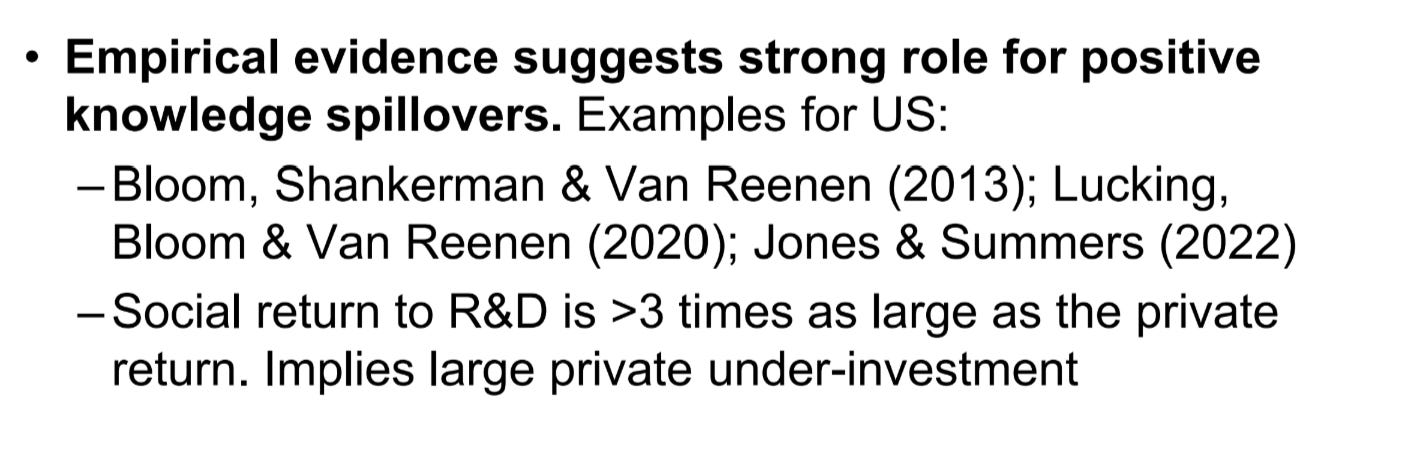
The conclusion they generally come to is that the social returns to research and development are way larger than the private returns. A factor of three or more is a typical number. That implies there’s a lot of underinvestment in the private sector in innovation.
That’s the fundamental justification for why we might want the government to intervene.
There is a nuance to this, though. For a smaller country in particular you might say, “It’s great that we have more innovation in the world, but I’d much rather that the taxpayers of another country pay for it rather than I pay for it. So by all means, subsidize research and development in your country, create these ideas, so I get the benefits without having to pay the financial costs of doing the R&D.”
For a big country like the US, the European Union, or China, this is less important. It’s also much harder for advanced countries, which are near the technological frontier. For a developing country it may make a lot of sense to enjoy the benefits of the innovation happening at the frontier. The issue is — and this is the development process — as countries get closer to the frontier they may have to switch their model of development from the diffusion and imitation model toward more innovation. Japan would be an example of that, and now China might be another.
The third reason is that when we think about research and development, people sometimes say it has two faces. We often think of it as the innovation part: if I do more research, I can push the technological frontier. But there’s also some evidence that by doing research and development — by having engineers and scientists who can understand innovation at the frontier — this might help you catch up to the frontier as well. This is sometimes called “absorptive capacity.” To the extent that’s important, this is another reason why a country may have incentives to build up its R&D even if its neighbors are not paying as much as it is. There are answers to that policy challenge.
A toolkit of innovation policies
I mentioned this paper in the Journal of Economic Perspectives that Heidi Williams, Nick Bloom and I put together, where we try to summarize the existing evidence, as it was in 2019, on different policies. We divided things up into the type of policies, the quality of the evidence, and how conclusive it was. We did a rough benefit-cost calculation.
I’ve just come out of spending almost two years chairing the Council of Economic Advisers in the UK. If you talk to policy makers about what type of innovation policy you should be putting into place, they’re very alert to how long it’s going to take. Of course, innovation policy takes longer to have an effect on growth than a policy toward unemployment insurance or something which is more near-term. But within the class of innovation policy, some things have a larger effect in the shorter term — say over the life of a parliament or a president — than others do. From a political point of view, that is something which is very front of mind. The other thing that policy makers are often very concerned about is the effect on inequality — spatially and across people. That’s also something we discussed a bit.
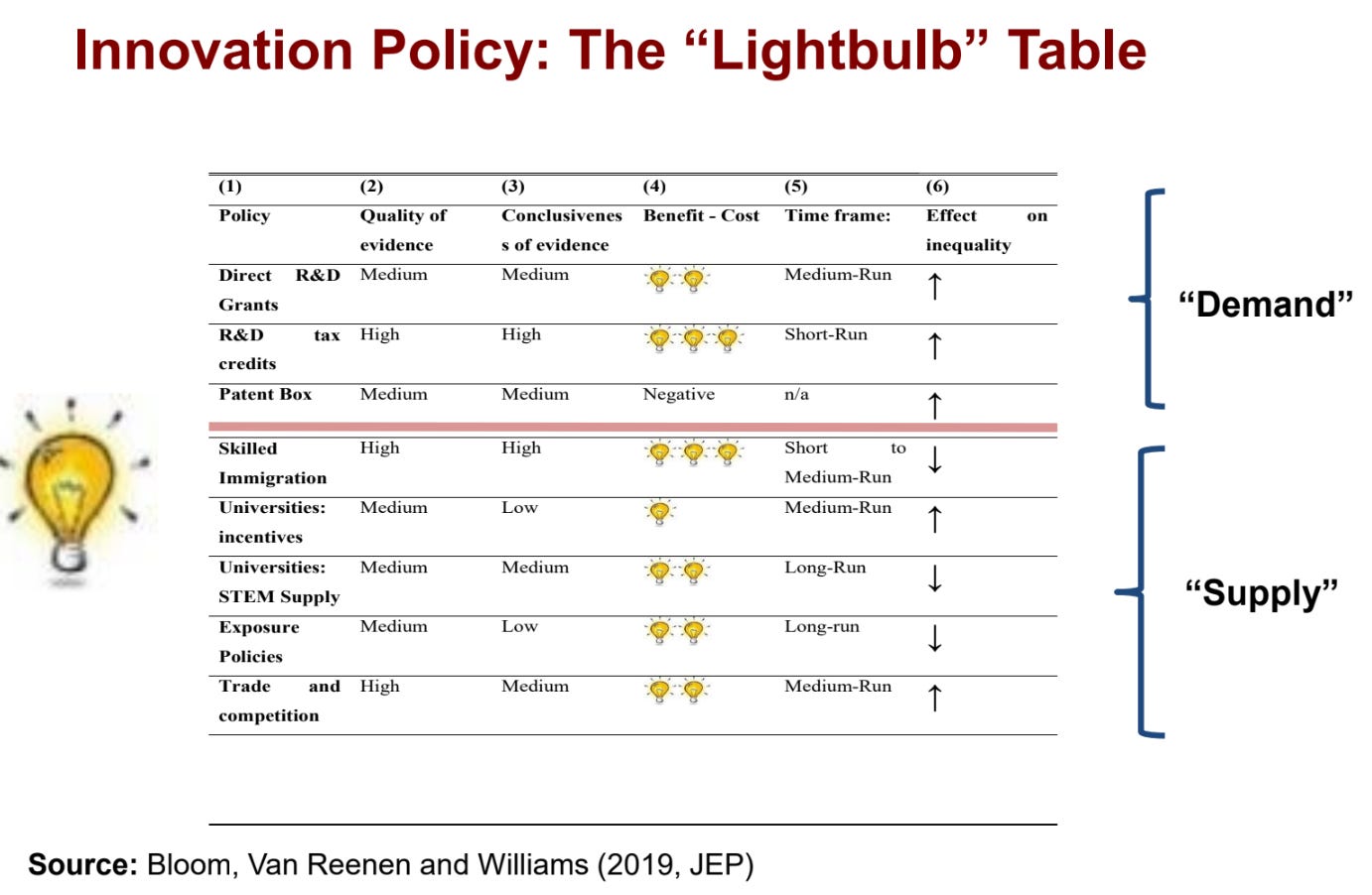
The kind of policies that we looked at are:
Direct R&D grants;
R&D tax credits, which I’ll talk about in some detail;
Patents and the patent box.
The reason I’m going to focus on the R&D tax credits is that there’s a lot of evidence that the benefit-cost ratios could be relatively high, and that they can affect over a relatively short run, like four or five years, rather than over a longer run like 20-40.
These are all demand-side policies: by trying to subsidize firms’ research and development activities, you can stimulate those firms to do more R&D. As I mentioned, there’s another group of policies on the supply side, such as:
Encouraging skilled immigration;
Changing incentives or the resources in universities
Exposure policies — exposing people to the possibility of becoming inventors at an early age, and;
Trade and competition.
Many of these also have some evidence, especially skilled immigration. Things like the exposure policies I’m going to talk about — there’s less evidence, and the effects are more in the long run. But the reason why supply-side policies are quite attractive is that demand policies stimulate demand, but if you don’t have an elastic supply side you’ll end up driving up the prices — the cost of doing research. Since most of the cost of research is people, the wages of scientists and engineers may go up a lot when you stimulate demand. That’s good for us as researchers, but not necessarily good for society and the taxpayer, if you’re driving up the price rather than increasing the quantity, which is ultimately what we want.
Taxation and innovation
This has been talked about for a long time. Joseph Schumpeter said, “On the one hand, taxation is an essential attribute of commercial society… on the other hand, it is almost inevitably… an injury to the productive process.” Schumpeter was a bit skeptical about the benefits of tax.
This wasn’t his most famous quote, of course. That was probably, “Early in life I had three ambitions. I wanted to be the greatest economist in the world” — very modest guy — “the best horseman in all of Austria, and the greatest lover in all of Vienna.” “Those who knew Schumpeter as an economist, lover or horseman” — this is a quote from an unnamed source — “presumed his skills were in the other two fields.” It’s probably a nasty referee of one of his papers.
When we’re thinking about tax and innovation, it’s a very broad question, so we’re going to start off relatively narrowly, with specific taxes around innovation.
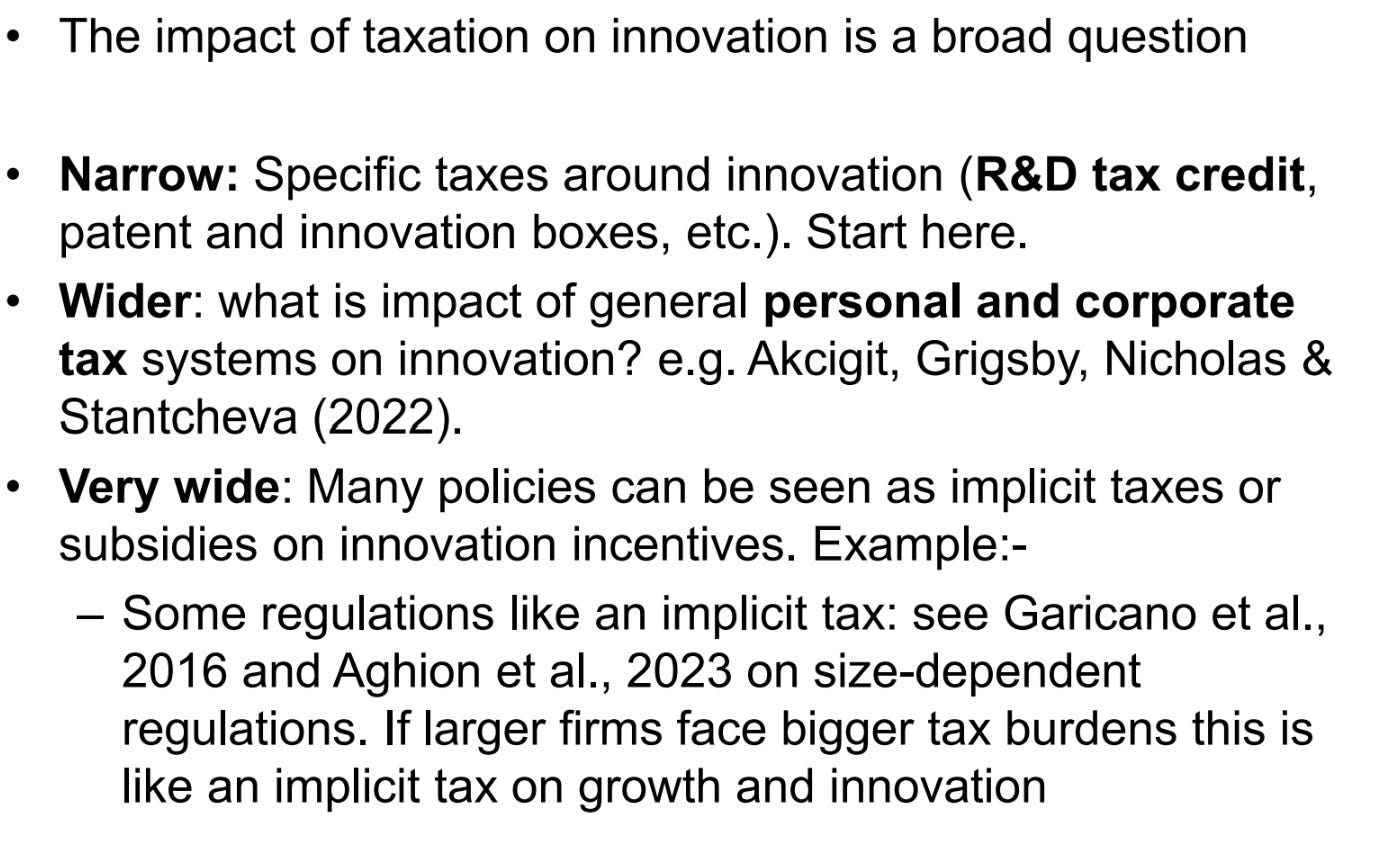
The primary example of this is tax credits for research and development. But we could also have what’s sometimes called patent and innovation boxes, giving incentives for intellectual property. We’ll focus on the R&D tax credit. Then we’ll move on to a wider question, which is the impact of more general personal and corporate tax systems on innovation as a whole, and we’ll draw on this recent paper by Akcigit, Grigsby, Nicholas and Stantcheva.
There’s an even wider way you could see this. You could think of many policies as implicit taxes or subsidies on innovation incentives. If you saw some regulations as being like an implicit tax — some employment regulations start when firms grow beyond a certain size, and they’re like a tax on size. These size-dependent regulations can also affect your incentives to innovate. If you know that if you innovate and get very big you’d have to pay a higher tax because the regulatory burden was so high — it’s not an explicit tax, it’s an implicit tax, but this could have an effect on your incentives to innovate. We have some evidence on that in a couple of papers.
R&D tax credits
Ronald Reagan introduced the first US R&D tax credit. They’re a way of supporting R&D through the tax code. The basic idea is to change the tax system to make R&D more attractive than other kinds of spending. It’s increasingly popular all over the world. If you look over time, there’s been a shift from direct support — giving out direct R&D grants to firms — to indirect support by changing the tax system. This OECD report I looked at from last year showed that 34 out of 38 countries granted tax relief for R&D — that’s risen from 20 in 2000.
What’s the advantage of an R&D tax credit, as opposed to choosing which firms to directly give subsidies to through a grant system?
Because it’s performed in the private sector, it’s probably managed more efficiently than if it was done in a government laboratory.
Informational: if you set the parameters of the tax system, there’s no need for a government to explicitly choose projects and have to say, “I want to subsidize this particular new fighter jet, or chemical, or pharmaceutical.” It can say to the private sector, “You choose what you want to do,” and that economizes a lot on bureaucracy, and also the government’s information — the private sector probably has more information.
It mitigates the risk of political capture by a single firm or industry. The move away from direct subsidies being given to firms is that if firms know this, they start investing in lobbying and trying to get more money out of governments. By setting the parameters through the tax system, in principle that’s a much more neutral way, and is less subject to single-firm or industry lobbying.
The disadvantages:
It’s a pretty blunt instrument. If the main market failure is the knowledge spillover, what you’d want to do is to target your marginal research dollar on high-externality R&D, like basic research at universities. Firms left on their own devices are more likely to do activities in R&D which are nearer to the market — that’s where they’re going to get the biggest returns. If there were much lower or no externalities there, that’s going to be a much less attractive thing to do from the government’s point of view.
Firms might relabel existing activities to obtain the tax break. You can imagine that firms might want to say, “The money I’m spending on McKinsey consultants — this is actually research and development.” In order to get that tax break I can relabel activities as R&D to get the advantage of that tax break. They have some incentives to do that anyway, but the incentive might be greater the more generous the tax credit is.
The tax credit is like a reduction of your corporate income tax bill. But if you’re a startup or an SME, you make very little profit. You may be making losses. Having a reduction of your corporation tax doesn’t benefit you very much, because you’re not paying any tax to begin with. You can potentially overcome that. You can say, “Even if I’m not making profits today, I can build up the credits to use them in the future” — carry-forward provisions. Some of the tax credit systems say that if you’re not making profits you can still get some of the money. So there may be ways to overcome that, but it’s still an issue, because it means that the incentives are less the more you discount the future.
There are lots of perverse incentives it can create, depending on the particular design it has. There’s a lot of work on that.
As with any demand-side policy, you’re subsidizing R&D to increase the demand; if the supply side is not strong, you could end up increasing the price of R&D.
If research and development is defined quite narrowly in order to avoid the relabeling, it means you’re missing out on some of the potential innovative activity; and if it’s defined very widely, you might end up subsidizing lots of activity that would have already taken place — it’s not necessarily targeting the marginal investments.
What does the empirical evidence suggest?
There are two types of things that people have looked at. One is: do fiscal incentives increase R&D? The broad answer is yes, and we’ll go through some of the studies. A typical thing people will look at is the elasticity of R&D with respect to the tax-adjusted user cost: if you halve the user cost, how much do you increase research and development? Most estimates place that elasticity at least one, and usually greater than one. A 10% reduction of the cost of R&D through the tax system increases the amount of R&D by at least 10%, and usually more. There are even meta studies of this. The micro studies tend to find larger elasticities than the macro studies, and that is because, as this paper by Appelt and co-authors argues, take-up is much less than you might think by some of the firms who could have taken out these tax credits. But that doesn’t necessarily suggest the macro effect isn’t big; it’s just that not all firms necessarily take up the tax credit when it’s offered.
A second group of questions is whether fiscal incentives increase innovation. This is important because if there’s this concern that some activities get relabeled, then maybe what looks like research and development goes up but it doesn’t mean that innovation increases. This is a question which hasn’t been looked at as much as it should have been, because ultimately we don’t care directly about R&D; we care about the innovation growth and the welfare it creates.
Identifying the effect of R&D tax credits
What are the designs that people have used to try and look at the impact of R&D tax credits? I mention four designs here.
Federal tax credit heterogeneity in firm-level user cost
The first wave of studies — this is a bit US focused, but this is the same method people use in lots of different countries. The federal tax credit in the US generates a lot of heterogeneity in the firm-level user cost across different types of firms. You can use some of this firm-level heterogeneity. For example, in the US tax credit when it started, it looked at your past levels of R&D and then said, for your R&D spend this year, how much bigger is your R&D than that historical base? You got the tax credit based on that incremental amount. People could use the fact that different firms had different histories of R&D, and that would mean that the generosity of the tax credit depended on your history.
Another form of heterogeneity comes from the fact that if you’re a firm which is not making profits, you’re going to have less of an incentive, because you can’t write off your profits against the benefits of the tax credit system. Although the federal tax credit rules are the same across the US, that still gives you a lot of variation across different firms which you can use to try and identify the effect of the tax credit.
Bronwyn Hall had this early study where she used that variation and used standard econometric techniques — panel data techniques, using lags as instruments — to try and look at the impact of the tax credit on outcomes. That variation I’ve described is useful, but it’s not exogenous variation. Whether you’re earning profits, what your history of R&D was, isn’t solely exogenous — it can also react to expectations. For that she tried to come up with instrumental variables. These instrumental variables use the lagged values of some of these variables, and they suffer some problems: you have weak instrument problems, especially if you have serial correlation.
More recent work, which has used administrative data from the IRS which has actual tax credit receipts, has typically used synthetic instruments approaches. The classic paper here is by Gruber and Saez. The idea here is that you say, “Let’s hold firm characteristics fixed at their lagged values.” Firms will have different values of things like profits or R&D, and then you say, “Given those characteristics, how much does the generosity of the user cost change because of the changes of the tax rules on those individual firms?” You’re not using the actual changes of the firm’s tax liabilities, or the R&D, or anything else — endogenous components. You’re fixing that in the pre-policy period and then using the policy change to generate what the user cost would have been had you not changed any of your other choice variables. That is a shift-share analysis, if you like — a kind of Bartik instrument, if you know that — but in a very disciplined way. With a tax simulation model you can calculate for each firm what its tax rate would have been, given its prior characteristics, coming from the change of the policy. Some firms will be more affected than others, depending on whether they’re lucky enough to have characteristics which are conducive to the generosity of the tax credit system. That was Rao’s approach. Both of these papers found long-run elasticities well above one — relatively sensitive, and definitely positive, responses to the tax changes. That is one classic approach to try to identify the effects.
Cross-country variation in R&D tax credits
Because of these worries about endogeneity at the firm level, some approaches have taken cross-country variation. I did an early study with Nick Bloom and Rachel Griffith. There we used cross-country variation over time — firm country panels — and we again found elasticities about one. So smaller than some of the micro elasticities, but still positive. We did find that in the short run the effect was much smaller than it was in the long run. There are quite long adjustment dynamics for firms to adjust to the changes of tax credits.
State-specific tax credits
Wilson has a paper using different tax credits across different states. That’s a nice source of variation. You’re staying within one country, institutions are the same, but you’re using the fact that California may introduce a tax credit whereas Nevada doesn’t. Then you can use that variation to look at the impact. He emphasizes in his paper that there was a lot of cross-state relocation as a result of the state-level R&D tax credits. When California made its system more generous, it saw its R&D go up, but a lot of that was because firms were moving from, say, Nevada to take advantage of the tax credit. That may have been good for California, but it wasn’t so obviously such a good thing for the US as a whole.
Using non-linear design of tax credits to generate regression discontinuity designs
Some of the more modern stuff uses non-linear designs of the R&D tax credit system, using regression discontinuity designs (RDD). This Dechezleprêtre paper uses administrative tax data and firm accounts in the UK to look at the impact of R&D tax credits. It looks not just at R&D but also at patenting, jobs and productivity. It exploits a discontinuity in the generosity of the R&D tax relief at a particular threshold. In 2008, the government changed the R&D tax credit system, making it more generous for small and medium-sized enterprises based on, for example, their assets. You can use the discontinuity around that threshold to do an RDD. In doing that we found there were positive effects both on the subsidized firm itself, in terms of its research and development and its innovation, but also there were technological spillovers to other firms. This is an “RDD for R&D,” which Josh Angrist particularly likes, because it sounds good: an RDD for R&D.
This was the threshold.
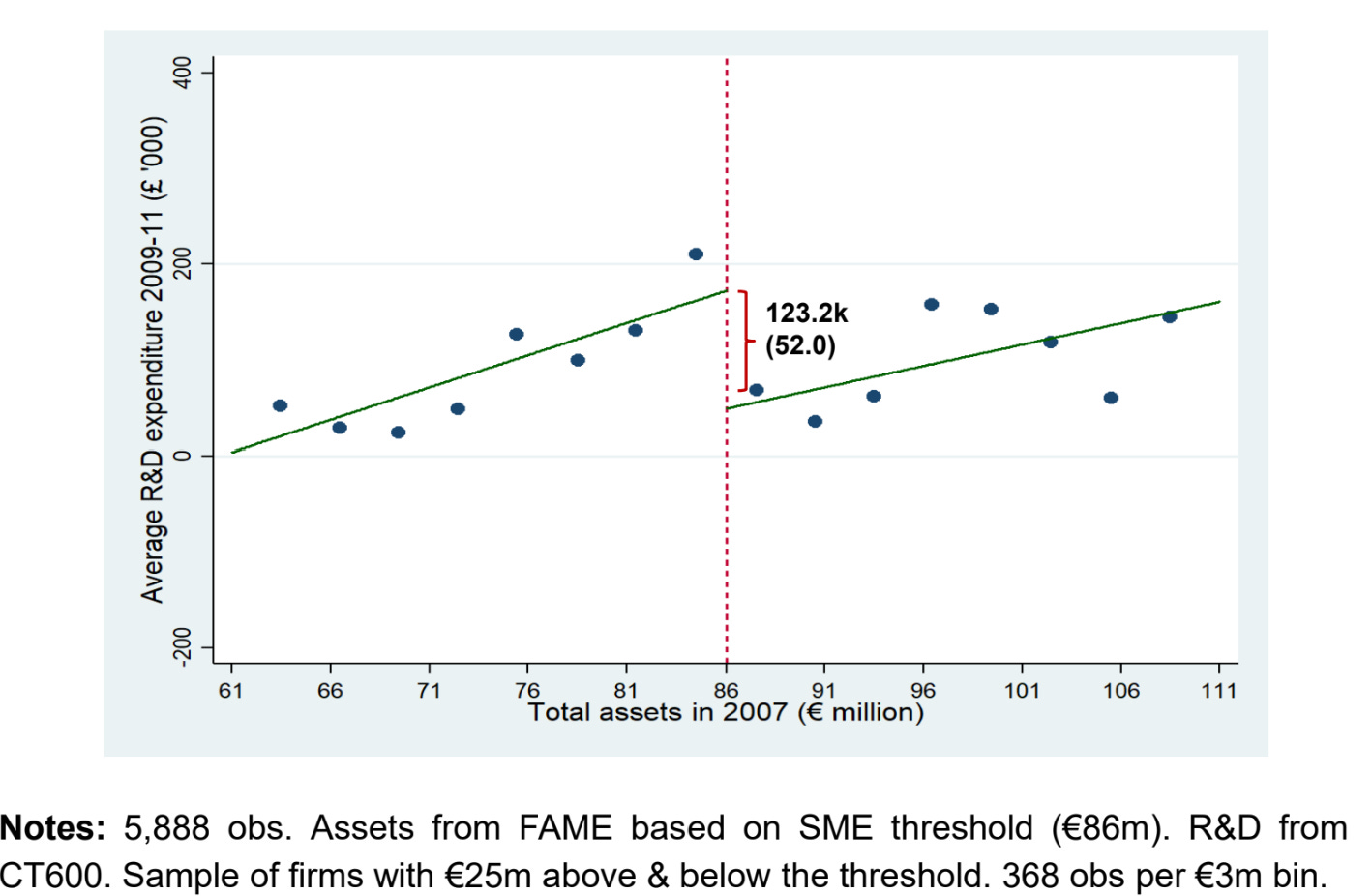
Bigger firms, as measured by assets, do more research and development. But you can see that around this threshold, after the policy was introduced, firms which were just to the left of the threshold, which got the more generous tax credit, did a lot more R&D than firms to the right of the threshold, which had a less generous tax credit. This looked very much like there was a large and significant effect of the policy. You didn’t see this prior to the policy coming in. Firms seem to react.
Similarly, if you look at outcomes like patents, you see these effects.
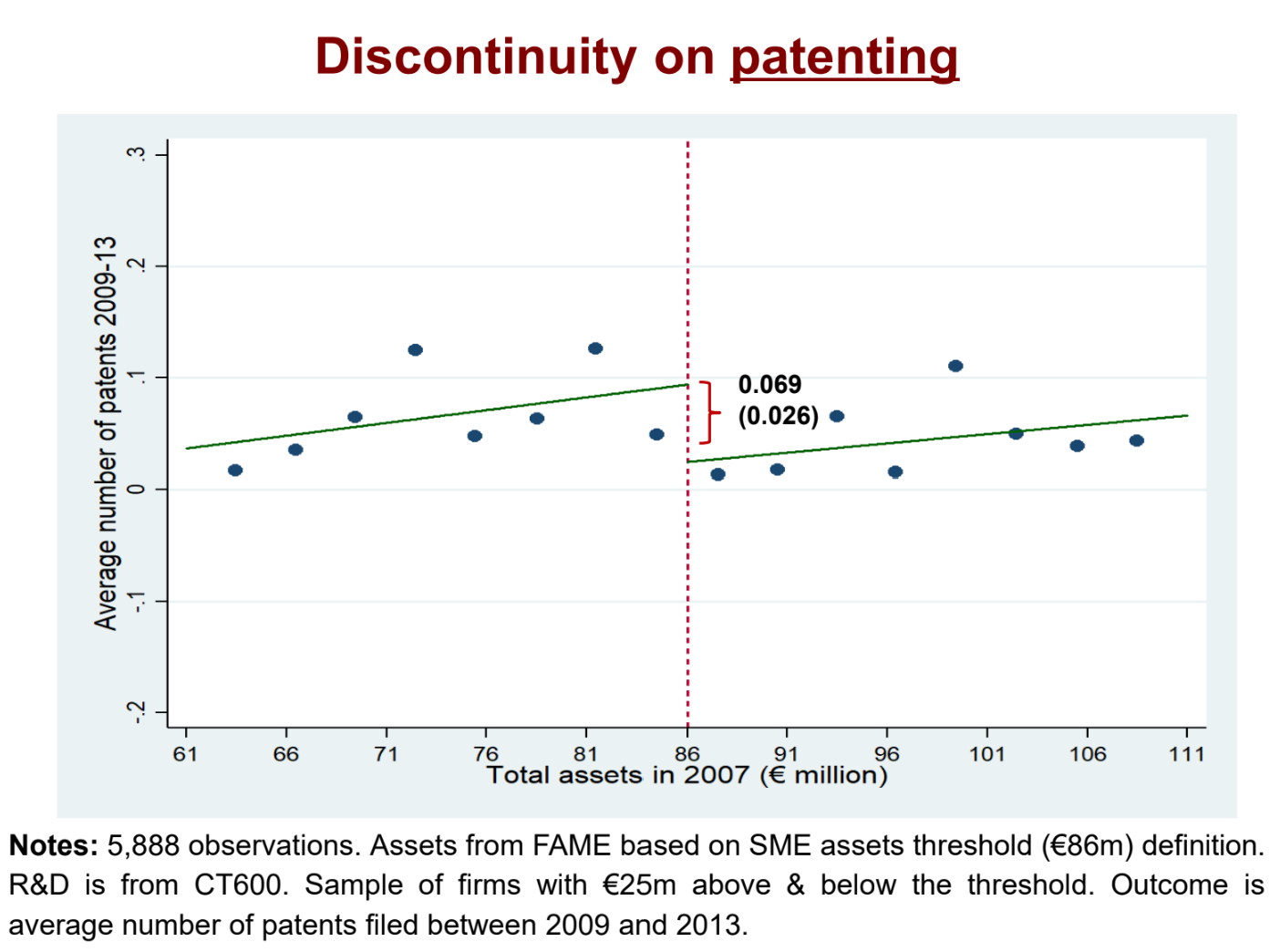
Those took a few years to come through — there’s a lag — but there appeared to be both an effect on R&D and on innovation as measured by patenting. R&D more or less doubled as a result of this; quality of the patents increased by about 60%. These are larger than some of the past literature, and the argument the paper makes is that this is likely because these treated firms are smaller than most of the existing literature, and therefore more likely to be financially constrained.
You can also try and look at technology spillovers. The idea here is that within a technology class, the greater generosity that the smaller firms get spilled over to some of the larger firms, using this neighbor design.
Does general taxation affect innovation?
The more general type of taxation gets very political. I’m going to try to avoid politics to make general economic points. Higher taxes reduce returns to successful innovation. You could say, “It’s obvious that higher personal income taxes reduce innovation incentives, and the only question is by how much is that innovation reduced.” One proviso would be that it depends what you do with the revenues from that tax. Tax is generally not there for its own sake; it’s there to provide other services. If you use that revenue to do pro-innovation things, that might be a reason for doing it. But the tax in and of itself is going to reduce innovation incentives.
If innovation was about a lone genius model — in your ivory tower as an academic — and that was it, maybe there’s some effect, but not much. Much recent work has tried to test for this by looking at individual inventors — measured by whether you’re an inventor on a patent — and seeing to what extent inventors do or do not respond to changes in the expected tax rate.
There are a few reasons that you might think the aggregate innovation tax elasticity might be small in magnitude. If you think about a fall in the tax rate to induce more innovation, the people who are going to be affected first of all will be the marginal inventors. The really good inventors are inventing, so when you reduce the tax rate you’re going to maybe encourage the marginal inventors. They’re going to be lower quality, so that might reduce the aggregate effect, if innovation was forecastable.
What about if innovation is uncertain? It’s like buying a lottery ticket. If you think about individual incentives, if you have concave utility as we normally think — a dollar to a billionaire is worth less than a dollar to a poor person — then if you imagine you’re a successful innovator but you win the lottery for $1 million versus $5 million, that difference may not be so huge. Even for unforecastable innovation, the tax impact may not be quantitatively large. This is the optimal tax literature intuition.
The third factor is that the decision to be an inventor depends on information. If it depends a lot on information and early motivation or exposure, then that decision on the extensive margin may not have so much of an effect on whether you choose to have an inventor career. It may have a much bigger effect on people who are already inventors and are trying to decide, “Do I do more invention?” or “Which state or which country do I live in?” There may be more effect on that intensive margin.
This paper by Akcigit et al. tries to look at this directly. They take data from the US Patent Office from 1920 onwards, focusing on the 60-year period from 1940. They disambiguate the inventor names and they calculate state-specific marginal tax rates for corporations and for individuals. They focus on the 90th percentile of the income distribution compared to the average, with the assumption that inventors are more likely to be in the higher parts of the income distribution, and they use tax simulation models to work out the different levels of tax that those individuals are going to face.
They do some estimates at what they call the macro level, the state level, and the micro level, which is the individual level, looking at the effect of taxes three years ago on:
Counts of inventors, including mobility across states;
Number of patents;
The quality of patents as measured by citations.
The result they get is that lower general taxes do encourage more innovation.
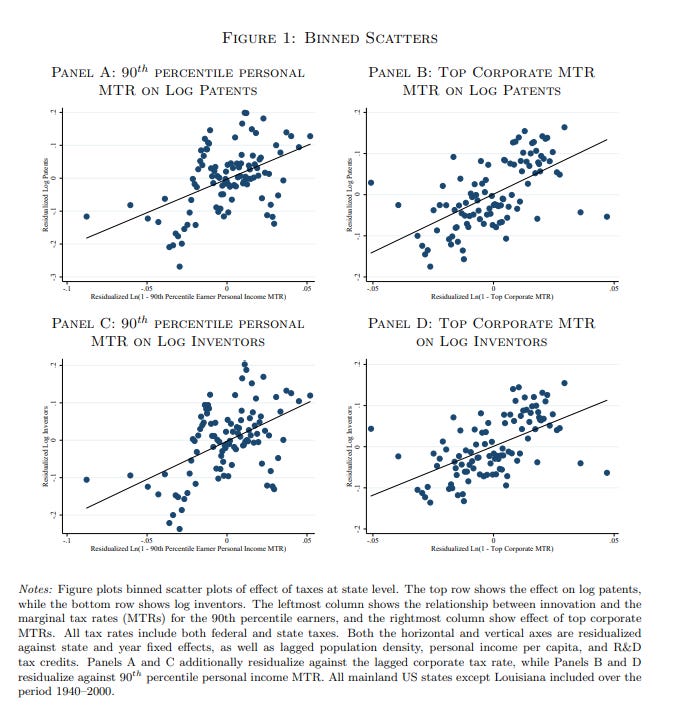
Broadly speaking, states that increased taxes had slower growth in subsequent innovation.
How do they deal with the fact that when the state changes its tax there could be lots of other things changing at the same time? It could be a new government; it could be a stronger economy. They do various things.
Because they have individual information, they can include inventor-level fixed effects and look at how the change in the tax rate changes the probability of a patent for an individual inventor.
Because they’re looking at the top tax rate versus the median personal tax, they can include state-by-time dummies and then identify this difference within a state year by looking across the income distribution.
They can also use this kind of Gruber-Saez synthetic IV approach that I mentioned before, where you fix an individual’s characteristics and construct an instrument based on the changes of federal and state taxes.
Finally, they do some event studies.
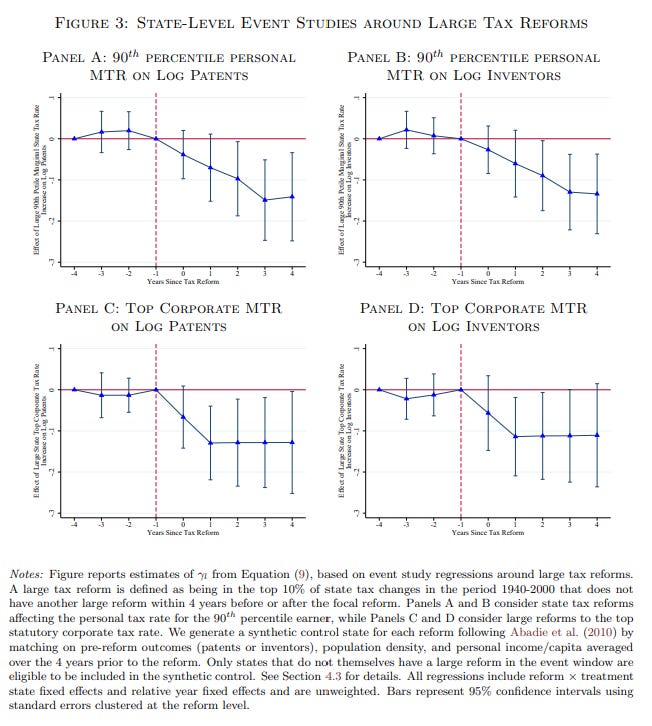
They look around states which had big changes of tax reforms and use an event study. They find effects on innovation in the states which made the tax systems different. An increase in tax is associated with — or causes — a lower amount of innovation.
They find an elasticity of patents with respect to the personal net tax rate of about 0.8, and the corporate tax rate of about 0.5. So smaller than some of the elasticities from the R&D tax credit, but still significant. A big part of the effect is driven by relocation, a bit like the Wilson paper on R&D tax credits. Inventors are much less likely to move to the high-tax states. For the corporate tax one, it’s almost all relocation. For the personal one it’s divided up: some is the personal tax, some is relocation, and some, they argue, is a general aggregate effect.
So it’s somewhat smaller than the tax credit effects, but there is some effect there at the individual level.
In terms of identification, one of the issues is whether or not they’re capturing the extensive margin. When you include inventor fixed effects, this conditions on people who are inventors: you only look at — if you’re an inventor, do you innovate more when tax goes down? What that misses out is people who could have invented but didn’t invent. What about the “lost Einstein” or “lost Marie Curie” effect — that it doesn’t necessarily take into account whether you become an inventor in the first place? That was the original motivation I started this with. There’s a second thing on the link to the R&D tax credit literature: it’s not obvious how well that’s controlled for.
They emphasized that there was a risk of “beggar thy neighbor” tax policy. They’re not necessarily arguing in favor of using the tax system to encourage innovation, because of some of the effects of relocation. They argue in the paper that building up amenities and research infrastructure may be a better way of reducing the risk of brain drain than cutting taxes. Nevertheless, this is a paper which does show that there may be more effect of changing income tax rates on innovation than would maybe have been previously thought by some.
Innovation and human capital
These demand-side policies, like fiscal incentives and direct subsidies, do seem to be effective. But there’s this critique — Paul Romer was the first to voice it — which is simply that if the supply side is completely inelastic, the main effect of this is to increase the R&D price.
There’s a paper by Austan Goolsbee who, using macro time series data, argued that if you looked at federal subsidies, almost all the effect was simply to increase the wages of scientists rather than the volume of R&D. I’m not sure I totally believe that 100% of the incidence is on wages, but certainly in the short run prices are likely to increase as you increase the subsidy, unless the supply side responds.
That’s why there are a lot of attractions to doing these supply-side policies. If you can increase the quantity of R&D workers, that directly boosts innovation, because people who are doing R&D do more innovation. But it could also have an equilibrium effect: by increasing the supply you reduce the price of R&D, you depress the wages of people, and this will give an indirect boost to innovation through a general equilibrium effect.
One problem is that you train more R&D workers — more people come out of MIT with a physics degree — and if they all go off and work on Wall Street, there’s a leakage of that talent to other sectors of the economy. Of course the effect might be slower than a subsidy. With the tax credit you get an immediate reduction of the price of R&D; in order to train someone to have a PhD in physics it takes several years, and then they have to go out and do the research. So it’s a slower effect than the demand-side policies.
[Question:] Is there some evidence about the elasticity of this supply of human capital? At least in the medium run, and even more in the long run, the wage of researchers is going to attract people into research. Is this supply quite inelastic?
There is evidence on this, and there’s dispute over the magnitude of it. There is clearly an elasticity. A lot of the estimates have been done on looking at elasticities of existing inventors — like the paper I mentioned, that was cross-state elasticities. Stefanie Stantcheva has a really nice paper looking at cross-country mobility of inventors, and they respond a lot to tax incentives.
In terms of the effect of higher wages on choosing to become an inventor, there’s a broader labor economics literature on that, looking at how people go into occupations and study as a result of prices. But the evidence there is much weaker, because it’s an occupational choice decision, and that’s a long-run decision. You’re looking not just at a small change in wages, you’re looking at your expectation over the whole future. There are some estimates of that, but I’d say it’s pretty unclear what the magnitude is of the response. I think everybody would agree that there is an effect as you increase the wages of different groups, but the magnitude of that is quite hard to identify. That’s an important parameter, of course, in terms of assessing some of these effects.
Universities and graduate supply
There are lots of types of human capital policy:
Increase the supply of STEM-qualified people,
Expand universities,
Increase skilled immigration,
This exposure, “lost Einstein” or “lost Marie Curie” type of effect.
There’s evidence of positive impacts of universities and entry expansion on GDP per capita at the subnational and national level. There is better-identified work focusing on universities and innovation, usually finding positive effects. There’s an old paper by Jaffe looking at state-level spending on university research, which seems to be associated with more corporate patenting. There are innovation surveys. There are nice papers by Belenzon and Schankerman and Hausman looking at patenting in universities.
One of the big issues is that university presence or expansions aren’t exogenous. Furman and MacGarvie have a nice paper using the land grant college funds to instrument for university location, and find that it seems to have a positive impact on corporate pharmaceutical R&D.
One question is: even if there is a positive causal impact of universities on innovation, what’s the mechanism? It could be faculty scientists at universities starting firms, doing research; it could be democracy and institution building; there could be demand effects as well — Andrews has a paper on this. All of those could be at play. There’s a lot of important work which could be done, especially now we’re in an era where universities, especially in the US, have had all their research funding cut. People are very interested in what the impact of that might be in terms of thinking about growth and innovation.
There is a series of papers which have looked at whether graduate supply has had an effect — that’s an obvious mechanism. There’s a nice paper by Bianchi and Giorcelli who looked at enrollment requirements changing for STEM Master’s in Italy, and they found that subsequent innovation increased, especially in biomedical and ICT, although there was some leakage into other sectors like finance.
There are also some papers looking at an increase in STEM (Science, Technology, Engineering and Math)-focused colleges. A paper by Otto Toivanen and Lotta Väänänen looking at technical schools in the 1960s in Finland found they had not just direct effects on patents but also indirect effects on the second generation, the children of those original people who went to university. There’s also some evidence in Norway. This is a growing area trying to get at one of the mechanisms, which is the supply of high-skilled workers, and there seems to be some evidence on that.
There is lots of good stuff on immigration: Kerr is my go-to reference.
“Lost Einsteins”
This is a stream of research that I began with Raj Chetty, Xavier Jaravel, Alex Bell and Neviana Petkova, looking less on what you do when you’re already an inventor, but whether you become an inventor in the first place. We matched patent applications in the US and patent grants from 1996 to de-identified tax records. For everybody in the US we could figure out whether or not they were on a tax record.
Then we focused on looking at who grew up to become an inventor. In particular, we were interested in this question of whether there are some groups who systematically are much less likely to become inventors than others. We documented how kids from low-income families, minorities, and women are very underrepresented in the inventor pool. Part of the paper was looking at, what is the reason for that? We found evidence that the majority of this effect wasn’t due to lower ability, but rather more to do with lack of opportunity or exposure to the very idea of becoming an inventor.
To show you a couple of stylized facts from this.
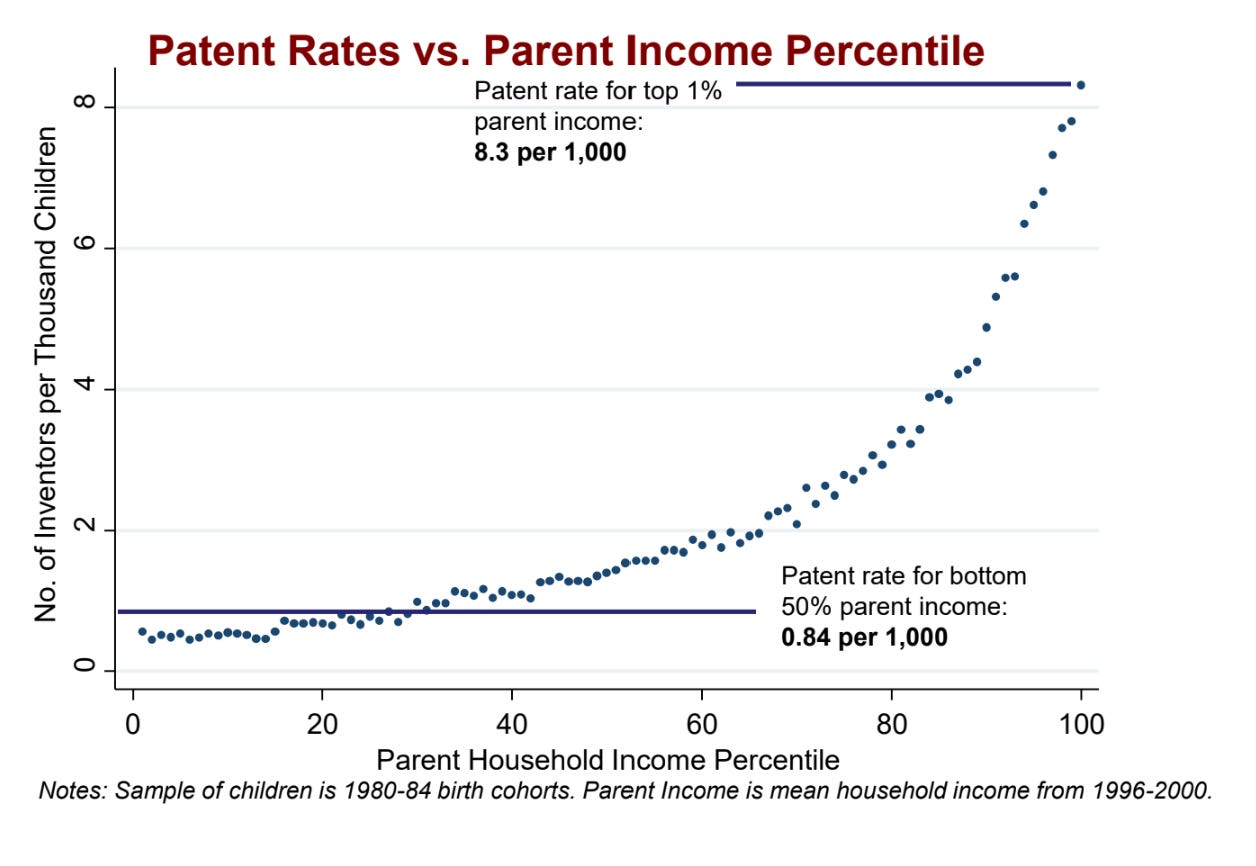
We looked at whether you became an inventor and we lined that up against your household income. I put those in percentiles here along the x-axis, from kids from the poorest families to kids from the richest families. You can see here that there’s an upward-sloping curve. It’s a bit convex. The patent rate if you’re in the bottom 50% of the income distribution is about 0.84 per 1,000. The patent rate if you’re born in the top 1% of the income distribution is 10 times higher than that: 8.3 per 1,000.
Of course, it may be that parents up here are much more able than parents down here. What we did was we matched in information on different measures of early human capital. This is one of the experiments.
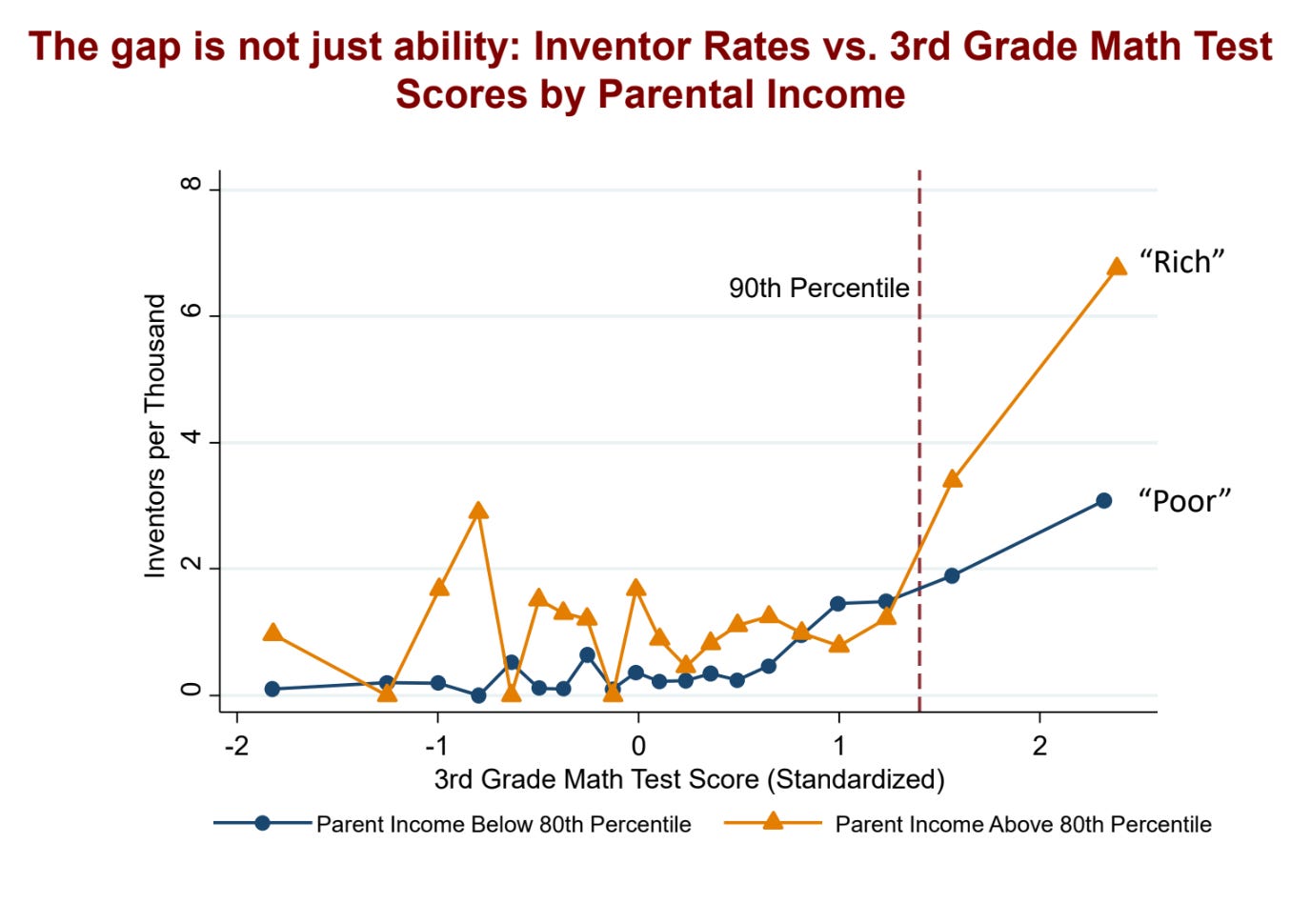
We looked at the math test results that kids got in the 3rd Grade and split this up in various ways. Along the x-axis is your standardized math test score, in standard deviations.
We found that kids from poor families were less likely to become inventors than kids from rich families. But even when we look among the very smart kids, it’s still the case that the kids from the rich families are much more likely to become inventors than kids from the poor families. When we do a formal decomposition of the effects, we find that although ability can explain maybe a third of that gradient between income and invention, most of it is not explained by different measures of ability; it looks like it’s other factors.
Similarly with gender: if you look at the difference between men and women, there are a lot more men who are inventors than women.
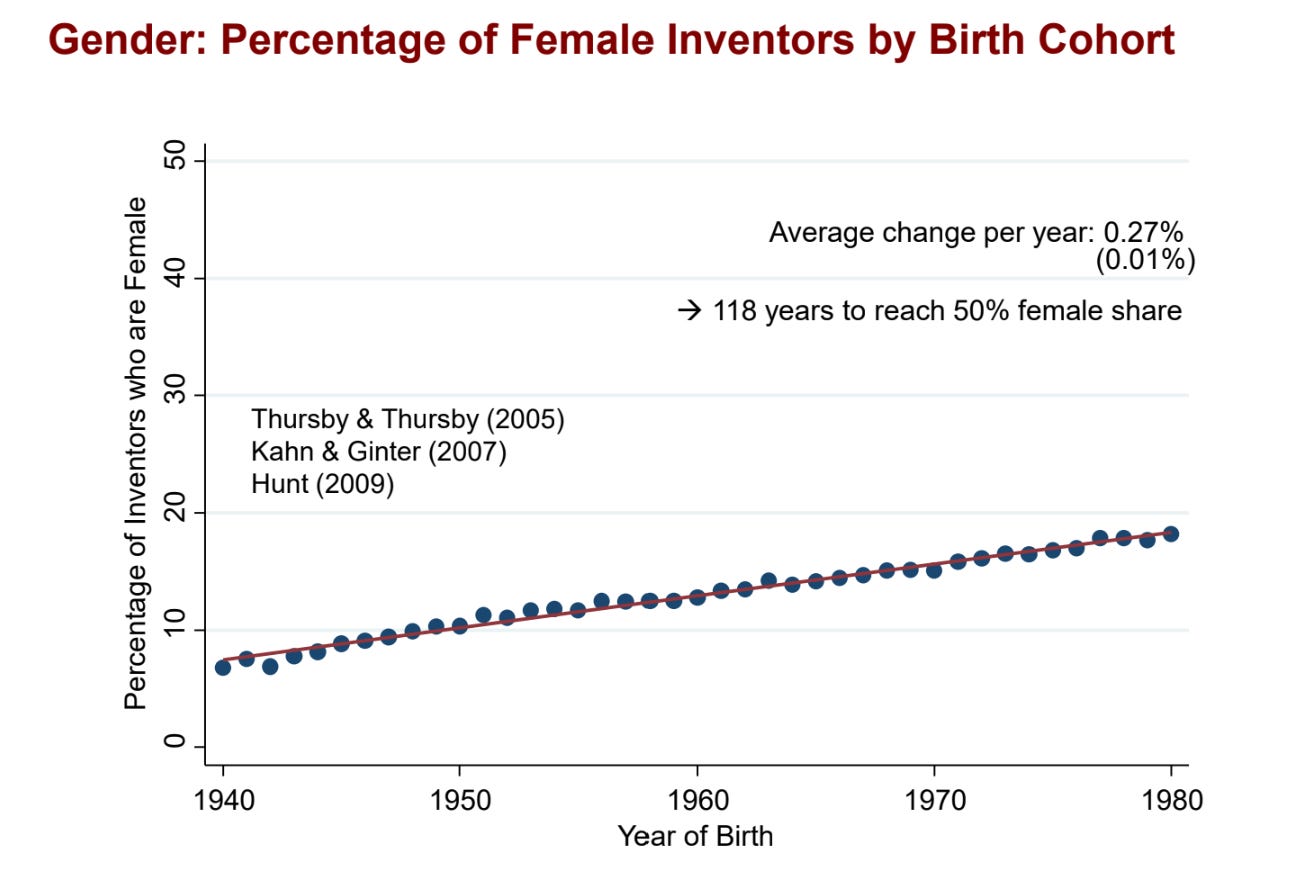
If you look over time, that’s started to converge. For cohorts in the 1940s, less than 10% of inventors were women, compared to about 20% of the cohort born in 1980. But the rate of convergence is pretty slow — it’s going to take over a century to get full parity at current rates. If you look at measures like math scores or other kinds of measures of ability, men and women are very similar. That can’t explain these differences.
The thing which did seem to be more important was the exposure that you had to the possibility of becoming an inventor when you were young. We cut the data in various ways to look at this, but one way is to look at this by place. We broke up the adult invention rate by where you grew up.
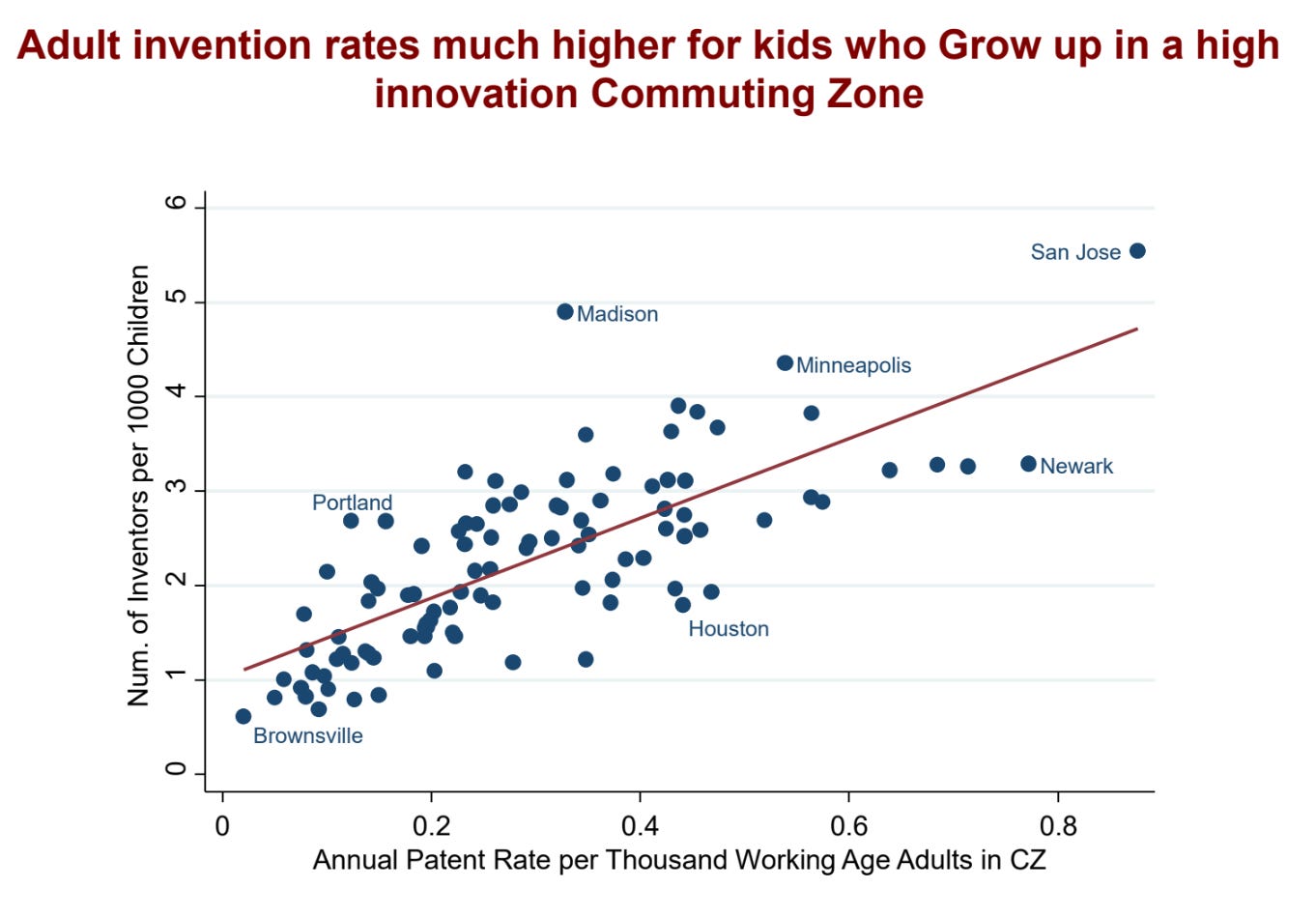
If you grew up in a place where there was a lot of innovation happening when you were growing up, as measured by things like the patenting rates, you were much more likely to subsequently be an inventor than if you were in a place where there wasn’t so much innovation going on. In San Jose and Silicon Valley, a lot of people grew up to be inventors. Someone from, say, Brownsville is much less likely to grow up to be an inventor.
Of course, those are just correlations. To try and get at the causal impact of some of these place-based exposure measures, we try different strategies.
We look at timing: we look at adult outcomes and child exposure. We can dummy out the current destination place — take two people living in Boston, where did they originally come from — to see what the effect was on innovation.
We use the sharp discontinuity by technology class, with the idea that growing up in an area that specializes much more in software compared to medical devices — if there was a genuine exposure effect, it should mean that you’re much more likely to grow up to innovate in software than medical devices. That’s true even within very narrowly defined patent classes.
Finally, we can use a kind of movers design, where we can compare families where kids moved at a young age compared to ones moving at a later age. This is all conditional on these being people who moved, because people who moved are not the same as those who stay, but the exact timing of how old the kid was when they moved — we can argue that’s not correlated with the overall chance of becoming an inventor, except through the mechanism of being more exposed. We found that if you moved when you were a kid, say when you were two, compared to moving when you were 15, to Silicon Valley, the kids who moved when they were younger were much more likely to grow up to become inventors.
All these designs suggest an important role of early exposure to innovation in determining who grows up to be an inventor. That suggests that when we think about the right model for pulling people into becoming inventors on the extensive margin, it goes much beyond the conventional tax measures that we think of. We might want to think about other types of policies:
Educational interventions at earlier ages;
Mentorship programs to give people experience working for innovative firms;
Other ways of reaching out to give people who are not traditional inventors the idea, “Well, this might be a possible career route that you might want to think of.”
One of the problems with looking at whether you’re on a patent as a measure of innovation is that it’s quite narrow. Some of the work that Raj and I have been doing more recently is looking at entrepreneurship as a wider measure of innovation. This is work which is literally hot off the press — or slide deck, I should say. It’s not even a paper yet. We look at 10 million US entrepreneurs using the IRS data who founded employer firms — looking at stars who created lots of employment and revenue in particular. We document similar gaps in entrepreneurship rates by class, gender, and so on. One difference is that, although there are these effects of early exposure — and we also look at liquidity shocks as well — we find that a critical thing for entrepreneurs is whether you had early labor market experience of working in more entrepreneurship-friendly firms, like tech firms. We use port-of-entry type of instruments there: whether you graduated into San Francisco in 1999 when there was a dotcom boom, compared to 2000 when there was a crash. We find that this early labor market experience is important for entrepreneurship, and one of the things we’d like to do is also look at that for inventors.
Conclusion
Human capital policy acts on the supply side — it’s more attractive than demand-side tax subsidy policies — to reduce equilibrium cost, and also reduce inequality for some of these things as well. These are policies which can be good for equality and also growth. There’s much less of an empirical literature, and policies take longer to have an effect.
Some lessons. A lot of what we’ve done here is leveraging off the credibility revolution, using modern empirical work in innovation policy. It does pose special challenges when we think about using a lot of the Angrist-Pischke type techniques: spillover effects can violate the SUTVA assumption — your control group can be affected by the treatment. Because innovation is all about spillovers, this poses a particular challenge when you’re thinking about empirical work. General equilibrium effects are going to be critical, because we’re focusing on growth.
Despite some of these issues, there’s been a lot of progress made over which policies work better or worse over the last 10-15 years. Tax does matter — that’s certainly coming out of the literature. But the supply side is also critical. There are a lot of opportunities for very good work, especially on the supply side.
But the bottom line is that there are effective ways of increasing the growth rate and the innovation rate through policy interventions. A lot of people are unduly pessimistic about the future growth rate. People often take my paper ‘Are Ideas Getting Harder to Find?’ in a negative way, to say, “This shows you that there’s diminishing returns to R&D.” The point of that paper was that even if there are diminishing returns, if we want to have the rates of economic growth that we have become accustomed to, and we want more of them, then we can do it if we’re prepared to make policies which raise the rate of R&D innovation. That’s absolutely possible, and many of these papers show that there just needs to be the political will in order to make that happen.
