



McKenzie Leier is a Policy Manager at J-PAL’s Science for Progress Initiative.

In 2025, the federal science enterprise faced the most dramatic proposed budget cuts in modern history. The White House requested reductions of nearly 40% to the National Institutes of Health (NIH) and 57% to the National Science Foundation (NSF), alongside major cuts to other science agencies.1 These policy requests ran in opposition to public sentiment; in fact, new evidence shows that a large majority of Americans actually want science funding to grow.
Fortunately, Congress ultimately rejected the President’s Budget Request, cutting the nondefense R&D budget by 5%, rather than the 21% requested by the White House. But while congressional appropriations were higher than many expected, scientists still have reason for concern: data shows that the government may not spend all of the money that Congress authorized for fiscal year 2026. Science spending for the year thus far has been slower than in previous years, and fewer new grants have been released than are usually out by this time of year. While that may be compounded by the fall 2025 government shutdown, the White House has also been slow in approving agency spending plans. If agencies don’t spend their appropriated funds by the end of the fiscal year, they risk losing them.
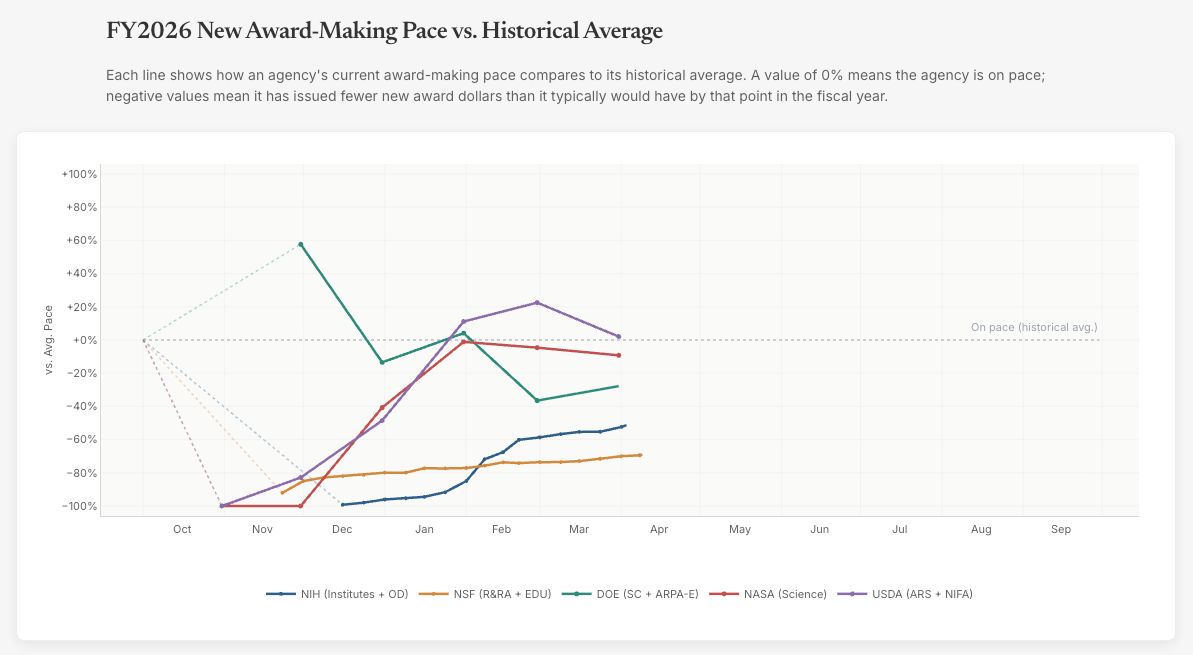
To meet the public demand to protect science spending, the Executive Branch must actually spend the money Congress appropriated.
New evidence shows that US citizens largely support federal science funding
When the Trump Administration came into office in 2025, it began freezing and terminating science grants and laying off staff at federal agencies. In response to these cuts, and with funding from the Science for Progress Initiative at J-PAL, Francesco Capozza, Krishna Srinivasan, and Mattie Toma surveyed 2,008 US citizens about how much the US should spend on R&D.2 They found that over 80% of Americans want to increase R&D spending, and that the median citizen would prefer R&D to receive 7% of the federal budget, compared to its current 3%.
What made this study unique, compared to most public opinion polls, is that the researchers gave respondents context on the federal budget and tested whether question phrasing would influence their stated preferences. Participants received a short primer on what R&D is and which domains federal R&D funding supports, and were then randomized to receive different framings of the question. In one version, respondents were asked to allocate the total federal budget across different categories, including R&D. In the other, they were first told the actual allocations to different spending categories before being prompted for their own distribution.
Across these groups, preferences remained consistent. No matter how the question was posed, respondents preferred allocating 6–10% of the federal budget to R&D, and most respondents favored growing R&D spending beyond current levels. There was some variation in opinion by demographics: respondents with higher levels of education and higher incomes were more likely to support increased R&D spending, while conservative respondents were a bit less likely to want increased spending than liberals.
The study also surveyed experts in science and innovation, including both researchers and civil servants. One notable finding is that experts tend to greatly underestimate citizens’ support for federal R&D: 76% of experts mistakenly believe that Americans want to either maintain or cut current R&D spending, predicting that the typical American would prefer 3% of the budget to be allocated to R&D (the amount currently allocated).
Let us caveat these findings: survey results are not always airtight and voters may not put their money where their mouths are. For example, poll respondents have consistently stated support for gun control measures that they then fail to support at similar levels in state referenda, and public opinion on healthcare reform has also been inconsistent. These may be thermostatic changes in public opinion — voters don’t become activated against a policy or politician until it is dominant. But while we should hesitate to take respondents literally, there’s no evidence that they would endorse the proposed budget cuts.
How does this evidence compare to other polling on science funding?
Polling from the General Science Survey (GSS) shows less support for science funding, but methodological differences may explain the gap. In polling conducted between 2002 and 2024, 34–44% of Americans reported that they think the US spends too little on science — considerably lower than the 80% found in Capozza et al, 2025. But the 8–13% who said the US spent too much on science in the GSS more closely aligns with our focal study’s finding that 11.75% of Americans wanted to lower R&D spending.3
While we can’t draw clear conclusions across two distinct studies, the context on the federal budget provided to respondents in Capozza et al. may have helped participants make more informed decisions.4 And in fact, prior to learning that 3% of the budget goes to R&D, the median respondent thought it was around 10% — their preference for increased science spending might be a response to learning that it was lower than they’d thought.
Another notable finding is that while Americans are critical of universities, they value the research universities produce. It’s broadly known that the public is unsatisfied with higher education institutions: according to a 2025 Pew Research survey, 70% of Americans think that higher education is headed in the wrong direction. This view is shared by Republicans and Republican-leaning independents (77%) and Democrats and Democratic leaners (65%).
But despite their frustrations with rising tuition costs and inadequate pre-professional support, 55% of Americans hold a positive view of universities’ ability to advance research and innovation. In the same vein, 77% of US adults say they have a “great deal” or “a fair amount” of confidence in scientists acting in the public’s best interests.
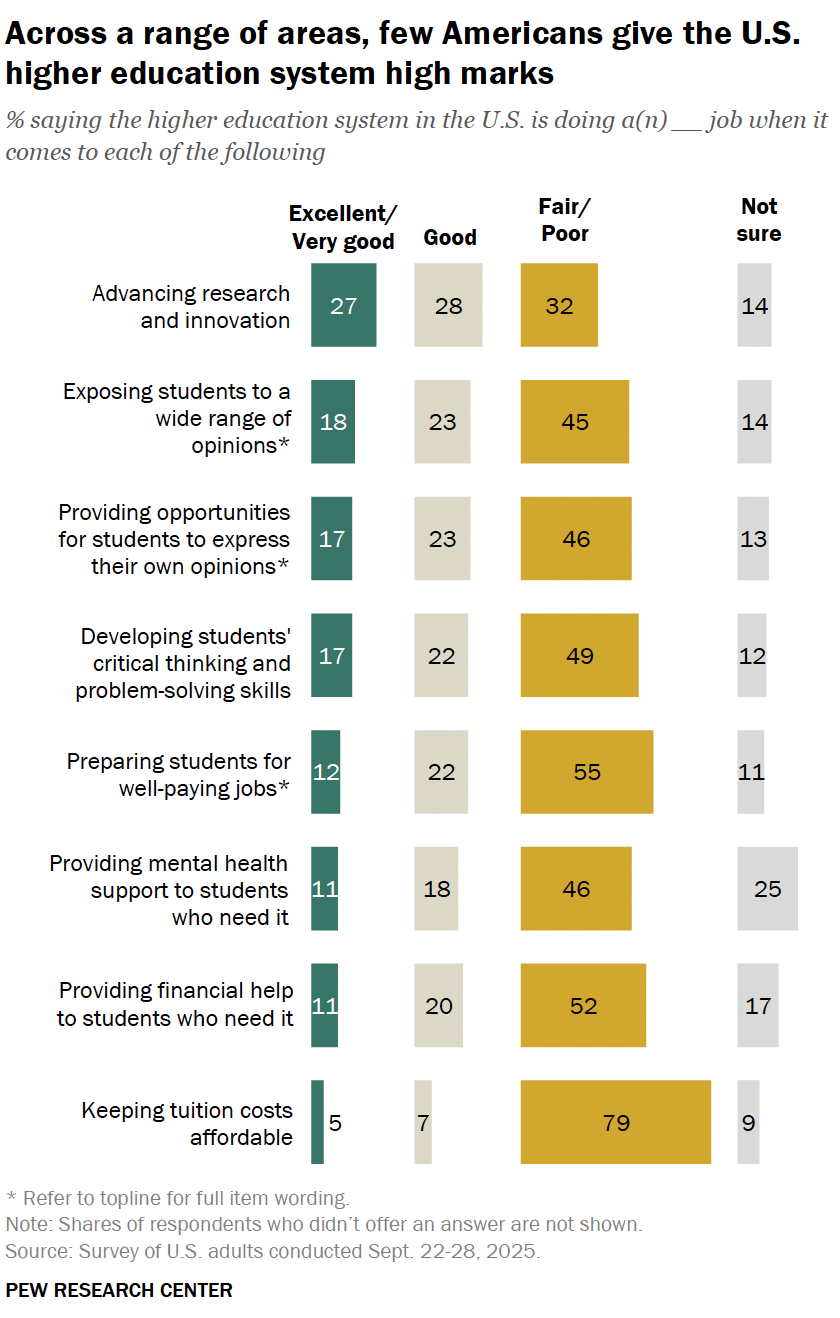
Taken together, the new data we’ve presented, the GSS data, and survey data from Pew suggest a coherent picture. Americans support science funding. When told how low it is, they support more science funding. And while they have grave concerns about American universities, they’re supportive of the scientific function of higher education.
If you are a member of Congress, you can confidently appropriate funds for science, knowing that the winds of public opinion are at your back. And if you’re in the Executive Branch, you can be sure that Americans want you to spend appropriated funds. Given these facts, why has science spending been so slow to get out the door?
What’s going on with spending?
Agency data visualized at Tracking Science Spending suggests that the executive branch is not spending appropriated funds at its typical pace, leading to concerns that some science funding may not be used at all. This trend has raised the question of whether the Executive Branch can simply decide to not spend appropriated funds.
Historically, this has not been a major concern. The Impoundment Control Act requires that the Executive Branch spend money appropriated by Congress unless lawmakers explicitly approve unspent funds via “rescissions.”5 However, this assumption has recently been called into question, and the head of the Office of Management and Budget (OMB) has stated that he believes the Act is unconstitutional. And while the Trump administration ultimately spent most appropriated science funds in 2025, it awarded fewer grants than usual and spent much of the money quickly at the end of the fiscal year after pressure from Senate Republicans.
While the underlying reason for the slow pace of spending is unclear, failure to spend appropriations introduces the risk that OMB will either request rescissions from Congress (as it did in 2025), attempt a “pocket rescission” where they simply do not spend money at the end of the fiscal year, or force agencies to spend quickly at the end of the fiscal year.6 While the last case is the best option, as we saw last year, this creates funding uncertainty.
Congress has heeded public demand by appropriating science funding. Now the Executive Branch should spend the appropriated funds. Delaying or withholding appropriated science dollars has clear consequences: fewer grants, disrupted research programs, lost talent, and ultimately slower progress.
Americans support science funding. Policymakers should act accordingly.
These cuts were proposed in the President’s Budget Request (PBR) for Fiscal Year 2026. The federal fiscal year runs from October 1 to September 31, so Fiscal Year 2026 began in October 2025 and will end in September 2026. Each year, the President’s Budget Request lays out the White House’s priorities and preferred levels of spending. However, the actual funding appropriated by Congress has generally followed congressional spending priorities, rather than the President’s.
Americans surveyed were broadly representative of the US population in terms of gender, income, education, age, region, and political ideologies.
Here is the question asked by the GSS:
“We are faced with many problems in this country, none of which can be solved easily or inexpensively. I’m going to name some of these problems, and for each one I’d like you to name some of these problems, and for each one I’d like you to tell me whether you think we’re spending too much money on it, too little money, or about the right amount. First supporting scientific research. . . are we spending too much, too little, or about the right amount on supporting scientific research?
Evidence suggests that survey respondents might shift their stated preferences based on learning actual amounts of government spending.
When Congress approves a rescission package, as they did in 2025 for cuts to the US Agency for International Development and Corporation for Public Broadcasting, that money goes back to the US Treasury. Those funds can then be redirected to other purposes rather than the intended use. While making loan payments and other general purpose uses may be perfectly fine, they do not have the massive social return on investment of R&D spending.
In congressional testimony in March 2026, NIH Director Jay Bhattacharya said that the NIH would spend its full budget in fiscal year 2026. However, how quickly they will spend it remains an open question.
> While the underlying reason for the slow pace of spending is unclear
The Trump administration is trying to starve the universities of their grant funding, because it views them as political enemies. It's not complicated. I'm not sure what is gained by feigning ignorance here.